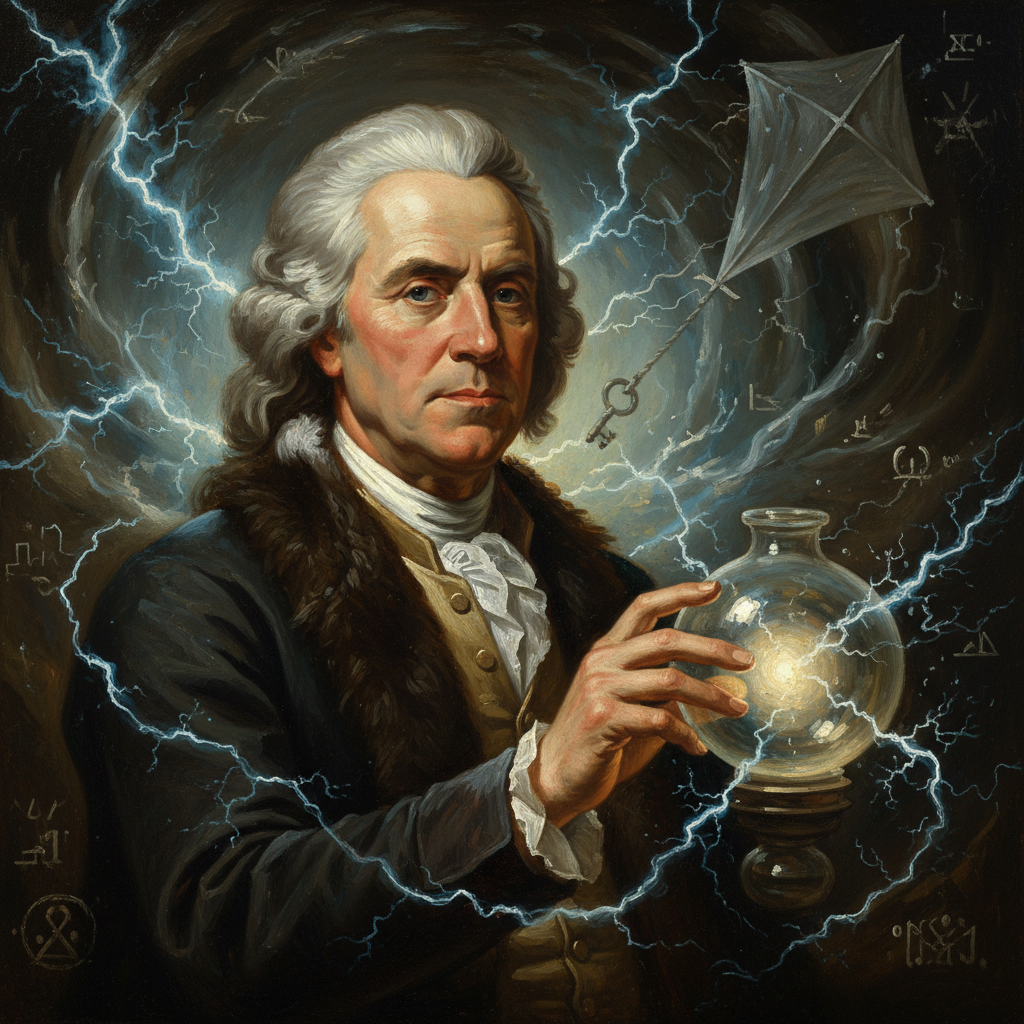
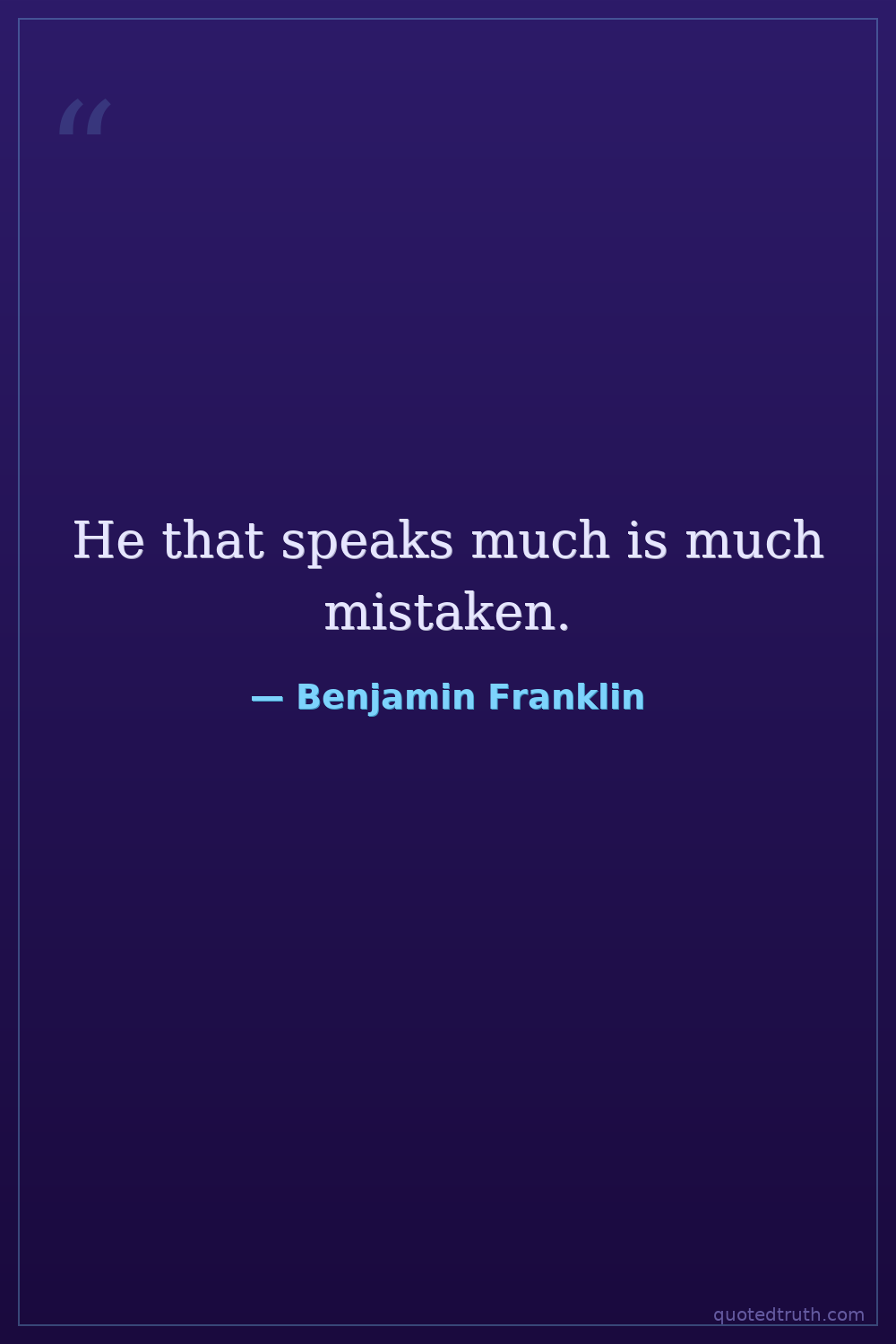
Benjamin Franklin — "He that speaks much is much mistaken."
He that speaks much is much mistaken.
He that speaks much is much mistaken.
Click any product to generate a realistic preview. Up to 3 at a time.
* Initial load can take up to 90 seconds — revising the preview in another color is nearly instant.
"Sloth makes all things difficult; but industry all easy."
"He that has a trade, has an estate; and he that has a calling, has an office of profit and honor."
"Save a penny every year and you shall die a millionaire."
"An ounce of prevention is worth a pound of cure."
"The great secret of succeeding in conversation is to admire little, to hear much, to contradict seldom, and to use all the good manners one can."
Polymath Founding Father, diplomat, and Poor Richard's Almanack author who helped draft the Declaration of Independence and the Constitution. Closely associated with John Adams (fellow Founder, Massachusetts statesman) and Thomas Jefferson (fellow Declaration drafter). For an intellectual contrast, see Thomas Hutchinson, last royal governor of colonial Massachusetts — Franklin leaked Hutchinson's loyalist correspondence to Boston in 1772 to inflame revolutionary sentiment — Hutchinson represented the colonial-aristocrat crown-loyalty that Franklin's revolution was organized to dismantle.
Found in 1 providers: deepseek
1 source checked
Talking excessively almost guarantees you'll say something wrong. The more words you produce, the more chances for errors, overstatements, and misjudgments to slip through. This is a case for deliberate, restrained communication: speak only what you know, say it clearly, then stop. In modern terms, the person who dominates every conversation usually exposes the most gaps in their thinking. Brevity signals confidence; verbosity signals insecurity or carelessness.
Franklin spent 26 years distilling wisdom into tight aphorisms for Poor Richard's Almanack, living this principle professionally. As a printer, he knew every word cost money and space. As a diplomat negotiating with Britain and France, he understood that measured speech outperformed verbose argument. His success in Paris relied on charm, silence, and precision — never rambling. Franklin's own reputation rested on saying memorable things concisely, not on exhausting rooms with talk.
In colonial and revolutionary America, words carried serious legal and political risk — loose speech meant libel charges or accusations of sedition. Pamphlets and broadsides shaped public opinion, so every printed or spoken word was consequential. Puritan traditions still prized measured, purposeful speech over empty talk. In legislative halls and coffeehouses, long-winded speakers were dismissed as lacking substance. Diplomatic miscommunication between colonies and Britain was actively destabilizing empires, making verbal precision a matter of survival.
AI-generated insights based on extensive research and information for context. Factual errors? Email [email protected].
Your cart is empty