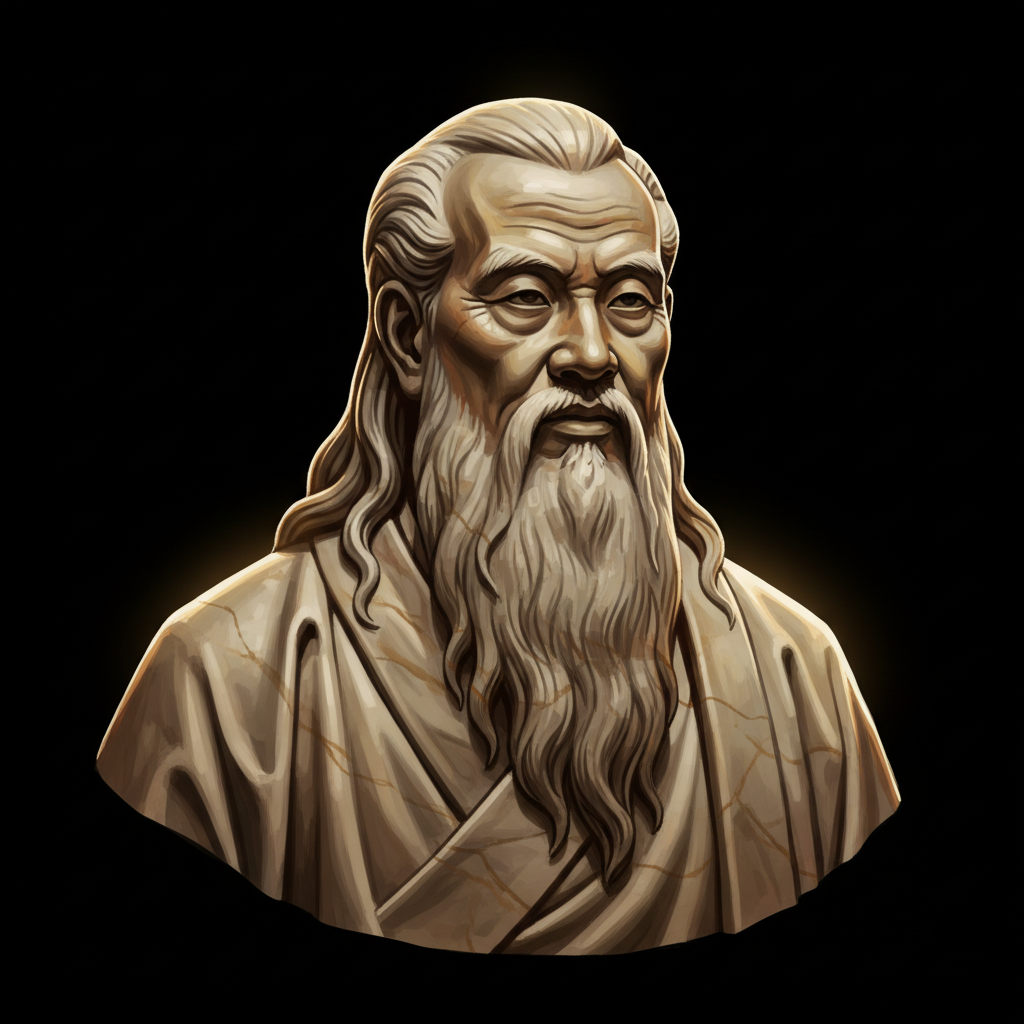
Laozi — "He who conquers others is strong; He who conquers himself is mighty."
He who conquers others is strong; He who conquers himself is mighty.
He who conquers others is strong; He who conquers himself is mighty.
Click any product to generate a realistic preview. Up to 3 at a time.
* Initial load can take up to 90 seconds — revising the preview in another color is nearly instant.
"The more prohibitions there are, the poorer the people will be."
"The best ruler is one whose existence is merely known by the people. The next best is one who is loved and praised. The next is one who is feared. The next is one who is despised."
"Simplicity has no name is free of desires. Being free of desires it is tranquil. And the world will be at peace of it's own accord."
"The sage has no mind of his own. He takes the mind of the people as his mind."
"Pursue without interfering."
Reputed founder of Taoism and author of the Tao Te Ching, whose wu wei (effortless action) shaped East Asian philosophy. Closely associated with Zhuangzi (later Taoist who extended Laozi's framework). For an intellectual contrast, see Confucius, near-contemporary Chinese sage of social ritual and duty — Confucius systematized social order through ritual and hierarchy; Laozi argued that all such systems were the disease, not the cure — the two founding poles of Chinese moral philosophy.
Found in 1 providers: gemini
1 source checked
Defeating other people shows physical or social power, but mastering your own desires, impulses, fears, and weaknesses requires a deeper, more enduring kind of strength. Outward victories depend on circumstances and opponents, while inner self-control is entirely yours. The saying ranks internal discipline above external dominance, arguing that the person who governs their own mind holds a greater power than any warrior or ruler who only commands others.
Laozi, the legendary founder of Taoism and reputed author of the Tao Te Ching, taught wu wei, humility, and alignment with the natural Way rather than forceful conquest. Tradition holds he served as a keeper of archives in the Zhou court, observing rulers grasping for power and eventually withdrawing from society. This saying mirrors his central conviction that true sages cultivate inner stillness and self-mastery instead of pursuing domination, fame, or political control.
Laozi is traditionally placed in the 6th century BCE during the late Zhou dynasty, as China drifted toward the Warring States period. Feudal lords waged constant wars, betrayed allies, and scrambled for territory, while competing schools like Confucianism and Legalism debated how to restore order. Against this violent backdrop of external conquest, Laozi's emphasis on self-conquest offered a radical alternative: real strength came not from armies or court intrigue but from disciplining one's own heart.
AI-generated insights based on extensive research and information for context. Factual errors? Email [email protected].
Your cart is empty