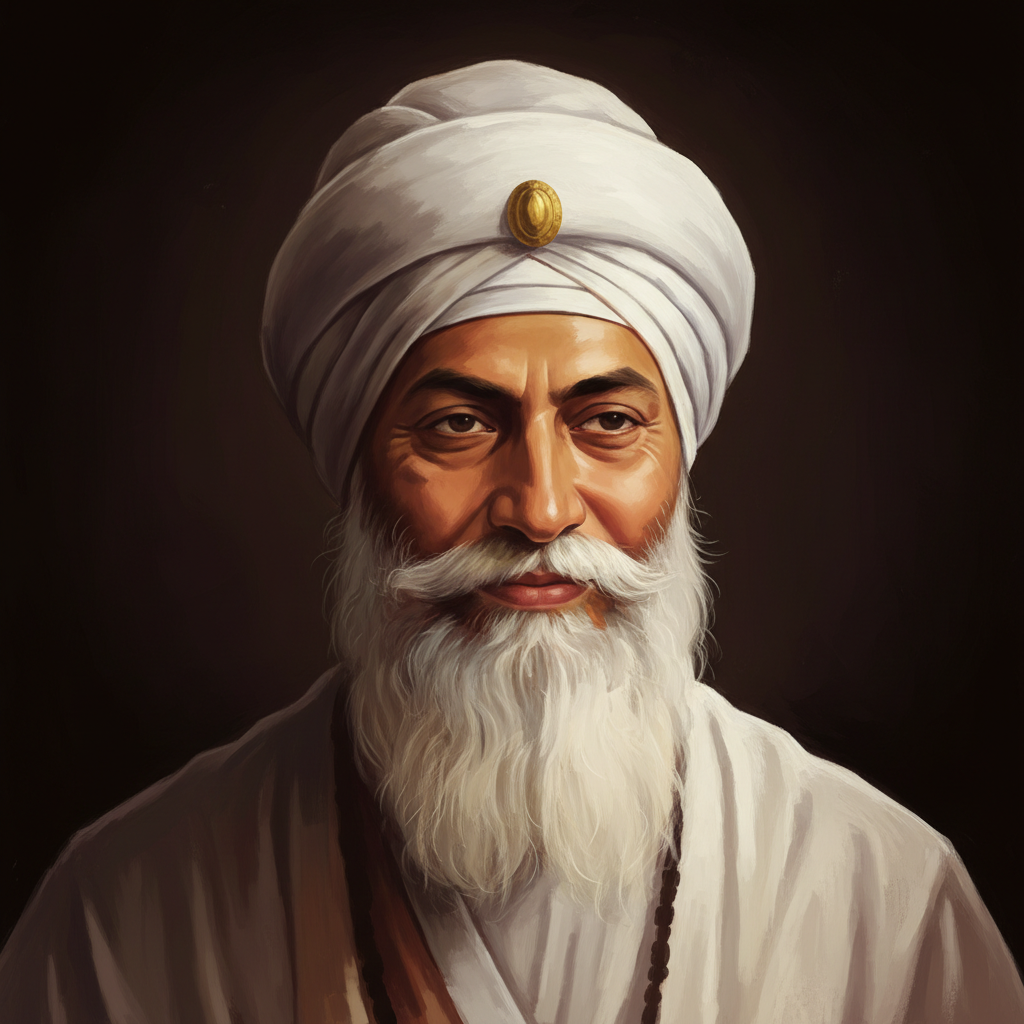
Guru Nanak — "The sun and moon, O Lord, are Thy lamps; the firmament Thy salver; the orbs of t…"
The sun and moon, O Lord, are Thy lamps; the firmament Thy salver; the orbs of the stars the pearls encased in it.
The sun and moon, O Lord, are Thy lamps; the firmament Thy salver; the orbs of the stars the pearls encased in it.
Click any product to generate a realistic preview. Up to 3 at a time.
* Initial load can take up to 90 seconds — revising the preview in another color is nearly instant.
"He who practices truth, contentment, and compassion, he alone is a true Yogi."
"The world is suffering in falsehood, and only truth can save it."
"Be the wisdom your support. Be the compassion your guide and listen to the Divine Music that beats in every heart."
"The whole creation is His temple."
"The five thieves (lust, anger, greed, attachment, ego) plunder the house of the body."
Founder of Sikhism and the first of the Ten Sikh Gurus, whose teachings of one universal God and rejection of caste shaped Punjab. Closely associated with Kabir (mystical poet whose verses appear in the Sikh Guru Granth Sahib). For an intellectual contrast, see Brahmanical orthodoxy, the Hindu caste-and-ritual establishment of his era — Sikhism was founded as a deliberate alternative to both Hindu ritual hierarchy and Islamic exclusivism — Nanak's universalism was a structural rejection of caste and priestly mediation.
Found in 1 providers: deepseek
1 source checked
The speaker looks at the natural world and sees it as a cosmic act of worship already underway. The sun and moon are lamps, the sky a ceremonial tray, the stars jewels set within it. Creation itself is performing the ritual offering to the divine, so no temple-bound ceremony can match what the universe is constantly giving. Reverence is built into existence, not manufactured by priests or rites.</meaning>
Guru Nanak rejected empty ritualism, caste hierarchy, and the gatekeeping of priests in both Hindu and Muslim traditions. He taught that God is formless, omnipresent, and accessible to anyone through honest living and remembrance. This verse, from his Aarti, reframes worship as something the cosmos itself performs, aligning perfectly with his insistence that devotion needs no temple, Brahmin, or mullah to mediate the divine.
Nanak lived 1469-1539 in Punjab under the late Delhi Sultanate and the arrival of the Mughals. Hindu-Muslim tensions, rigid caste rules, and priestly monopolies on scripture and ritual defined daily life. He reportedly composed this Aarti after witnessing an elaborate lamp ceremony at the Jagannath temple in Puri, contrasting its confined pomp with the boundless, ongoing worship already offered by the natural universe.
AI-generated insights based on extensive research and information for context. Factual errors? Email [email protected].
Your cart is empty