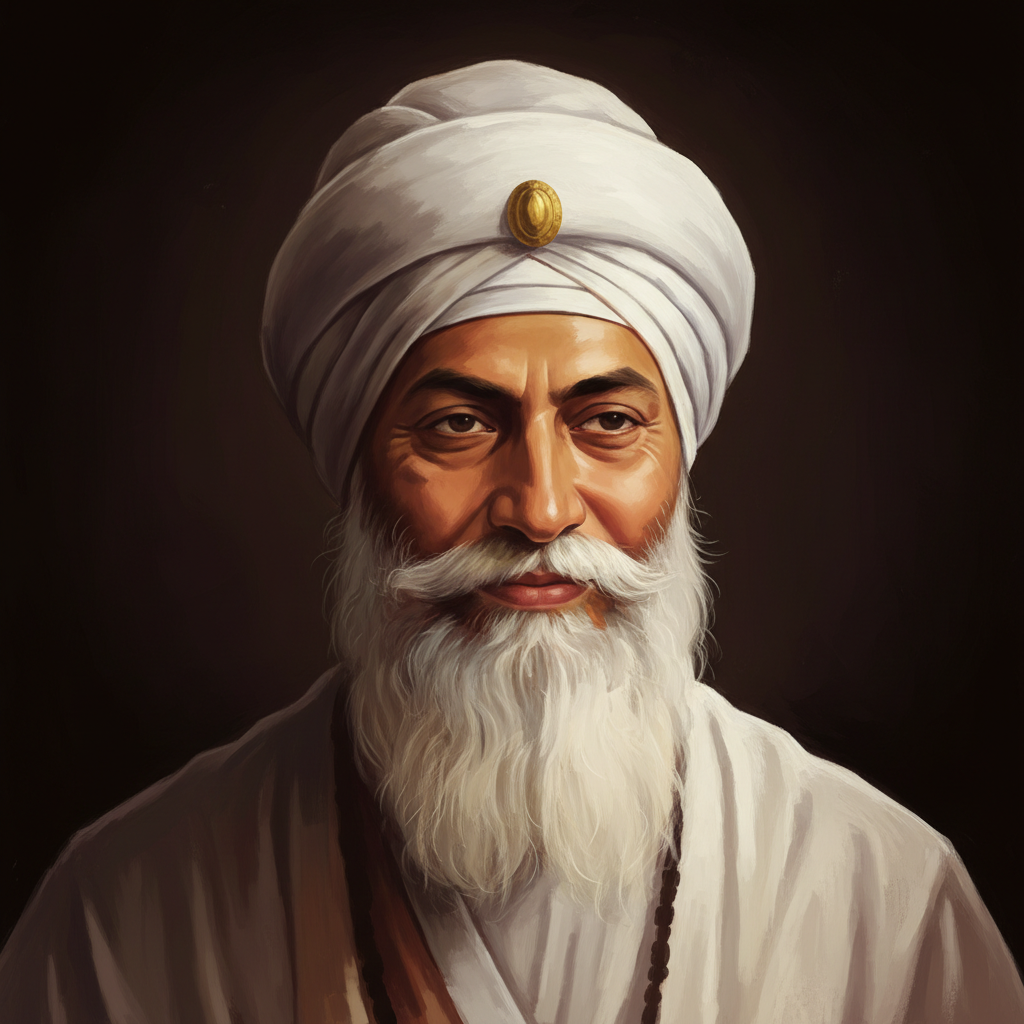
Guru Nanak — "He who sees the Lord in all, he alone is truly wise."
He who sees the Lord in all, he alone is truly wise.
He who sees the Lord in all, he alone is truly wise.
Click any product to generate a realistic preview. Up to 3 at a time.
* Initial load can take up to 90 seconds — revising the preview in another color is nearly instant.
"The mind is a mirror, and the world is its reflection."
"Emotional attachment to Maya is totally painful, this is a bad bargain."
"If there are hundreds of moons and thousands of suns, without the Guru, there is only utter darkness."
"The one who eats what he earns through hard labor and shares it, he alone knows the path."
"The mind is a mad elephant, intoxicated by ego. Only the Guru's teachings can tame it."
Founder of Sikhism and the first of the Ten Sikh Gurus, whose teachings of one universal God and rejection of caste shaped Punjab. Closely associated with Kabir (mystical poet whose verses appear in the Sikh Guru Granth Sahib). For an intellectual contrast, see Brahmanical orthodoxy, the Hindu caste-and-ritual establishment of his era — Sikhism was founded as a deliberate alternative to both Hindu ritual hierarchy and Islamic exclusivism — Nanak's universalism was a structural rejection of caste and priestly mediation.
Found in 1 providers: grok
1 source checked
True wisdom is not about knowledge, status, or religious credentials. It belongs to the person who perceives a single divine presence in every being and thing they encounter. Recognizing that the same sacred reality animates all life dissolves the categories we use to rank, exclude, or dismiss others. Anyone who cannot see that shared essence, no matter how learned, is missing the most basic truth about existence.
Guru Nanak founded Sikhism on the radical premise of Ik Onkar, one universal creator present in everyone. As a young man he famously declared there is no Hindu and no Muslim, meaning the labels obscured the same God. He traveled for decades visiting Hindu temples, Sufi shrines, and Mecca, treating all seekers as equal. This saying distills his core teaching that spiritual insight is measured by how universally one recognizes the divine.
Nanak lived from 1469 to 1539 in Punjab, where the Delhi Sultanate and later the Mughal conquest sharpened Hindu-Muslim divisions, caste rigidity, and ritual gatekeeping by Brahmins and clerics. Bhakti and Sufi movements were already pushing back with devotional, boundary-crossing spirituality. Declaring that the wise see one Lord in everyone was a direct challenge to caste hierarchy, forced conversion, and communal violence, and it laid the groundwork for the Sikh emphasis on equality and the shared langar meal.
AI-generated insights based on extensive research and information for context. Factual errors? Email [email protected].
Your cart is empty