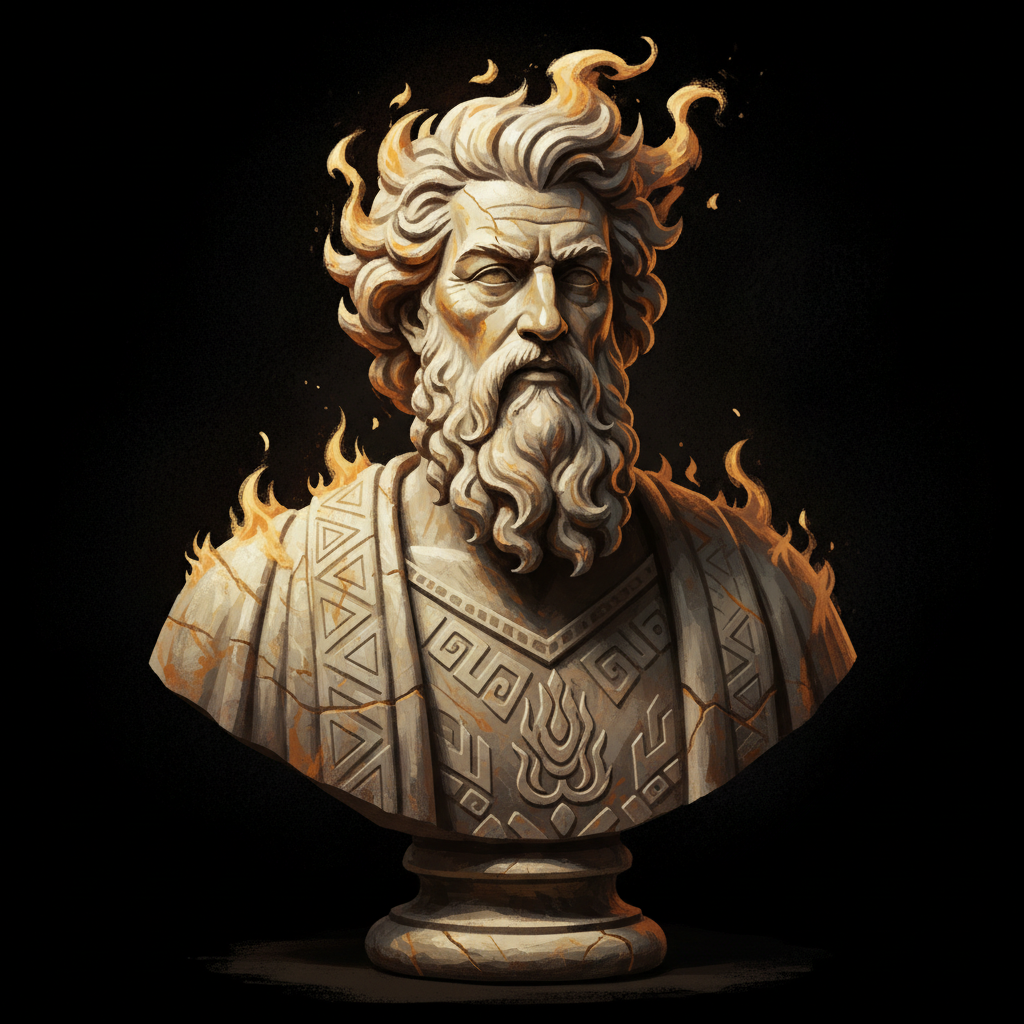
Zoroaster — "He who thinks evil, speaks evil, does evil, him Ahura Mazda will cast down from …"
He who thinks evil, speaks evil, does evil, him Ahura Mazda will cast down from the bridge of judgment.
He who thinks evil, speaks evil, does evil, him Ahura Mazda will cast down from the bridge of judgment.
Click any product to generate a realistic preview. Up to 3 at a time.
* Initial load can take up to 90 seconds — revising the preview in another color is nearly instant.
"I shall be master of my own destiny."
"May your heart be full of love and your pockets full of... well, whatever you like."
"And when these two spirits came together, they created life and non-life, and how at the end the worst existence shall be for the wicked, but the Best Mind for the righteous."
"There are two fundamental spirits, twins which in waking hours are heard, but in thought are not seen. They are the better and the bad. Of these two, the wise have chosen rightly, not so the foolish."
"Through the best righteousness, through the best mind, and through the best works, we approach Thee, O Mazda Ahura."
Iranian prophet who founded Zoroastrianism, the first major religion of cosmic dualism between good (Ahura Mazda) and evil (Angra Mainyu). Closely associated with The Buddha (near-contemporary Eastern moral-cosmological revolutionary). For an intellectual contrast, see Friedrich Nietzsche, German philosopher of 'beyond good and evil' — Nietzsche appropriated Zarathustra's name for Thus Spoke Zarathustra (1883) precisely to invert the original's moral cosmology — the historical Zoroaster founded the good-versus-evil framework Nietzsche's character announces the end of.
Found in 1 providers: grok
1 source checked
Bad thoughts, bad words, and bad actions all have consequences. If you consistently choose harm over good, you will face judgment and fall short when your life is weighed. The verdict isn't arbitrary—it reflects the cumulative pattern of how you lived. Evil isn't just about dramatic wrongdoing; it includes the thoughts you nurture and the words you speak. Your inner life, speech, and conduct are all accountable, and together they determine your ultimate fate.
This captures Zoroaster's signature ethical triad: good thoughts, good words, good deeds—the foundation of Zoroastrianism. As the prophet who received revelations from Ahura Mazda, he taught that humans hold genuine moral agency in a cosmic struggle between truth and falsehood. The Chinvat Bridge he describes is central to his eschatology: souls crossing it are judged by their lived character. He framed morality not as ritual compliance but as daily choice.
Zoroaster likely lived in ancient Persia around 1500–1000 BCE, amid polytheistic tribal religions centered on ritual sacrifice and nature gods. His monotheistic, ethics-driven revelation was radical: he rejected blood offerings and priestly corruption, insisting divine favor came through righteous living, not ceremony. The concept of a bridge-judgment separating good souls from evil was revolutionary—introducing personal moral accountability and afterlife consequences that later shaped Judaism, Christianity, and Islam.
AI-generated insights based on extensive research and information for context. Factual errors? Email [email protected].
Your cart is empty