What it means
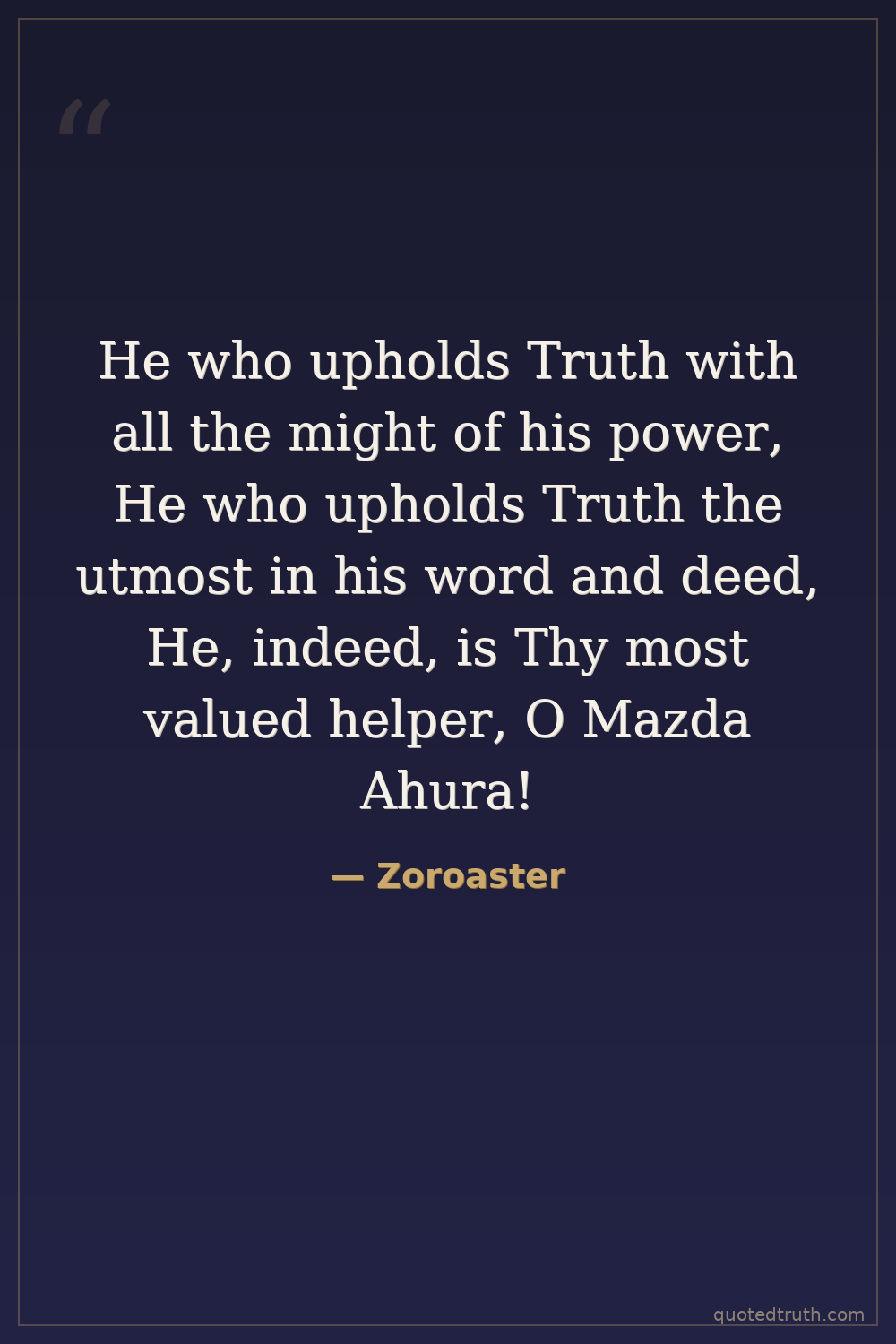
The passage praises anyone who commits fully to honesty and moral integrity, backing up truthful speech with truthful action. It argues that living by truth with every ounce of one's strength is the highest form of devotion a person can offer the supreme god. Such a person isn't just virtuous in private but becomes an active partner of the divine, helping push back against falsehood and disorder in the world around them.
Relevance to Zoroaster
Zoroaster built his entire religious system around asha, the cosmic principle of truth and right order, opposed to druj, the lie. As a reforming priest who challenged the polytheistic Iranian establishment, he taught that humans choose sides in a moral struggle through thought, word, and deed. This verse, from his own Gathas, captures his core message: Ahura Mazda needs human allies who embody truth consistently, not just ritual performers.
The era
Zoroaster lived in Bronze Age eastern Iran, likely between 1500 and 1000 BCE, amid tribal societies practicing animal sacrifice, raiding, and polytheistic cults led by hereditary priests. Cattle theft, warfare, and ritualism dominated religious life. Against this backdrop, his ethical monotheism, emphasizing personal moral choice over blood sacrifice and clan loyalty, was radical. Framing truth as humanity's contribution to divine victory gave ordinary people agency in a world otherwise ruled by warriors and priests.
AI-generated insights based on extensive research and information for context. Factual errors? Email [email protected].