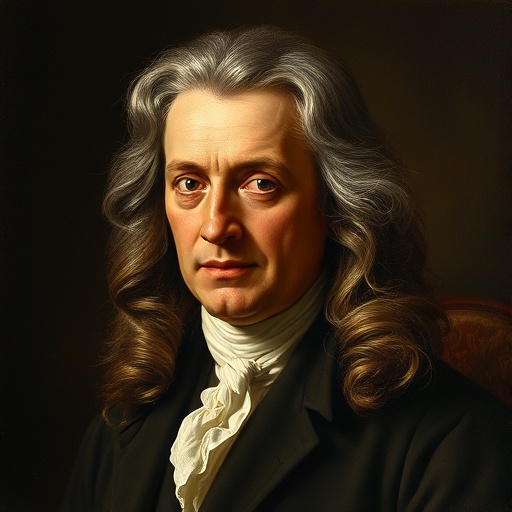
Isaac Newton — "Hypotheses non fingo. (I frame no hypotheses.)"
Hypotheses non fingo. (I frame no hypotheses.)
Hypotheses non fingo. (I frame no hypotheses.)
Click any product to generate a realistic preview. Up to 3 at a time.
* Initial load can take up to 90 seconds — revising the preview in another color is nearly instant.
"The true way of considering a thing is by its causes."
"It is not the business of philosophy to account for the truth of things by hypotheses, but to deduce them from phenomena."
"Plato is my friend, Aristotle is my friend, but my greatest friend is truth."
"I have studied these things – you have not."
"Atheism is so senseless and odious to mankind that it never had many professors."
Found in 1 providers: grok
1 source checked
Newton is declaring that he does not invent or impose speculative explanations for why things work as they do. He observes, measures, and mathematically describes phenomena but refuses to guess at hidden causes he cannot prove experimentally. If something cannot be deduced from observations, he won't theorize about it. It's a commitment to empirical rigor over philosophical conjecture — letting measured data stand on its own without layering on unverifiable speculation.
Newton lived this principle most visibly when critics demanded he explain why gravity acts across empty space — what unseen mechanism pulls the Moon toward Earth. He refused to speculate. His Principia described gravity's mathematical laws with revolutionary precision, yet he never claimed to know gravity's ultimate cause. His laws of motion similarly derived from careful experiment, not invented mechanisms. For Newton, mathematical description without causal hypothesis was the highest form of scientific integrity.
In the early modern period, natural philosophy was dominated by competing speculative systems — Descartes' vortex theory assigned mechanical causes to all phenomena, while scholastic Aristotelian tradition required explanations of purpose and essence. Newton's declaration was a radical methodological break: empirical observation and mathematics, not invented mechanisms, would define legitimate science. This helped establish the Scientific Revolution's empiricist turn against centuries of hypothetical natural philosophy and elevated experiment as the gold standard.
AI-generated insights based on extensive research and information for context. Factual errors? Email [email protected].
Your cart is empty