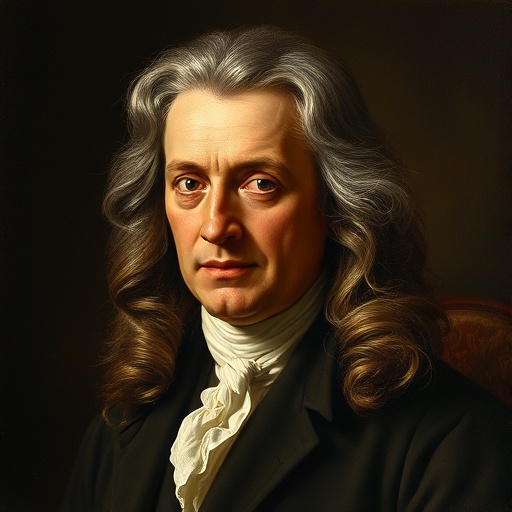
Isaac Newton — "I have studied these things – you have not."
I have studied these things – you have not.
I have studied these things – you have not.
Click any product to generate a realistic preview. Up to 3 at a time.
* Initial load can take up to 90 seconds — revising the preview in another color is nearly instant.
"Oh, Diamond! Diamond! thou little knowest what mischief thou hast done!"
"I feign no hypotheses."
"The greatest challenges to the truth of the Holy Scriptures are not the work of infidels, but of professing Christians."
"I consider the world as a stage, and the actions of men as a play, in which every one acts a part."
"Every body continues in its state of rest, or of uniform motion in a right line, unless it is compelled to change that state by forces impressed upon it."
Reportedly said to Edmund Halley during a discussion about biblical prophecies
Date: Undetermined, but well-known anecdote
WisdomFound in 1 providers: grok
1 source checked
Expertise earned through deep study confers authority that casual observers and critics simply cannot claim. The speaker draws a hard boundary: if you haven't done the work, your challenge carries no weight. It's a declaration that rigorous, sustained investigation—not opinion, intuition, or received wisdom—is the only valid foundation for judgment. Don't debate a specialist who has spent years mastering something you've barely glanced at.
Newton spent 18 solitary months during the 1665–66 plague years developing calculus, optics, and gravitational theory—breakthroughs he kept private for years. He was legendarily combative when challenged: his feuds with Leibniz over calculus priority and with Hooke over optics consumed decades. Possessing mathematical depth virtually no contemporary could match, his impatience with critics who lacked rigorous grounding was consistent throughout his career and character.
The 17th-century Scientific Revolution was reshaping how Europeans understood nature, but mathematical natural philosophy remained accessible to a tiny elite. Before universities systematized scientific curricula, mastery was self-directed and extraordinarily rare. Newton's Principia Mathematica (1687) was so demanding that even trained mathematicians struggled with it. In an era when empirical rigor still battled religious doctrine and classical authority, claiming superior study was both a legitimate credential and a decisive rhetorical weapon.
AI-generated insights based on extensive research and information for context. Factual errors? Email [email protected].
Your cart is empty