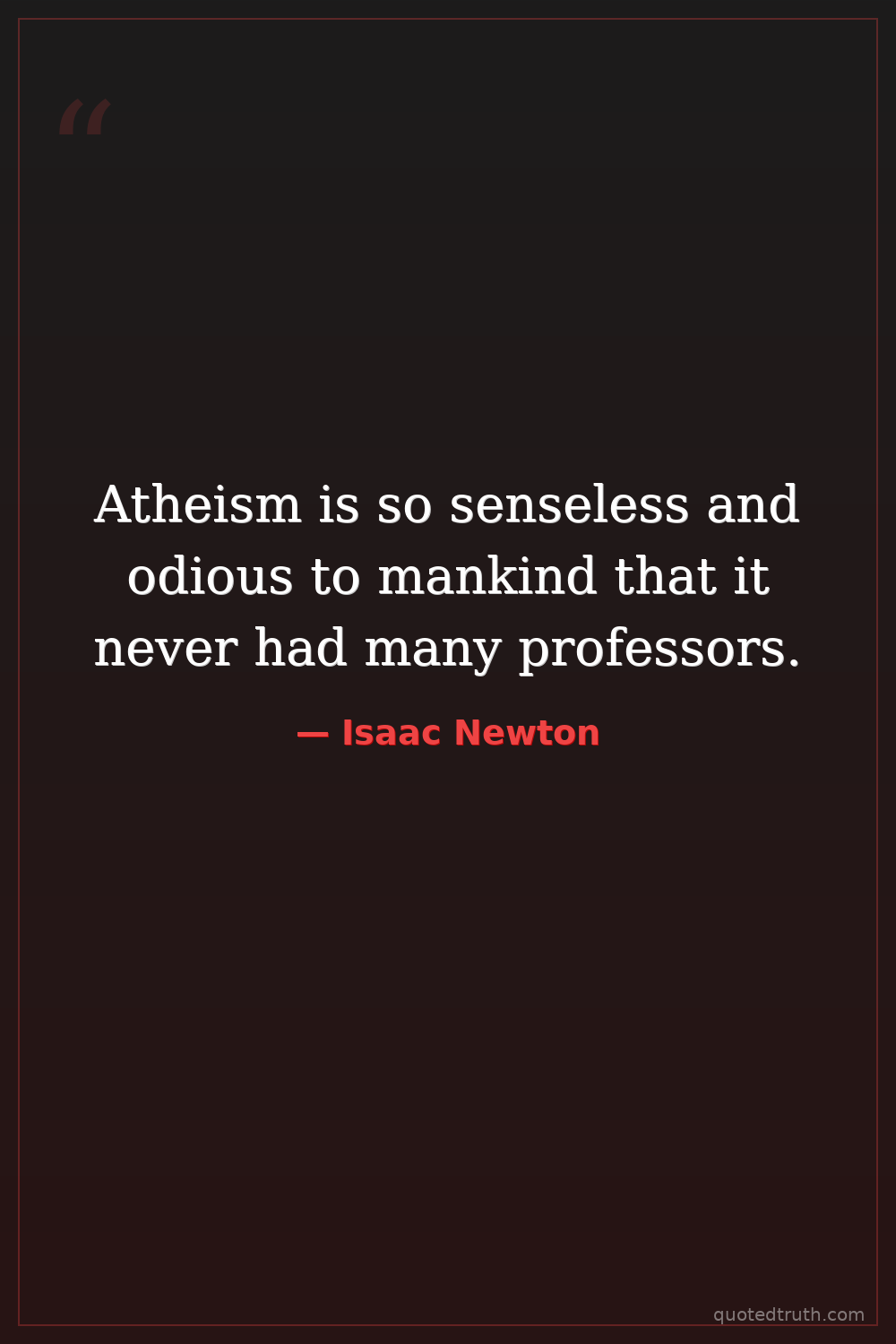
Isaac Newton — "Atheism is so senseless and odious to mankind that it never had many professors."
Atheism is so senseless and odious to mankind that it never had many professors.
Atheism is so senseless and odious to mankind that it never had many professors.
Click any product to generate a realistic preview. Up to 3 at a time.
* Initial load can take up to 90 seconds — revising the preview in another color is nearly instant.
"He who thinks half-heartedly will not believe in God; but he who thinks seriously will believe in God, and will not doubt that God is the author of the world."
"The attractive force of the earth acts to the greatest distance, and is observed in the fall of the moon, which is continually drawn towards the earth."
"God in the beginning formed matter in solid, massy, hard, impenetrable, moveable particles, of such sizes and figures, and with such other properties, and in such proportion to space, as most conduced…"
"The way to chastity is not to struggle directly with incontinent thoughts but to avert the thoughts by some employment, or by reading, or by meditating on other things."
"Nature is pleased with simplicity, and affects not the pomp of superfluous causes."
Found in 1 providers: deepseek
1 source checked
Newton argues that atheism is both intellectually incoherent and morally repugnant to human beings, so much so that almost no one has genuinely held or openly declared it throughout history. He treats disbelief in God not as a reasonable philosophical position but as something so contrary to reason and human instinct that it barely qualifies as a real viewpoint worthy of serious engagement.
Newton devoted more manuscript pages to theology than to physics. He viewed his laws of motion and gravity as revealing the rational mechanics God built into creation — science and faith were unified for him. He wrote extensively on Biblical prophecy and rejected the Trinity as unscriptural. His religious convictions were not peripheral but central: discovering natural law was, to Newton, discovering God's design.
In 17th-century England, atheism was legally and socially dangerous — blasphemy laws made open disbelief a criminal matter. The Scientific Revolution paradoxically intensified theological debate: some feared new natural philosophy would displace God; defenders like Newton insisted it confirmed divine order. Most leading natural philosophers framed their work within Christianity. Declaring atheism 'senseless' was both sincere belief and a defense of science against accusations of impiety.
AI-generated insights based on extensive research and information for context. Factual errors? Email [email protected].
Your cart is empty