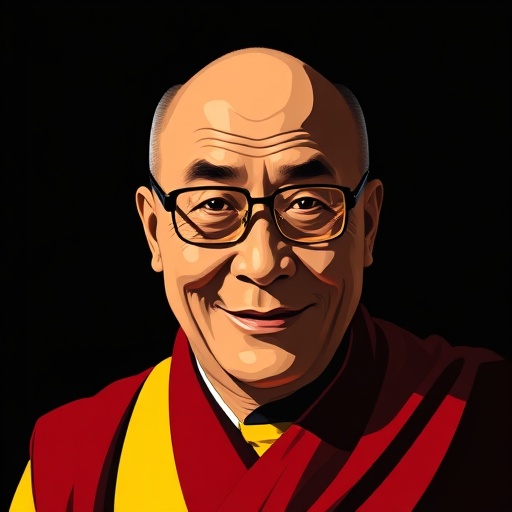
Dalai Lama (14th) — "I always say that I am a student of Shantideva. That's my main guru."
I always say that I am a student of Shantideva. That's my main guru.
I always say that I am a student of Shantideva. That's my main guru.
Click any product to generate a realistic preview. Up to 3 at a time.
* Initial load can take up to 90 seconds — revising the preview in another color is nearly instant.
"The very motion of our life is towards happiness."
"When we feel love and kindness toward others, it not only makes others feel loved and cared for, but it helps us also to develop inner happiness and peace."
"We need to educate people about the importance of inner values."
"I like to play golf, but I am not very good at it. I usually lose my balls in the bushes."
"I am an old man, but I still have a lot of energy. I think it's because I have a lot of hope."
Found in 1 providers: grok
1 source checked
The Dalai Lama credits Shantideva, an 8th-century Indian Buddhist monk, as his primary spiritual teacher. Shantideva wrote the Bodhicharyavatara, a foundational text on the bodhisattva path — dedicating one's life to relieving others' suffering. By calling himself a student, the Dalai Lama expresses deep humility: regardless of his own global stature, he looks to ancient wisdom for guidance. True spiritual authority, he suggests, comes from learning, not rank.
Tenzin Gyatso has lectured on the Bodhicharyavatara more than virtually any other text, calling it a daily companion. His famous emphasis on compassion, patience under persecution, and the bodhisattva vow directly mirrors Shantideva's central teachings. Even after winning the Nobel Peace Prize in 1989 and becoming a global moral figure, he consistently deflects personal veneration by pointing to lineage teachers like Shantideva, grounding his authority in transmission rather than personality.
Born 1935 and exiled from Tibet in 1959 after China's military occupation, the Dalai Lama spent decades as a stateless refugee defending Tibetan culture. His devotion to Shantideva, an 8th-century Indian scholar, carries political weight: it asserts Tibetan Buddhism's deep pan-Asian roots independent of Chinese territorial claims. During globalization and rising Western interest in Buddhism, anchoring spiritual authority in classical texts also counters the celebrity-guru phenomenon pervasive in contemporary convert communities.
AI-generated insights based on extensive research and information for context. Factual errors? Email [email protected].
Your cart is empty