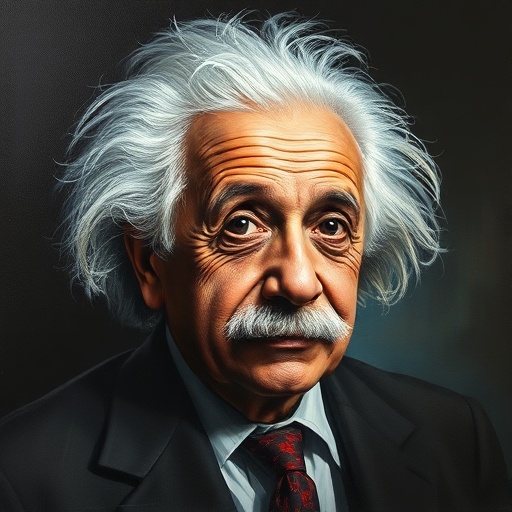
Albert Einstein — "I am a deeply religious nonbeliever. This is a somewhat new kind of religion."
I am a deeply religious nonbeliever. This is a somewhat new kind of religion.
I am a deeply religious nonbeliever. This is a somewhat new kind of religion.
Click any product to generate a realistic preview. Up to 3 at a time.
* Initial load can take up to 90 seconds — revising the preview in another color is nearly instant.
"With fame I become more and more stupid, which of course is a very common phenomenon."
"Reading, after a certain age, diverts the mind too much from its creative pursuits. Any man who reads too much and uses his own brain too little falls into lazy habits of thinking."
"If I were not a physicist, I would probably be a musician. I often think in music. I live my daydreams in music."
"I am almost ashamed to be living in such peace while all the rest struggle and suffer."
"The value of a man should be seen in what he gives and not in what he is able to receive."
Found in 1 providers: grok
1 source checked
Einstein distinguishes between organized religion's supernatural God and a deep, reverent sense of awe at the universe's order and beauty. He feels wonder and humility before nature's mysteries as intensely as any devout believer — but without faith in a personal deity or afterlife. He's naming a genuine spiritual posture: not atheism, not traditional belief, but a sense of the sacred rooted entirely in rational inquiry and natural law.
Einstein explicitly rejected belief in a personal God while simultaneously refusing the atheist label. He admired Spinoza's conception of God as the rational order of nature. In his 1954 letter to philosopher Eric Gutkind, he called a personal God 'childlike.' His daily work as a physicist — uncovering equations he described as revealing 'the mind of God' — embodied exactly this devotion to universal order. He saw scientific pursuit itself as a spiritual act.
Einstein shaped this view across the early-to-mid 20th century, when science and traditional religion were in sharp public tension. World War I had shattered faith for millions, while logical positivism and secular humanism rose among intellectuals. Yet fascist regimes weaponized both religious and anti-religious sentiment. Einstein's framing offered a third path — preserving moral seriousness and reverence without dogma — at a moment when both institutional religion and cold materialism seemed dangerously insufficient.
AI-generated insights based on extensive research and information for context. Factual errors? Email [email protected].
Your cart is empty