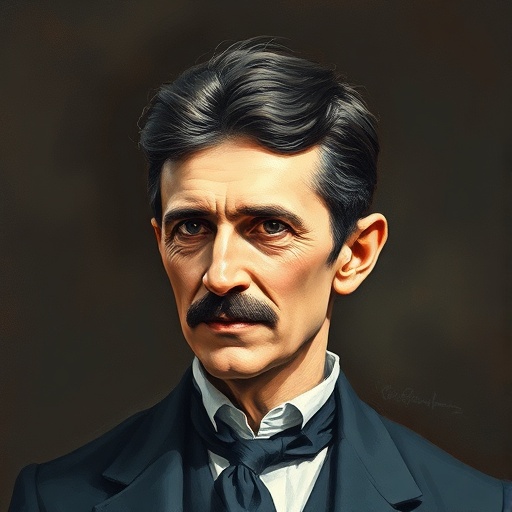
Nikola Tesla — "I am a man of science, not a politician."
I am a man of science, not a politician.
I am a man of science, not a politician.
Click any product to generate a realistic preview. Up to 3 at a time.
* Initial load can take up to 90 seconds — revising the preview in another color is nearly instant.
"I am credited with being one of the hardest workers and perhaps I am, if thought is the equivalent of labour, for I have devoted to it almost all of my waking hours. But if work is interpreted to be a…"
"The desire that guides me in all I do is the desire to harness the forces of nature to the service of mankind."
"The wireless transmission of power is a distinct possibility."
"The ideal of a true man is to lead a life of self-sacrifice and devotion to the welfare of others."
"The ultimate purpose is the complete mastery of mind over the material world, the harnessing of human nature to human needs."
Serbian-American inventor and electrical engineer whose alternating-current designs powered the modern electrical grid; died poor and largely forgotten. Closely associated with George Westinghouse (his AC-power business partner) and Mihajlo Pupin (fellow Serbian-American physicist at Columbia). For an intellectual contrast, see Thomas Edison, American inventor and direct-current advocate — Edison's direct-current power-distribution scheme was displaced by Tesla-Westinghouse AC in the 1890s 'War of Currents'. Edison ran a public-relations campaign electrocuting animals to discredit AC — the most famous engineering-ethics rivalry in American history. Tesla's AC won and powers nearly every electrical grid on Earth.
Attributed, often in context of his disinterest in public power struggles.
Date: Early 20th Century
EducationalFound in 1 providers: grok
1 source checked
Science operates on evidence and results; politics on persuasion and compromise. Tesla draws a sharp line between who he is and how he works. He belongs to the world of verifiable truth — experimentation, discovery, measurable outcomes — not to alliances, rhetoric, or power games. He's saying: judge me by what I build and prove, not by what I negotiate or who I impress. Truth, not influence, is his currency.
Tesla's career was defined by battles he fought with science while others wielded politics. Edison waged a calculated public campaign — electrocuting animals — to discredit AC power, while Tesla answered with demonstrations and proof. He lost Wardenclyffe Tower funding because he couldn't play financial politics with J.P. Morgan. Despite holding over 300 patents, he died nearly penniless — a direct consequence of choosing scientific integrity over commercial and political maneuvering.
Tesla lived through the Gilded Age — an era when science and industry were inseparable from corporate warfare and monopoly power. The War of Currents (1880s–1890s) was fought as much in newspapers and courtrooms as in laboratories. Edison and his backers used lobbying and staged spectacles to shape public opinion. Science was becoming a tool of business empires. Tesla's declaration was a principled refusal to play by those rules — in an age when refusing usually meant losing.
AI-generated insights based on extensive research and information for context. Factual errors? Email [email protected].
Your cart is empty