What it means
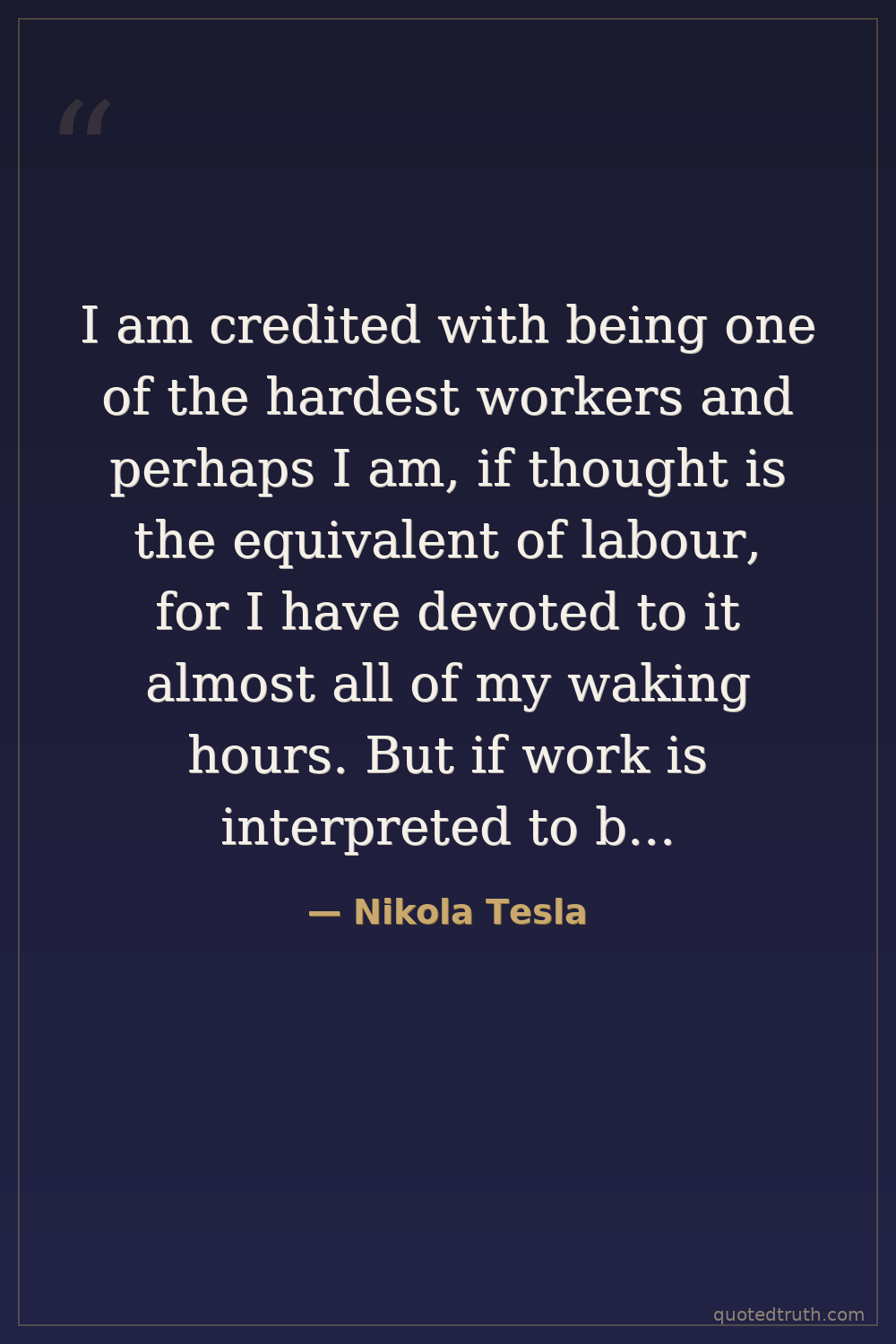
Tesla draws a line between two definitions of work: relentless mental effort versus clock-bound, task-defined labor. He argues his mind never stops—thinking is his work, consuming nearly every waking hour. But measured by conventional standards—fixed tasks, strict schedules, visible output—he'd look completely unproductive. The quote defends intellectual labor as genuine work, insisting deep, continuous thought is not idleness even when nothing tangible is being physically produced on a set timetable.
Relevance to Nikola Tesla
Tesla famously visualized entire machines in his mind before building them, often perfecting inventions mentally without touching hardware. He worked in intense, irregular bursts—sometimes forgetting food and sleep—rather than following factory-style schedules. His AC motor, Tesla coil, and wireless power concepts all emerged from this mental-first process. The quote directly mirrors his self-image: a thinker whose laboratory was his imagination, not a laborer whose output could be measured by hours logged at a workbench.
The era
Tesla's career spanned the Industrial Revolution's peak, when Frederick Taylor's scientific management movement (emerging ~1910s) defined productivity through time-motion studies, rigid schedules, and measurable physical output. Edison—Tesla's chief rival—embodied this ethos, championing relentless hands-on tinkering and long factory hours. In that environment, claiming pure thought as equivalent labor was genuinely countercultural. Tesla was pushing back against an era that valued visible, quantifiable work and had little framework for valuing invisible, abstract intellectual invention.
AI-generated insights based on extensive research and information for context. Factual errors? Email [email protected].