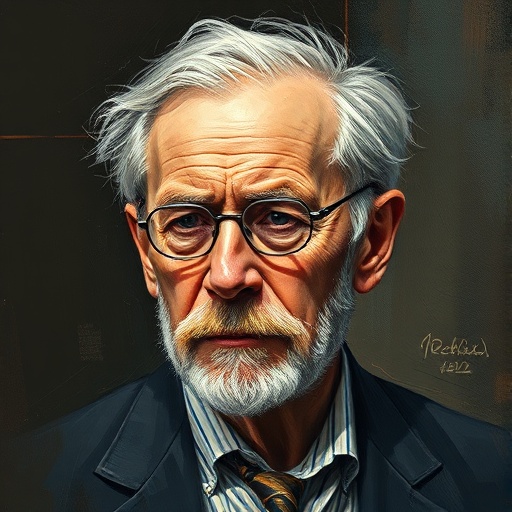
Erwin Schrodinger — "I am a physicist, not a philosopher. But I cannot help but think about these thi…"
I am a physicist, not a philosopher. But I cannot help but think about these things.
I am a physicist, not a philosopher. But I cannot help but think about these things.
Click any product to generate a realistic preview. Up to 3 at a time.
* Initial load can take up to 90 seconds — revising the preview in another color is nearly instant.
"Our body is not a thing, but a process."
"Quantum physics thus reveals a basic oneness of the universe."
"The world is given to me only once, not one existing and one perceived. Subject and object are only one. The barrier between them cannot be said to have broken down as a result of recent experience in…"
"The existence of life on Earth is just a fluke. There is no special reason for it."
"The world is much stranger than we can imagine."
Austrian physicist who shared the 1933 Nobel for the wave equation that bears his name and the famous cat thought-experiment. Closely associated with Werner Heisenberg (matrix-mechanics rival who reached the same physics by different math) and Albert Einstein (his pen-pal on quantum interpretation). For an intellectual contrast, see Niels Bohr, Danish physicist and architect of the Copenhagen interpretation — Schrödinger's cat thought-experiment was specifically designed to ridicule Bohr's 'observer-dependent reality' reading of quantum mechanics — Schrödinger thought the Copenhagen interpretation was absurd; the cat was meant as reductio ad absurdum.
Attributed, common sentiment for many scientists who delve into philosophy.
Date: Unknown
GeneralFound in 1 providers: grok
1 source checked
The speaker openly admits a tension between professional identity and personal curiosity. He works in physics, where measurements, equations, and verifiable predictions rule, yet the deeper questions his work raises—about reality, consciousness, and meaning—keep pulling at him. He cannot stay confined to his discipline because the implications of his own findings spill into territory traditionally owned by philosophers, and intellectual honesty forces him to engage with them.
Schrodinger lived this exact tension. After founding wave mechanics in 1926 and winning the 1933 Nobel Prize, he wrote What Is Life? (1944), influencing molecular biology, and Mind and Matter, openly engaging Vedanta philosophy and consciousness. His famous cat thought experiment was itself half physics, half metaphysics. Trained rigorously in Vienna physics, he nevertheless read Schopenhauer and Upanishads seriously, embodying a working physicist who refused to let disciplinary boundaries silence the broader questions his equations provoked.
Schrodinger worked through the 1920s–1950s, when quantum mechanics shattered classical certainties about objective reality, observation, and causality. Bohr, Heisenberg, and Einstein were publicly debating whether physics described nature or merely our knowledge of it. World wars displaced scientists across Europe; Schrodinger himself fled Nazi-influenced Austria for Dublin. In that climate, physicists could not avoid philosophy—their equations were dissolving the boundary between measurement, mind, and matter, forcing reluctant scientists into metaphysical territory.
AI-generated insights based on extensive research and information for context. Factual errors? Email [email protected].
Your cart is empty