What it means
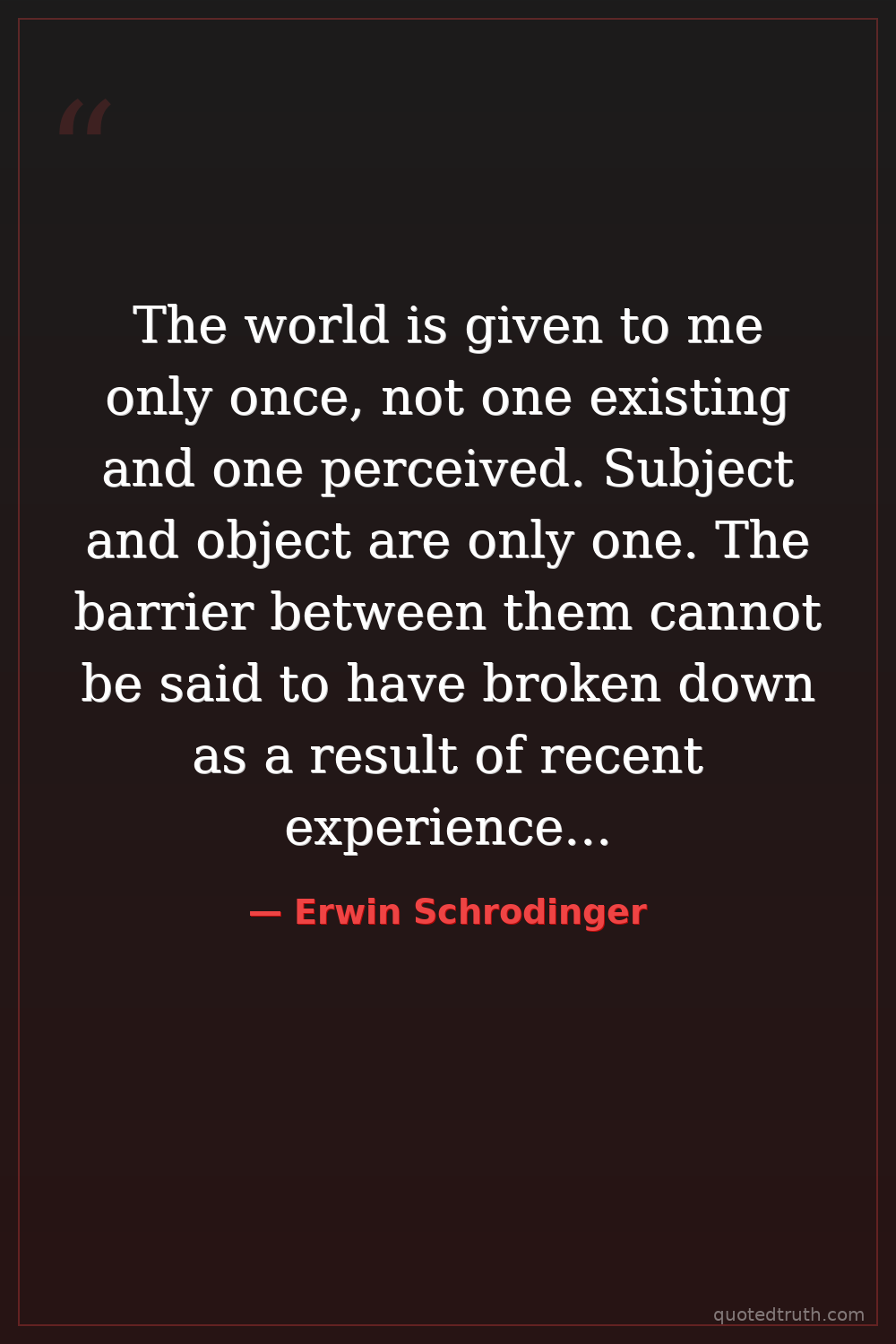
Reality isn't divided into two versions — one that objectively exists out there and one we perceive internally. We each encounter the world once, as a unified whole. The observer and the observed are inseparable; consciousness and matter aren't two distinct things bridged by perception. The division between self and world is a mental construct, not a feature of reality. There was never a wall to break down, because no wall ever existed.
Relevance to Erwin Schrodinger
Schrödinger developed wave mechanics, where quantum systems exist as superpositions until measured — making the observer inseparable from what's observed. His famous cat paradox dramatized this collapse of objectivity. He was deeply influenced by Vedantic philosophy, particularly the Upanishads' teaching that individual consciousness and universal reality are one. His book 'What is Life?' extended this into biology. This quote mirrors both his quantum physics insights and his lifelong conviction that mind and world cannot be cleanly separated.
The era
The 1920s–1940s saw quantum mechanics overturn classical physics' assumption of an observer-independent reality. The Copenhagen interpretation placed measurement — and therefore the observer — at the center of determining physical outcomes. Simultaneously, Western intellectuals were engaging Eastern philosophy seriously. Amid two World Wars, the old Cartesian split between mind and matter felt increasingly untenable. Physics itself seemed to confirm what mystics had long claimed: subject and object were never truly distinct categories to begin with.
AI-generated insights based on extensive research and information for context. Factual errors? Email [email protected].