What it means
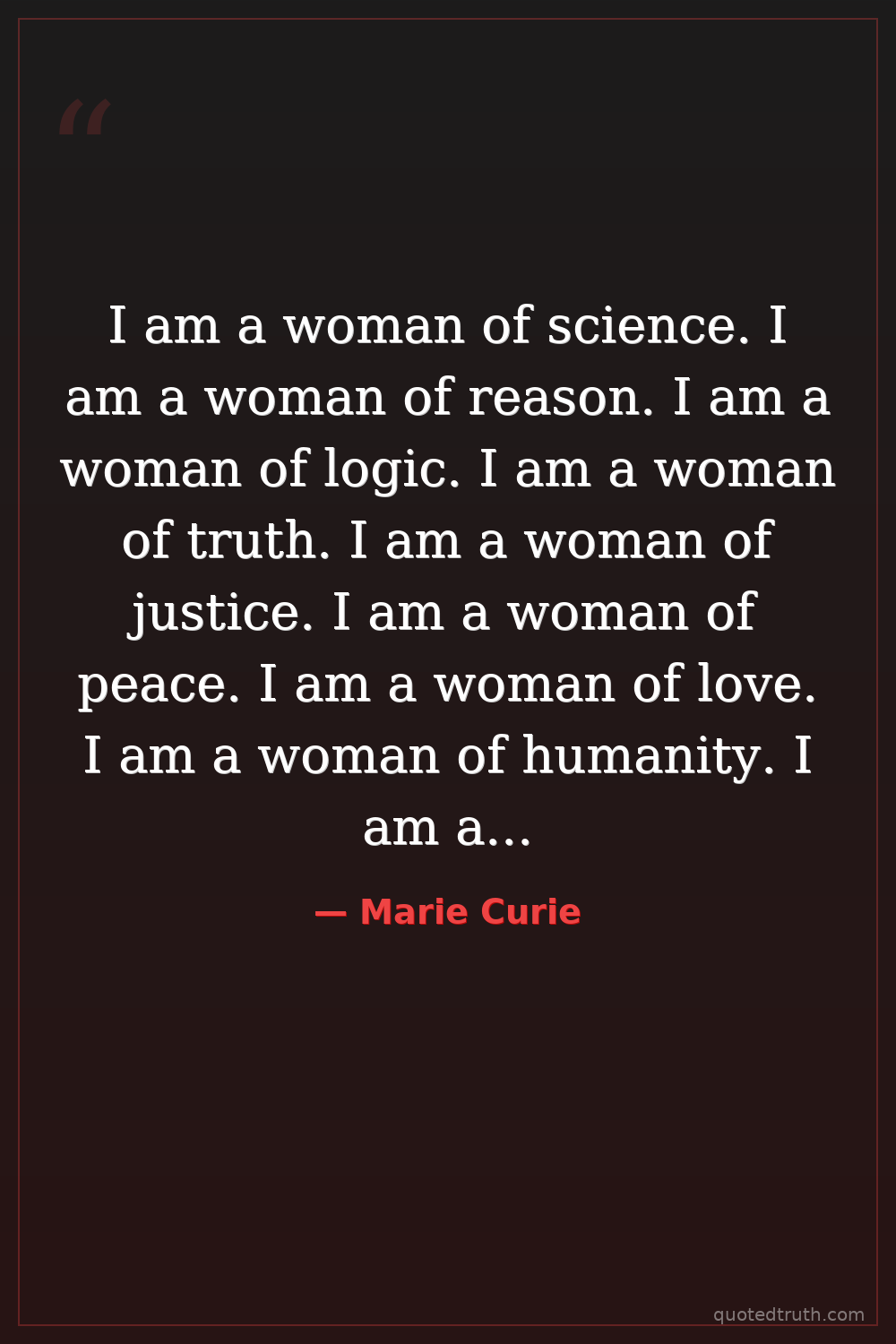
The speaker claims a full identity built on rational and moral pillars: science, reason, logic, truth, justice, peace, love, and humanity. Rather than accepting a narrow label, she insists she embodies all of these qualities at once and refuses to apologize for any of them. The closing line flips expected modesty into open pride, asserting that a woman can hold intellectual rigor and warm human values together without contradiction.
Relevance to Marie Curie
Marie Curie spent her career fighting to be taken seriously as a scientist in rooms that barely admitted women. She won Nobel Prizes in physics and chemistry, insisted on rigorous method, and also drove mobile X-ray units to the WWI front to treat wounded soldiers. The pairing of reason with love, justice, and humanity mirrors her actual life: cold lab discipline alongside deep personal sacrifice, refusal to patent radium, and quiet moral seriousness about how science should serve people.
The era
Curie worked from the 1890s through the 1930s, when European universities routinely barred women from degrees, labs, and academies. The French Academy of Sciences rejected her membership in 1911, the same year she won her second Nobel. Press coverage often reduced her to wife, widow, or scandal rather than scientist. A woman publicly claiming reason, logic, and pride in the same breath as love and humanity pushed directly against the era's assumption that serious intellect was male territory.
AI-generated insights based on extensive research and information for context. Factual errors? Email [email protected].