What it means
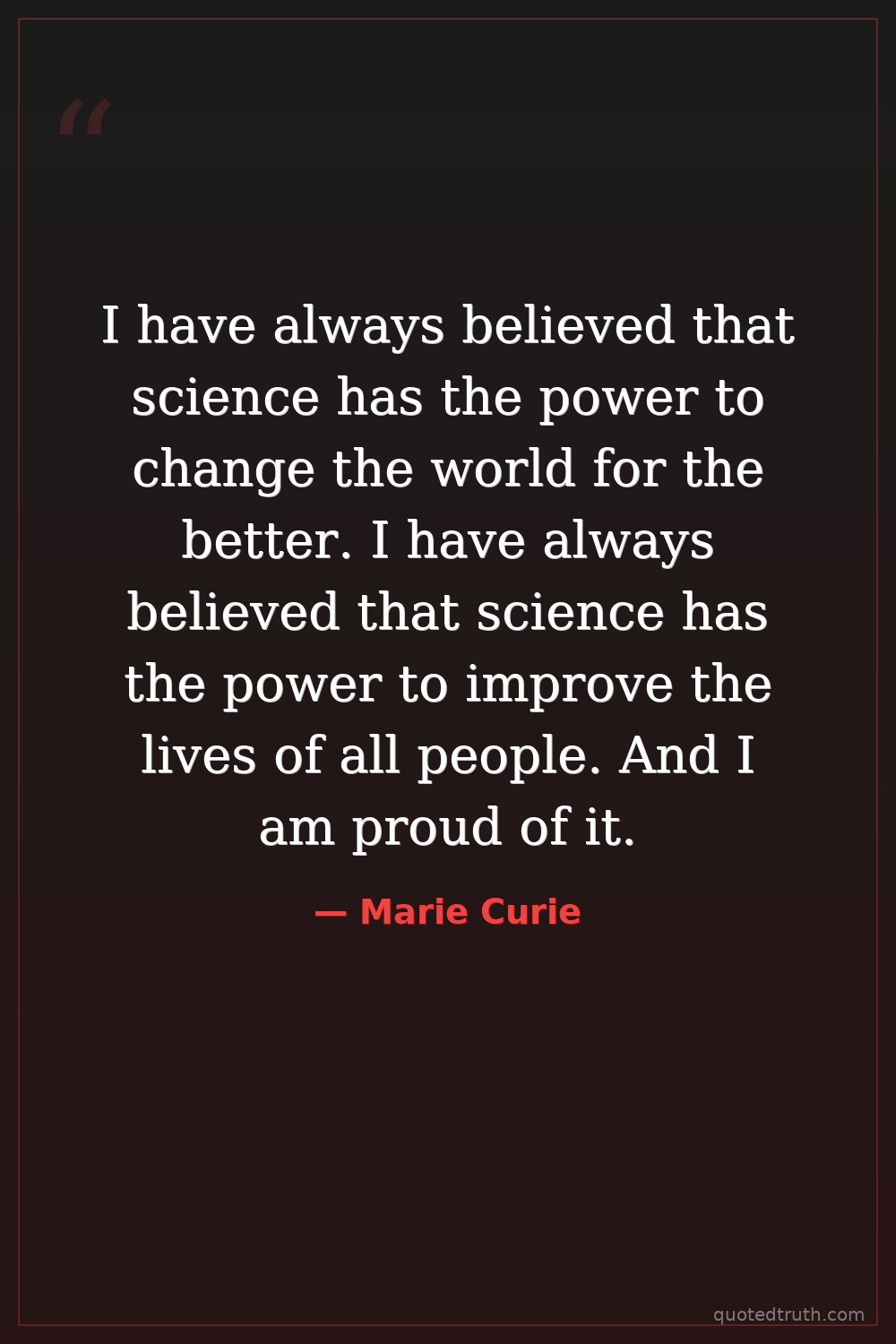
The speaker declares a lifelong conviction that scientific inquiry can materially better the human condition and lift the quality of life for everyone, not just a privileged few. They are expressing optimism about discovery as a force for progress and voicing personal pride in having contributed to that mission. It is a statement of faith in science as a humanitarian project rather than an abstract or purely academic pursuit.
Relevance to Marie Curie
Curie devoted her life to isolating radium and polonium, work that directly enabled cancer radiotherapy and medical imaging. She refused to patent the radium-isolation process so treatments could spread freely, and during WWI she built mobile X-ray units to treat wounded soldiers. Winning Nobel Prizes in both Physics and Chemistry, she embodied the belief that rigorous research should translate into concrete human benefit, not personal wealth or prestige.
The era
Curie worked from the 1890s through the 1930s, when radioactivity, germ theory, electricity, and vaccines were rapidly transforming medicine and daily life. Public faith in science as civilization's engine was peaking, yet women were largely barred from universities and laboratories. Her era also saw WWI's industrial carnage, which made medical applications of physics urgently visible and reinforced the idea that discovery carried a moral duty to serve humanity.
AI-generated insights based on extensive research and information for context. Factual errors? Email [email protected].