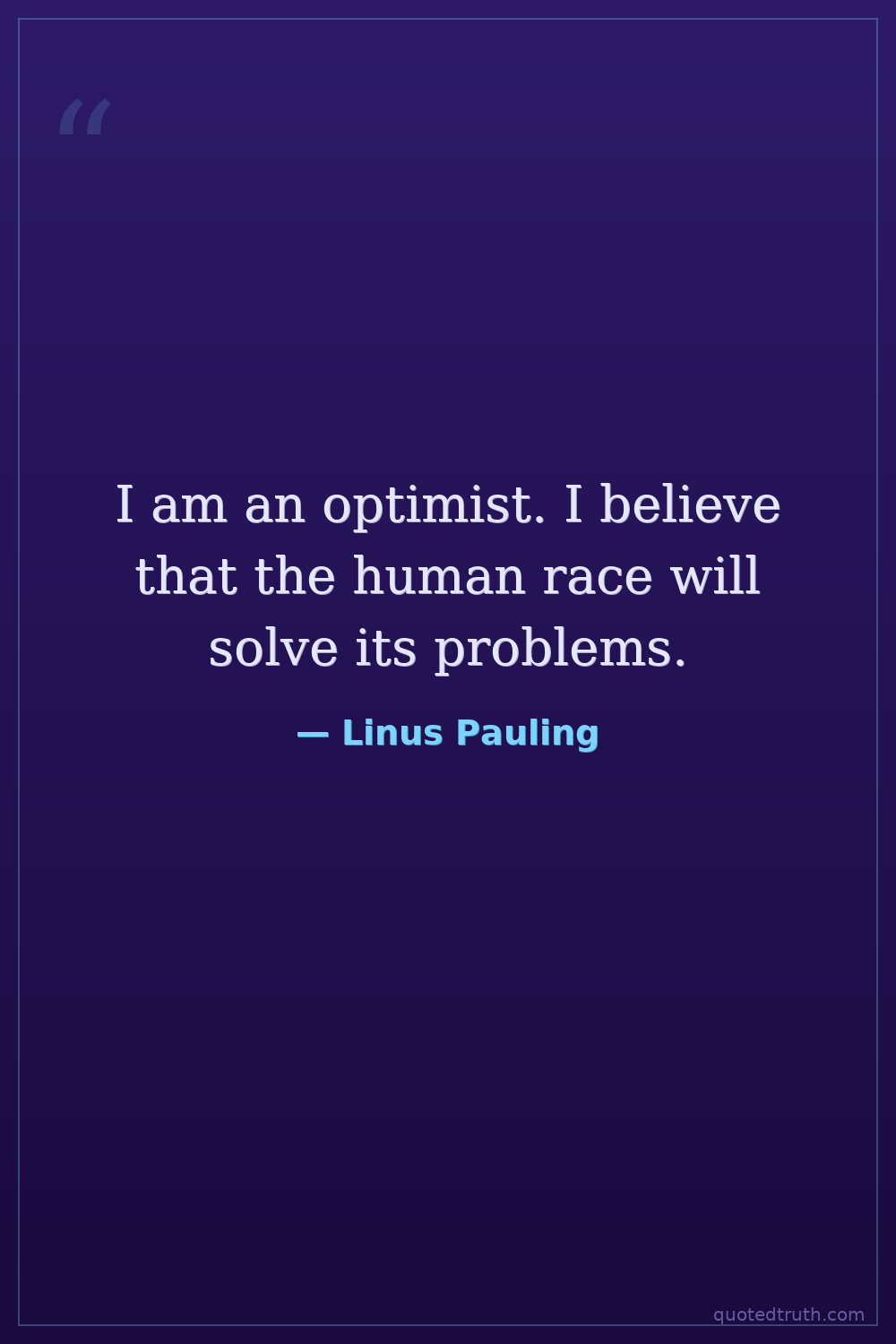
Linus Pauling — "I am an optimist. I believe that the human race will solve its problems."
I am an optimist. I believe that the human race will solve its problems.
I am an optimist. I believe that the human race will solve its problems.
Click any product to generate a realistic preview. Up to 3 at a time.
* Initial load can take up to 90 seconds — revising the preview in another color is nearly instant.
"I believe that there is a way to make the world better, and that we have a responsibility to find it."
"I have always been a fighter, and I believe that it is important to stand up for what you believe in."
"If there were nobody in the world but politicians, I would feel that there was no hope for mankind, no hope for civilization, no hope for the world."
"I realized that medical and biological investigators were not attacking their problems the same way that theoretical physicists do, the way I had been in the habit of doing."
"Vitamin C is the most important of all vitamins."
Found in 1 providers: grok
1 source checked
The speaker declares genuine belief that humanity, despite its flaws and ongoing crises, has the collective intelligence and will to overcome its greatest challenges. It's a rejection of despair and cynicism — a commitment to trusting that problems, however enormous — war, disease, poverty, environmental damage — are solvable. The statement positions hope not as naivety but as a reasoned stance grounded in evidence of human ingenuity and cooperation.
Pauling won two unshared Nobel Prizes — Chemistry in 1954 for chemical bonding theory and Peace in 1962 for anti-nuclear activism. He circulated a petition signed by 11,000 scientists demanding an end to nuclear testing, at personal risk during McCarthyism. His optimism was active: he believed scientific understanding and moral courage could redirect humanity from self-destruction, and his life demonstrated that sustained rational effort against powerful opposition could produce real change.
Pauling lived through two World Wars, Hiroshima, and the Cold War nuclear standoff. By the 1950s and 1960s, atmospheric nuclear testing was contaminating global food supplies with strontium-90, and ICBM arsenals threatened civilization's existence. Scientists debated whether their discipline had created an unsolvable catastrophe. Pauling's optimism was a deliberate counter-position to that despair, insisting that scientific literacy, international cooperation, and political will could still steer humanity away from self-annihilation.
AI-generated insights based on extensive research and information for context. Factual errors? Email [email protected].
Your cart is empty