Linus Pauling — "I have always been a fighter, and I believe that it is important to stand up for…"
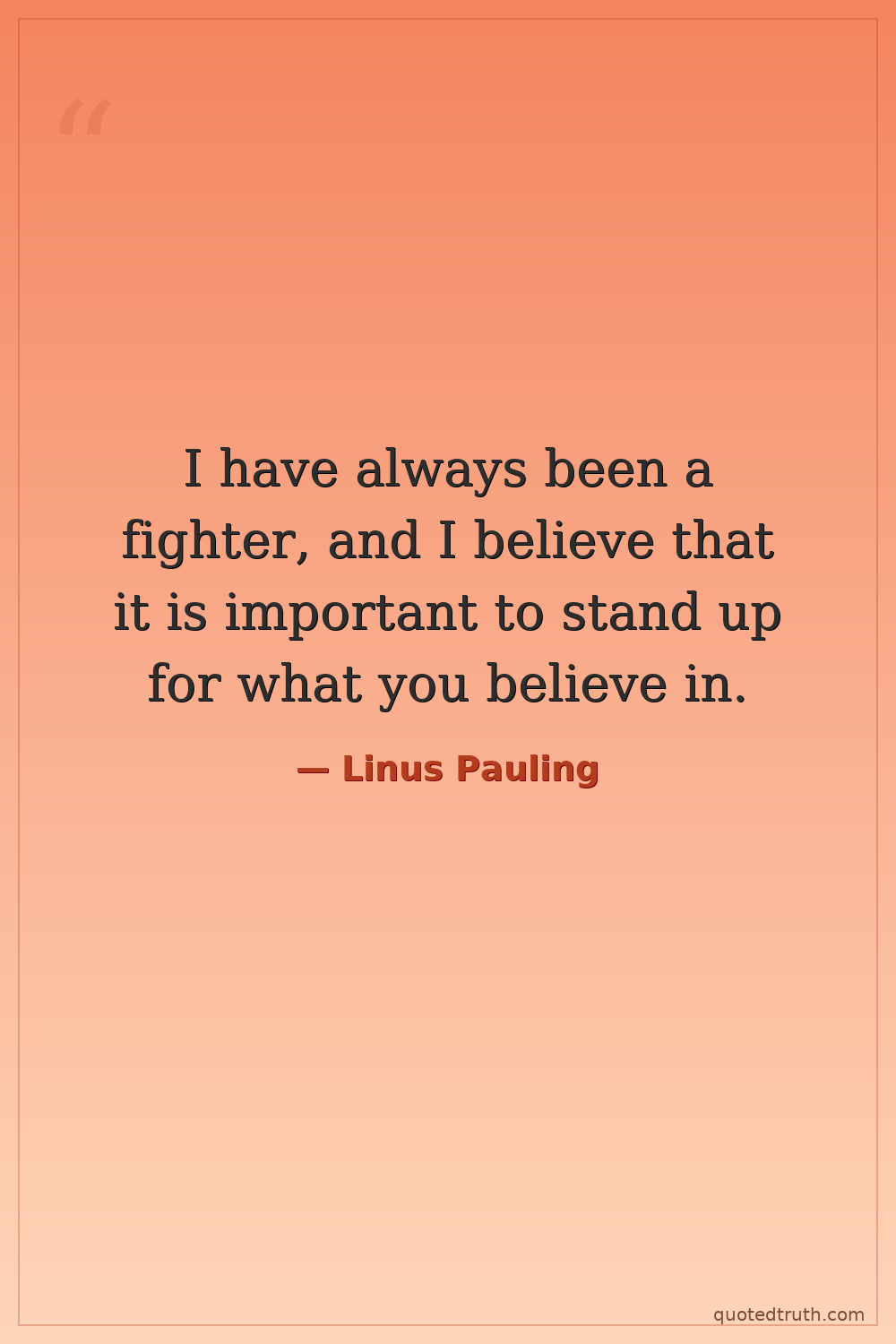
I have always been a fighter, and I believe that it is important to stand up for what you believe in.
I have always been a fighter, and I believe that it is important to stand up for what you believe in.
Click any product to generate a realistic preview. Up to 3 at a time.
* Initial load can take up to 90 seconds — revising the preview in another color is nearly instant.
"A good scientist thinks logically and accurately when conditions call for logical and accurate thinking—but so does any other good worker when he has a sufficient number of well-founded facts to serve…"
"The greatest enemy of knowledge is not ignorance, it is the illusion of knowledge."
"The only way to cope with a problem is to go right at it, and the only way to solve a problem is to keep on working at it until you've solved it."
"Orthomolecular medicine is the preservation of good health and the treatment of disease by varying the concentrations of substances normally present in the body."
"The greatest discovery of all time is that a person can change his future by merely changing his attitude."
Found in 1 providers: grok
1 source checked
Personal conviction demands action, not just private belief. When you know something is right — or wrong — staying silent is its own kind of failure. This quote argues that integrity means accepting the cost of opposition: criticism, risk, conflict. Fighting for what you believe isn't aggression; it's the minimum required of anyone who actually holds a position rather than just performing one when it's convenient.
Pauling lived this literally. After his 1954 Nobel Prize in Chemistry, he threw himself into anti-nuclear activism during peak Cold War tension, delivering an 11,000-scientist petition to the UN against weapons testing. The U.S. government revoked his passport; the FBI investigated him for Communist sympathies. He fought every accusation publicly and without retreat — and won the Nobel Peace Prize in 1962, one of only two people ever to receive two unshared Nobels.
The 1950s and early 1960s made public dissent genuinely dangerous. McCarthyism destroyed careers; scientists who questioned U.S. nuclear policy were labeled Communist sympathizers and investigated. Pauling's activism occurred when conformity was enforced institutionally, not just socially. The nuclear arms race had produced weapons capable of civilizational destruction, yet public opposition was treated as treasonous. Standing up in that climate meant risking everything — making the sentiment far more than rhetorical.
AI-generated insights based on extensive research and information for context. Factual errors? Email [email protected].
Your cart is empty