Michael Faraday — "I am no poet, but if you think for yourselves, as I proceed, the facts will form…"
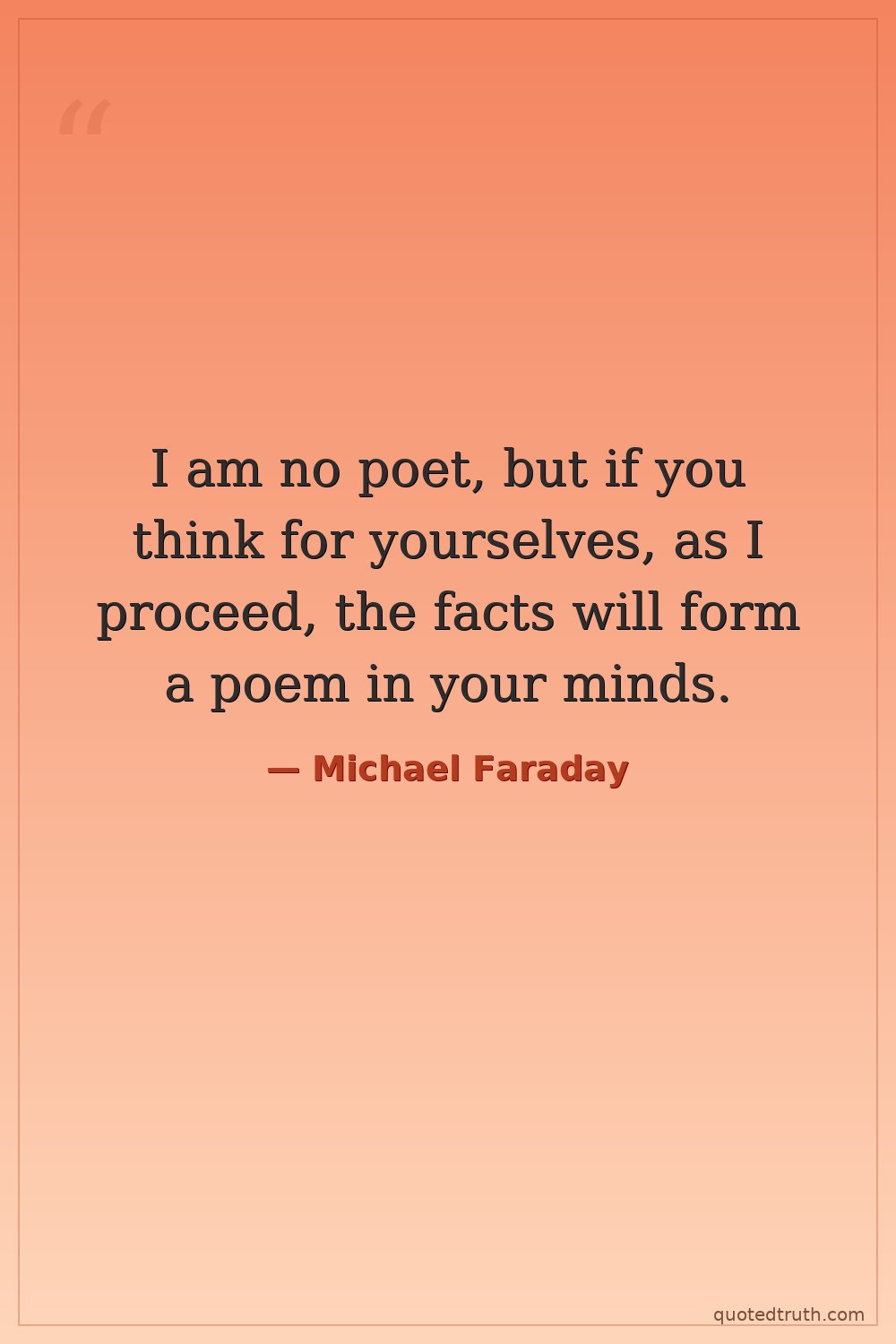
I am no poet, but if you think for yourselves, as I proceed, the facts will form a poem in your minds.
I am no poet, but if you think for yourselves, as I proceed, the facts will form a poem in your minds.
Click any product to generate a realistic preview. Up to 3 at a time.
* Initial load can take up to 90 seconds — revising the preview in another color is nearly instant.
"I have in fact been a very lucky fellow; I have often said that I should be a very miserable creature if I could not feel that I was doing something for the good of other people."
"I have often regretted that I was not able to pursue a more regular course of study."
"Work, finish, publish."
"The philosopher should be a man willing to listen to every suggestion, but determined to judge for himself."
"The secret of my success? I keep my mouth shut."
A charming and slightly self-deprecating introduction to his scientific explanations, likely from his lectures.
Date: 19th century (approximate)
Self-DeprecatingFound in 1 providers: gemini
1 source checked
Faraday is telling his audience he won't dress up his lecture in fancy language, but if they actively engage their minds and follow his reasoning, the raw facts themselves will arrange into something beautiful. Truth, carefully observed and connected, has its own poetry. The listener's thinking completes the art. Understanding nature requires participation, not passive reception of eloquent phrases.
Faraday was a self-taught bookbinder's apprentice who lacked formal mathematical training, which made him acutely aware he was no wordsmith or theorist. Yet his Royal Institution Christmas Lectures drew crowds through vivid demonstrations rather than rhetoric. He believed experimental facts, clearly shown, spoke louder than ornate prose. This humility masks genius: his intuitive field concepts later underpinned Maxwell's equations, proving nature's poetry was in the phenomena.
Faraday spoke during the Victorian era, when scientific lectures were popular public entertainment competing with Romantic poetry and oratory. The Royal Institution hosted packed evening discourses where audiences expected both education and eloquence. Science was being professionalized but still addressed general audiences directly. This was before specialization walled off physics from the lay public, when a blacksmith's son could demonstrate electromagnetic induction to London's elite and trust them to think alongside him.
AI-generated insights based on extensive research and information for context. Factual errors? Email [email protected].
Your cart is empty