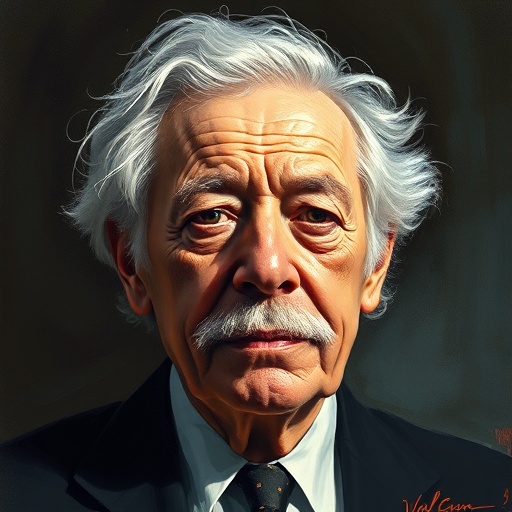
Linus Pauling — "I am not a quack. I am a scientist."
I am not a quack. I am a scientist.
I am not a quack. I am a scientist.
Click any product to generate a realistic preview. Up to 3 at a time.
* Initial load can take up to 90 seconds — revising the preview in another color is nearly instant.
"Science is the search for truth -- it is not a game in which one tries to beat his opponent, to do harm to others."
"I believe that the scientist has a special responsibility. He has a special responsibility to use his knowledge for the benefit of mankind."
"The most important thing in science is to ask the right questions."
"I am not afraid to be wrong, because I know that I can learn from my mistakes."
"I am convinced that we can abolish war, and that we must do so if we are to survive."
Found in 1 providers: grok
1 source checked
Someone is asserting their credentials and methodology against accusations of fraud or pseudoscience. The speaker draws a hard line between legitimate scientific practice—testing hypotheses, gathering evidence, applying rigorous methods—and quackery, which relies on anecdote, deception, or wishful thinking. It's a defiant claim that unconventional conclusions don't automatically equal bad science, and that credentials and process, not just consensus, define scientific legitimacy.
Pauling won two unshared Nobel Prizes—Chemistry in 1954 and Peace in 1962—making him one of the most decorated scientists in history. Yet his advocacy for megadose vitamin C as a cancer and cold remedy drew fierce condemnation from mainstream medicine. Colleagues and journals labeled him a crank. This quote reflects his conviction that vitamin C research followed genuine scientific methodology, regardless of whether it aligned with institutional consensus.
During the 1970s and 1980s, evidence-based medicine was consolidating as the gold standard, and bodies like the FDA tightened standards for health claims. Alternative medicine simultaneously grew as a cultural movement. Pauling's vitamin C advocacy fell directly into this fault line—praised by wellness communities, scorned by oncologists. His defense of the title 'scientist' came as the boundary between legitimate research and pseudoscience became increasingly contested and publicly visible.
AI-generated insights based on extensive research and information for context. Factual errors? Email [email protected].
Your cart is empty