What it means
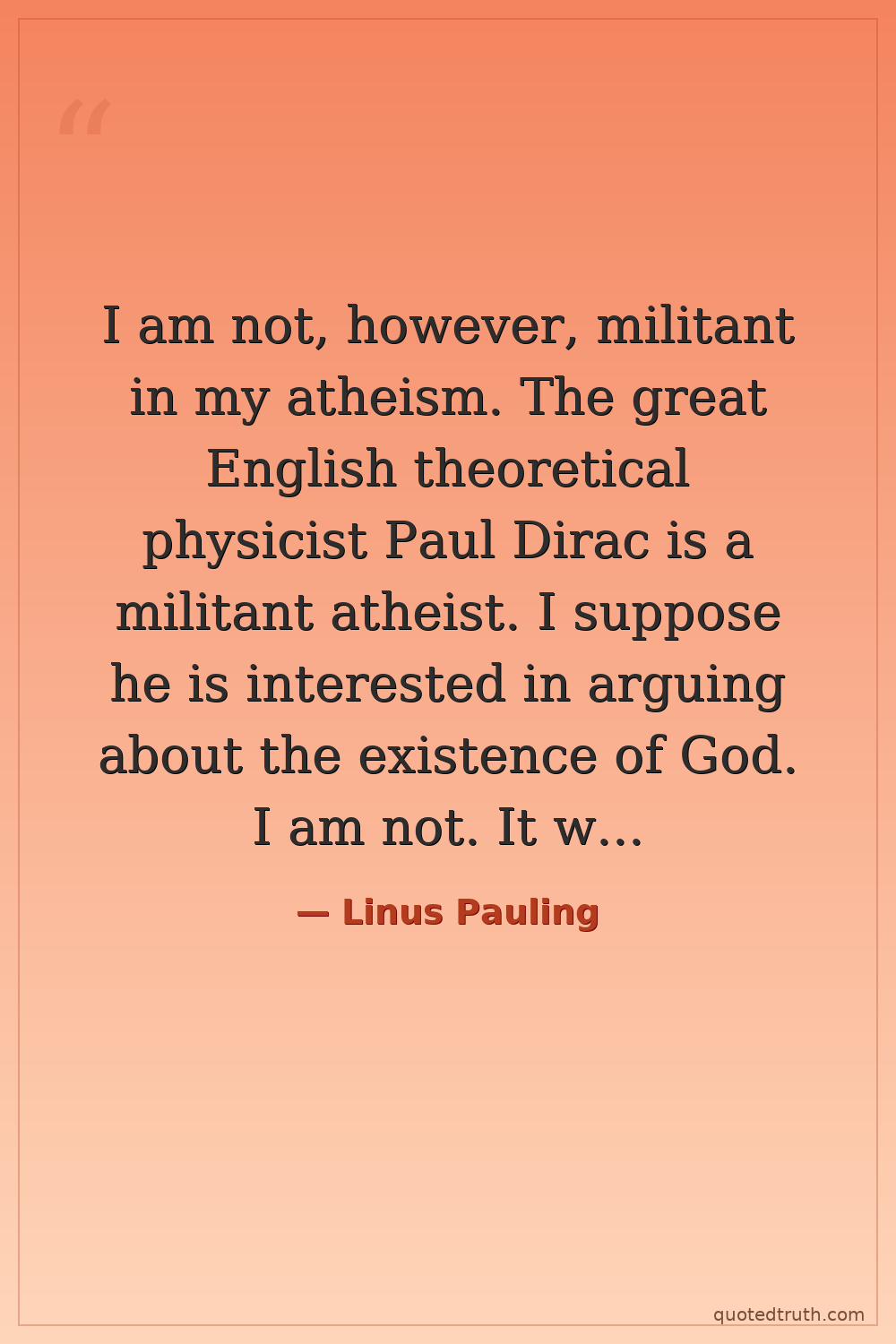
Pauling draws a distinction between passive and active atheism. He doesn't believe in God but sees no value in debating the question. Paul Dirac, his contrast figure, actively argued against religion. The joke — inverting the Islamic declaration of faith — mocks Dirac's crusading zeal. Pauling's point: non-belief need not become a mission. He simply lived without religion rather than organizing against it.
Relevance to Linus Pauling
Pauling's detached atheism mirrors his broader character: focused and pragmatic. He channeled passion into concrete causes — pioneering quantum chemistry, then anti-nuclear activism that earned him the 1962 Peace Nobel. Abstract philosophical battles held little interest for a man reshaping molecular biology and fighting weapons testing. His easy familiarity with Dirac reflects deep ties to mid-century theoretical physics, and his dry wit here matches the precision he brought to scientific argument.
The era
Mid-twentieth century America was deeply religious by public standard — 'In God We Trust' was stamped on currency in 1956, 'under God' added to the Pledge in 1954. Cold War rhetoric framed democracy as God-fearing versus godless communism. For prominent scientists to openly declare atheism carried social risk. That Pauling treated it as unremarkable rather than provocative reflected a quiet secular confidence rare among public figures of the era.
AI-generated insights based on extensive research and information for context. Factual errors? Email [email protected].