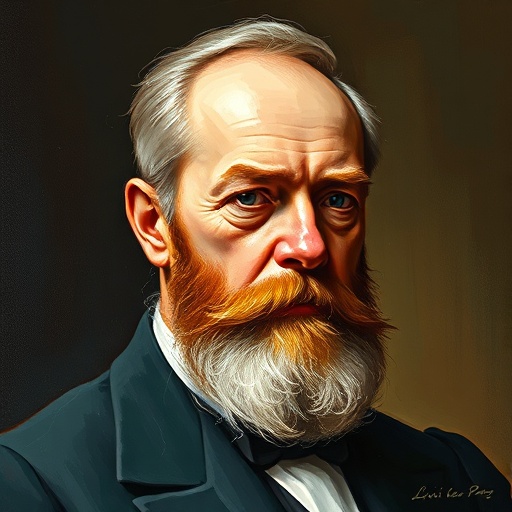
Louis Pasteur — "I am unable to find any experimental evidence that supports the doctrine of spon…"
I am unable to find any experimental evidence that supports the doctrine of spontaneous generation.
I am unable to find any experimental evidence that supports the doctrine of spontaneous generation.
Click any product to generate a realistic preview. Up to 3 at a time.
* Initial load can take up to 90 seconds — revising the preview in another color is nearly instant.
"Happy is the man who has a vocation which he can follow with passion."
"The role of the infinitely small in nature is infinitely large."
"The more I study nature, the more I stand amazed at the work of the Creator."
"I am utterly convinced that there is a germ for every disease."
"The more I learn, the more I realize how much I don't know."
Found in 1 providers: grok
1 source checked
Pasteur is saying that after careful testing, he cannot find any proof for the old belief that living things pop into existence from non-living matter, like maggots forming from rotting meat on their own. Every experiment he ran pointed to life coming only from pre-existing life. He is not just doubting the idea, he is stating that the evidence simply is not there to back it up.
This captures Pasteur at his core: a meticulous experimentalist who trusted data over tradition. His famous swan-neck flask experiments in the 1860s demolished spontaneous generation by showing sterile broth stayed sterile when airborne microbes were blocked. That work fed directly into his germ theory of disease and pasteurization. The quote reflects his lifelong insistence that belief must bow to repeatable evidence, a stance that defined his battles with rivals like Pouchet.
In mid-19th-century France, spontaneous generation was still widely defended, championed by Felix Pouchet and rooted in centuries of Aristotelian thinking. The French Academy of Sciences even ran prize contests on the question. Microscopy was improving, industrial fermentation problems in wine, beer, and silkworms demanded answers, and disease was still blamed on bad air. Pasteur's evidence-first stance arrived just as science was shifting from philosophical debate to rigorous laboratory proof.
AI-generated insights based on extensive research and information for context. Factual errors? Email [email protected].
Your cart is empty