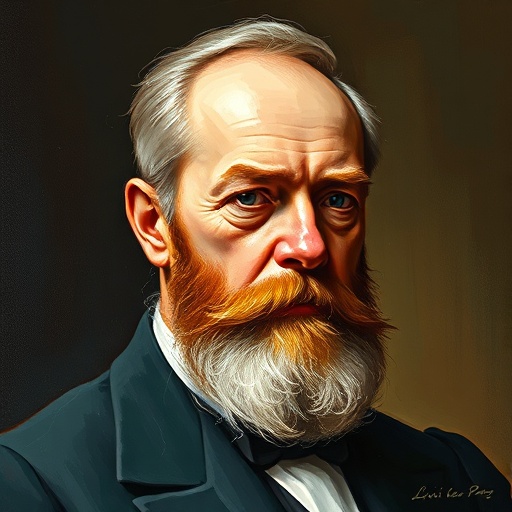
Louis Pasteur — "I am utterly convinced that there is a germ for every disease."
I am utterly convinced that there is a germ for every disease.
I am utterly convinced that there is a germ for every disease.
Click any product to generate a realistic preview. Up to 3 at a time.
* Initial load can take up to 90 seconds — revising the preview in another color is nearly instant.
"Do not let yourself be tainted with a barren skepticism."
"Messieurs, c'est les microbes qui auront le dernier mot. (Gentlemen, it is the microbes who will have the last word.)"
"Science knows no country, because knowledge belongs to humanity, and is the torch which illuminates the world."
"The more I learn, the more I realize how much I don't know."
"My passion for truth was the only guide of my life."
Found in 1 providers: grok
1 source checked
Pasteur is stating his firm belief that every illness has a specific microbial cause—an invisible living organism responsible for the sickness. Rather than attributing disease to bad air, imbalanced humors, or spontaneous generation, he insists there is a discoverable microscopic agent behind each ailment. It is a declaration of confidence in a unified biological explanation for sickness, asserting that finding the right microbe is only a matter of sufficient investigation.
This conviction drove Pasteur's entire career. After proving microbes soured wine and beer, he extended the logic to silkworm disease, anthrax, chicken cholera, and rabies, developing vaccines for each. A chemist by training, he refused to accept miasma theory and championed sterile technique, pasteurization, and vaccination. The quote captures his relentless, almost crusading certainty—the same stubbornness that let him overturn centuries of medical dogma despite fierce opposition from physicians who resented an outsider.
Pasteur worked in mid-to-late 19th-century France, when cholera, tuberculosis, puerperal fever, and rabies killed millions and surgeons still operated with unwashed hands. Miasma theory dominated, Semmelweis had been ridiculed, and Lister's antiseptics were only beginning to spread. Industrial brewing, urban crowding, and colonial expansion made epidemics economically devastating. Pasteur's era witnessed the collision of emerging microscopy, germ theory, and entrenched medical tradition, making his bold universal claim both scientifically revolutionary and culturally provocative.
AI-generated insights based on extensive research and information for context. Factual errors? Email [email protected].
Your cart is empty