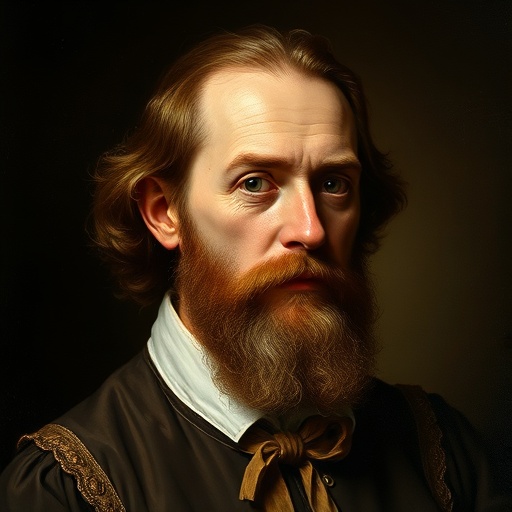
William Harvey — "I appeal to the evidence of my senses, and to the testimony of dissections."
I appeal to the evidence of my senses, and to the testimony of dissections.
I appeal to the evidence of my senses, and to the testimony of dissections.
Click any product to generate a realistic preview. Up to 3 at a time.
* Initial load can take up to 90 seconds — revising the preview in another color is nearly instant.
"The blood is a spirit, and the spirit is the life."
"All we know is that the blood is in motion, but what sets it in motion is God’s secret."
"The blood is the source of life, and the heart is the fountain thereof."
"The quantity of blood transmitted from the veins to the arteries, and so into the whole body, is so great that it must return to the heart."
"It is only when we have satisfied ourselves by careful dissection that we can truly understand the nature of things."
English physician whose On the Motion of the Heart and Blood in Animals (1628) demonstrated blood circulation, overturning 1,400 years of Galenic medicine. Closely associated with Francis Bacon (his contemporary in the new English empiricism). For an intellectual contrast, see Galenic medicine, the 2nd-century Greek medical tradition (humors, blood-as-consumed-fuel) — Harvey calculated that the heart pumps more blood per hour than the body could possibly produce as fuel — a single quantitative observation that demolished the entire Galenic-Aristotelian medical worldview. The cleanest example in medical history of arithmetic disproving 14 centuries of authority.
Found in 1 providers: grok
1 source checked
Trust direct observation and hands-on physical examination over inherited dogma or abstract reasoning. When making claims about how the body works, the only valid evidence comes from what you can personally witness through careful, repeated experiment and anatomical investigation—not from ancient texts or theoretical argument.
Harvey spent decades dissecting animals and human cadavers to map blood circulation, overturning Galen's 1,400-year-old model. His 1628 work De Motu Cordis was built entirely on quantitative measurement and direct observation—counting heartbeats, ligating vessels, watching valves function—rather than philosophical deduction.
In early 17th-century Europe, medical authority rested almost entirely on Galenic texts preserved through the medieval university system. Challenging ancient physicians risked professional ridicule and accusations of heresy. Harvey's insistence on empirical dissection over textual authority helped establish the experimental method that would define the Scientific Revolution.
AI-generated insights based on extensive research and information for context. Factual errors? Email [email protected].
Your cart is empty