What it means
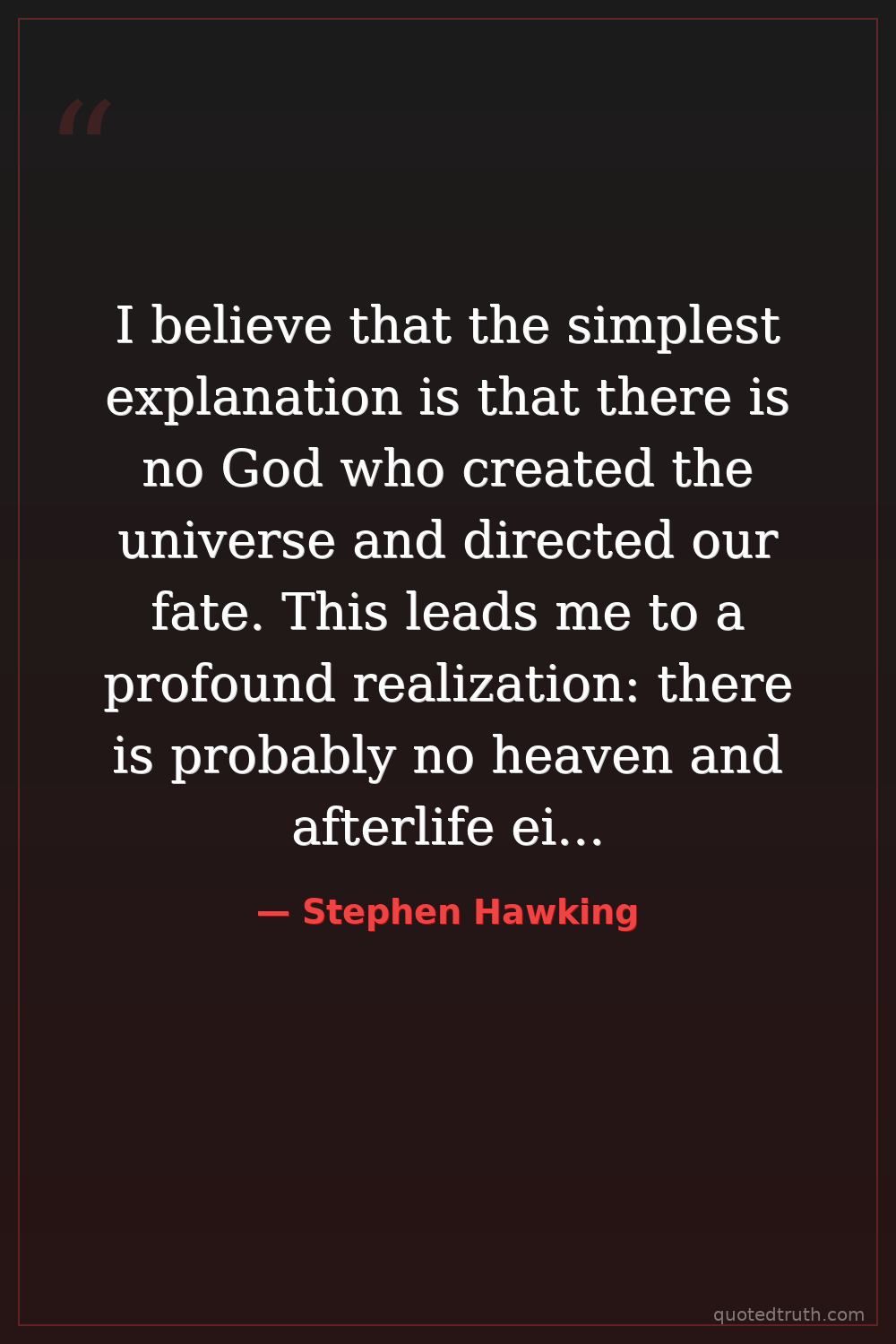
Applying Occam's Razor to existence itself: the universe requires no creator or divine director, so the simplest explanation is that none exists. That logic extends further—if no God, then no one to grant heaven or assign afterlife. Hawking frames belief in an afterlife not as reasoned conclusion but as psychological comfort, a human desire to deny the finality of death rather than accept what evidence actually supports.
Relevance to Stephen Hawking
Hawking spent his career proving the universe operates entirely through physical laws—General Relativity, quantum mechanics, thermodynamics—with no explanatory gaps requiring God. His Hartle-Hawking no-boundary proposal suggested the universe needs no prior cause or creator. Diagnosed with ALS at 21 and given two years to live, he survived 55 more yet never found death's proximity a reason to embrace comforting belief over rigorous evidence. His atheism was intellectual consistency, not rebellion.
The era
Hawking articulated these views during the New Atheism movement's peak—Dawkins' The God Delusion appeared in 2006, Hitchens' God Is Not Great in 2007. The 2012 Higgs boson discovery reinforced that fundamental physics needed no divine design. Western religious affiliation was measurably declining. Simultaneously, cosmological data from WMAP and Planck satellites painted an increasingly complete picture of the early universe, making God-of-the-gaps arguments harder to sustain in scientific discourse.
AI-generated insights based on extensive research and information for context. Factual errors? Email [email protected].