What it means
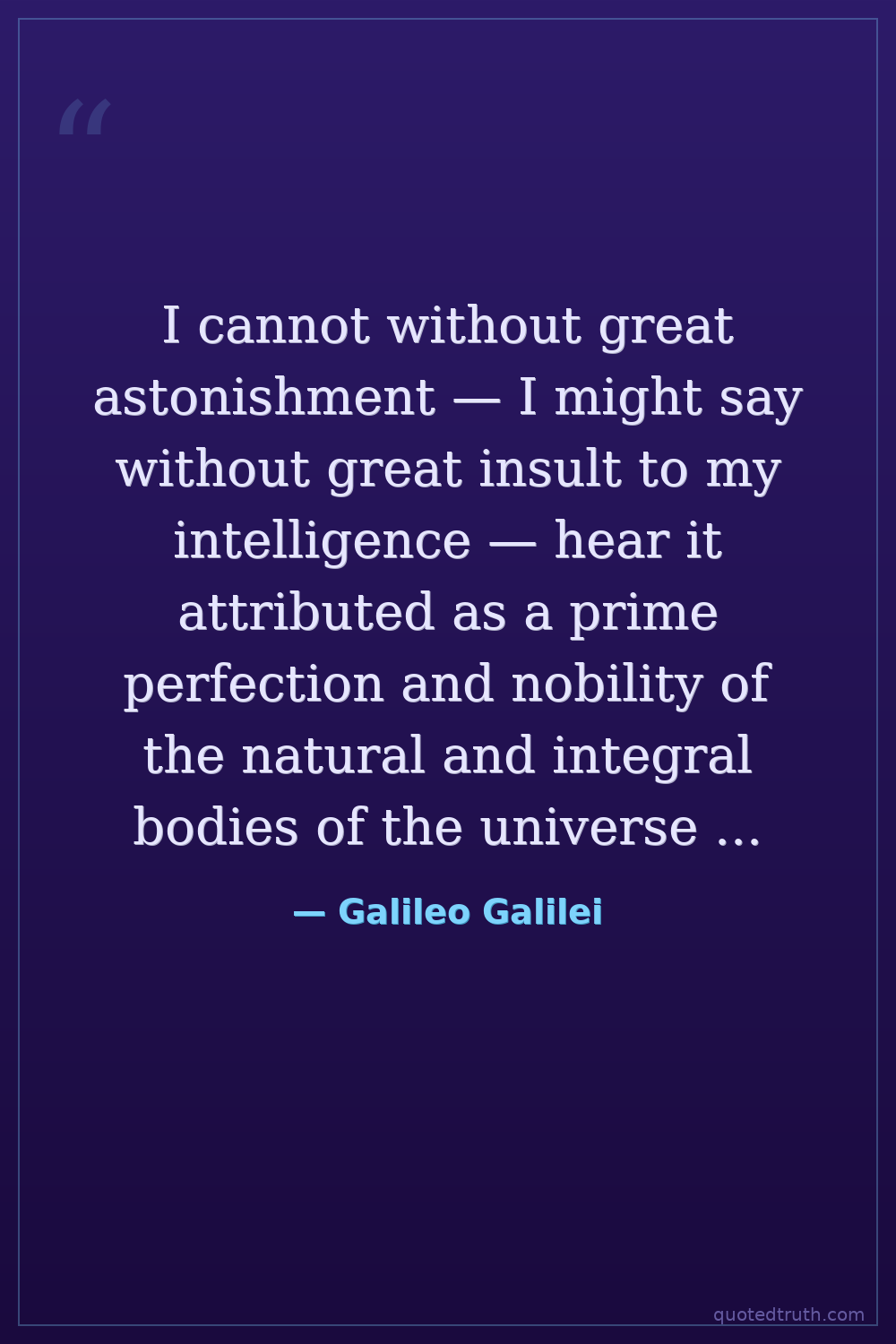
Galileo argues that calling immutability a perfection — and change an imperfection — is an insult to reason. He inverts the traditional hierarchy: Earth's endless transformations, cycles, and generative processes are precisely what make it admirable. Stasis is not superiority; vitality is. The capacity to change, generate, and evolve marks a richness in nature, not a deficiency. He demands that observation and logic, not inherited categories, determine what counts as noble.
Relevance to Galileo Galilei
This quote mirrors Galileo's entire scientific career. His telescope revealed the Moon's cratered surface and sunspots on the supposedly flawless Sun — direct evidence that celestial bodies were mutable, not perfect spheres. He built his method on observation over Aristotelian authority. Condemned by the Inquisition in 1633 for challenging a cosmology built partly on immutability-as-perfection, his defense of change here was not philosophical posturing — it was the intellectual foundation his discoveries rested on.
The era
Early modern Europe operated under Aristotelian cosmology, which divided the universe into a corrupt, mutable sublunary realm and perfect, unchanging celestial spheres — a framework the Catholic Church had institutionalized. Tycho Brahe's 1572 supernova and 1577 comet had already cracked the idea of an immutable heaven. Galileo wrote amid the Counter-Reformation, when scholastic doctrine had legal and theological teeth. Dismantling immutability-as-perfection was therefore not merely academic — it directly threatened the Church's cosmological authority.
AI-generated insights based on extensive research and information for context. Factual errors? Email [email protected].