What it means
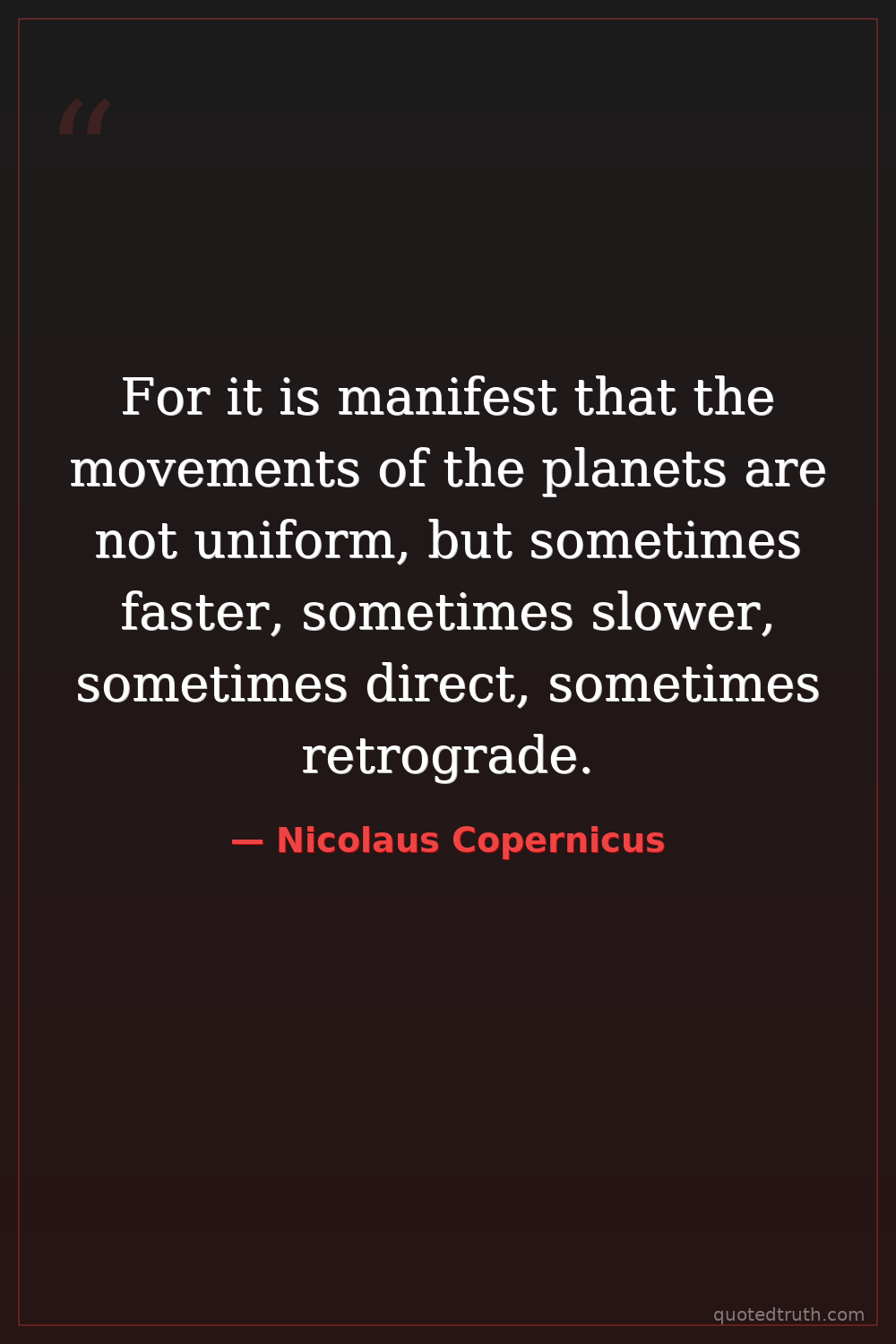
Planets don't travel at steady speeds or in fixed directions across the sky. Their motion varies — faster at some points, slower at others, sometimes appearing to reverse course entirely (retrograde motion). This irregularity is plainly visible to careful observers. Rather than dismissing these variations as anomalies, Copernicus treats them as real phenomena demanding a coherent physical explanation — one the Earth-centered model couldn't provide without increasingly convoluted mathematical workarounds.
Relevance to Nicolaus Copernicus
Copernicus spent decades as a cathedral canon at Frombork while obsessively recording planetary positions. These non-uniform motions were the central puzzle driving his life's work: the Ptolemaic system explained them with clunky epicycles and an artificial equant point — a mathematical trick he found philosophically repugnant. His heliocentric model reframed retrograde motion as an illusion caused by Earth overtaking outer planets, turning observational messiness into geometric elegance. This quote names exactly the problem he devoted his career to solving.
The era
In Copernicus's era, Ptolemy's geocentric model — dominant for 1,400 years — was both scientific orthodoxy and broadly aligned with Church cosmology. Yet navigators during the Age of Exploration urgently needed accurate planetary tables, exposing the model's practical failures. Ancient Greek texts were flooding Europe through the printing press, encouraging scholars to re-examine inherited authorities. This climate made Copernicus's blunt empirical observation — that planetary motion is demonstrably irregular — a legitimate opening for overturning centuries of assumed cosmological certainty.
AI-generated insights based on extensive research and information for context. Factual errors? Email [email protected].