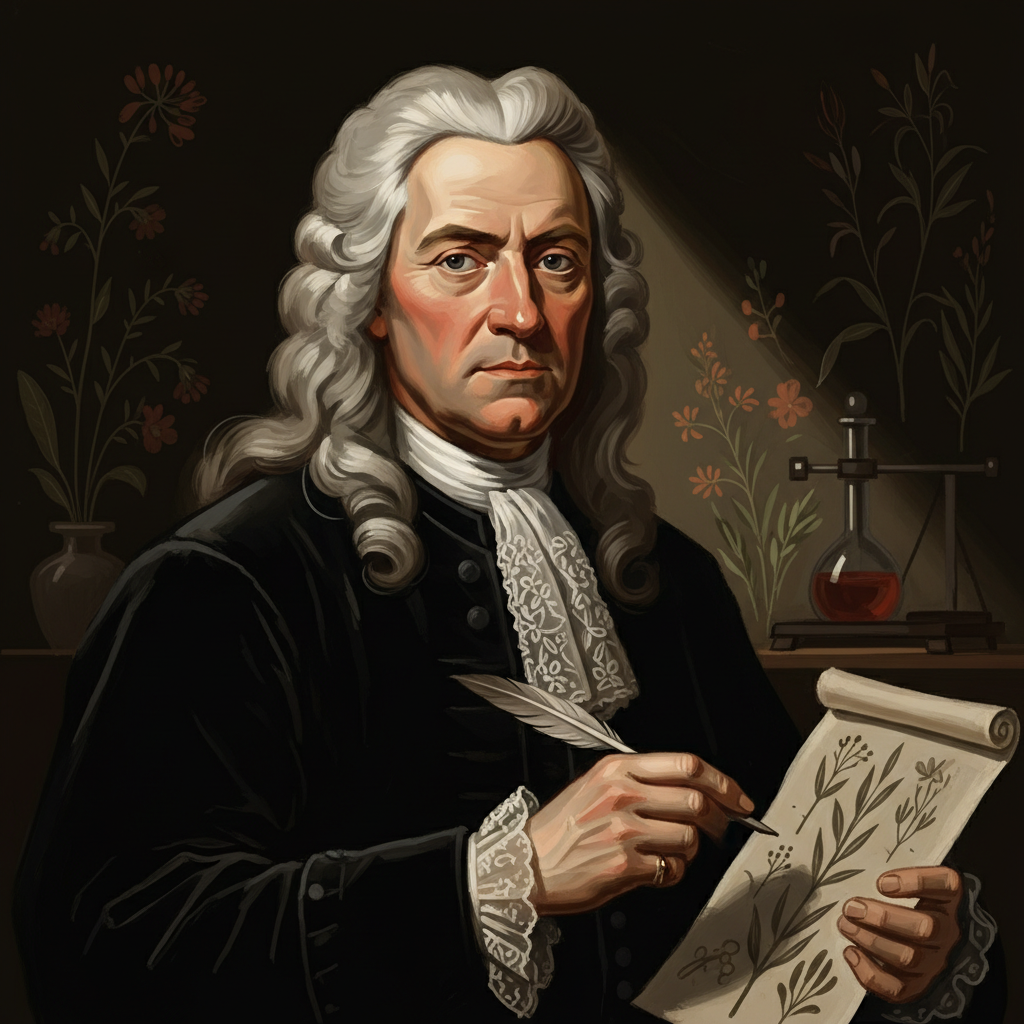
Carl Linnaeus — "I consider it the greatest achievement to be a good observer."
I consider it the greatest achievement to be a good observer.
I consider it the greatest achievement to be a good observer.
Click any product to generate a realistic preview. Up to 3 at a time.
* Initial load can take up to 90 seconds — revising the preview in another color is nearly instant.
"Without names, knowledge is lost."
"Every country has its own plants, and every plant has its own country."
"A professor can never better distinguish himself in his work than by encouraging a clever pupil, for the true discoverers are among them, as comets amongst the stars."
"Yet man does recognise himself [as an animal]. But I ask you and the whole world for a generic differentia between man and ape which conforms to the principles of natural history, I certainly know of …"
"If a tree were to be a god, it would be a god of solitude."
Swedish botanist and the father of modern taxonomy whose Systema Naturae (1735) introduced binomial nomenclature for naming all species. Closely associated with Joseph Banks (British naturalist who carried Linnaean classification on Cook's voyages). For an intellectual contrast, see Comte de Buffon, French naturalist and Histoire Naturelle author (1749-1788) — Buffon explicitly attacked Linnaean fixed-categories taxonomy as artificial and rejected the binomial system; his gradualist, environment-shaped natural history was the explicit alternative. Anticipates the fixed-species-vs-evolution debate Darwin would later resolve.
Highlighting the importance of empirical observation in natural history.
Date: c. 1750s
ShockingFound in 1 providers: grok
1 source checked
Careful, attentive observation of the world is the highest intellectual skill a person can develop. It elevates noticing and recording accurately above theorizing or speculating. Being a truly good observer means seeing what others miss — patterns, distinctions, fine details — without distortion from assumption. Disciplined perception is framed here as the foundation of all genuine knowledge, harder to master and more valuable than cleverness or invention.
Linnaeus spent his career cataloguing thousands of plant and animal species through relentless firsthand observation. His binomial nomenclature system worked precisely because he trained himself to see distinguishing characteristics others overlooked. Field expeditions to Lapland and decades of specimen work at Uppsala University reflected a lifelong conviction that careful seeing — not armchair speculation — was what separated real natural science from guesswork.
Eighteenth-century Europe was shifting from inherited authority toward empirical investigation. Natural historians, energized by colonial-era expeditions, were cataloguing global biodiversity for the first time. Observation was being formalized as a scientific method, distinct from theological or philosophical conjecture. Linnaeus's insistence on disciplined seeing directly challenged armchair theorists and positioned field-based naturalism as rigorous science at a pivotal moment when natural history was establishing itself as a legitimate discipline.
AI-generated insights based on extensive research and information for context. Factual errors? Email [email protected].
Your cart is empty