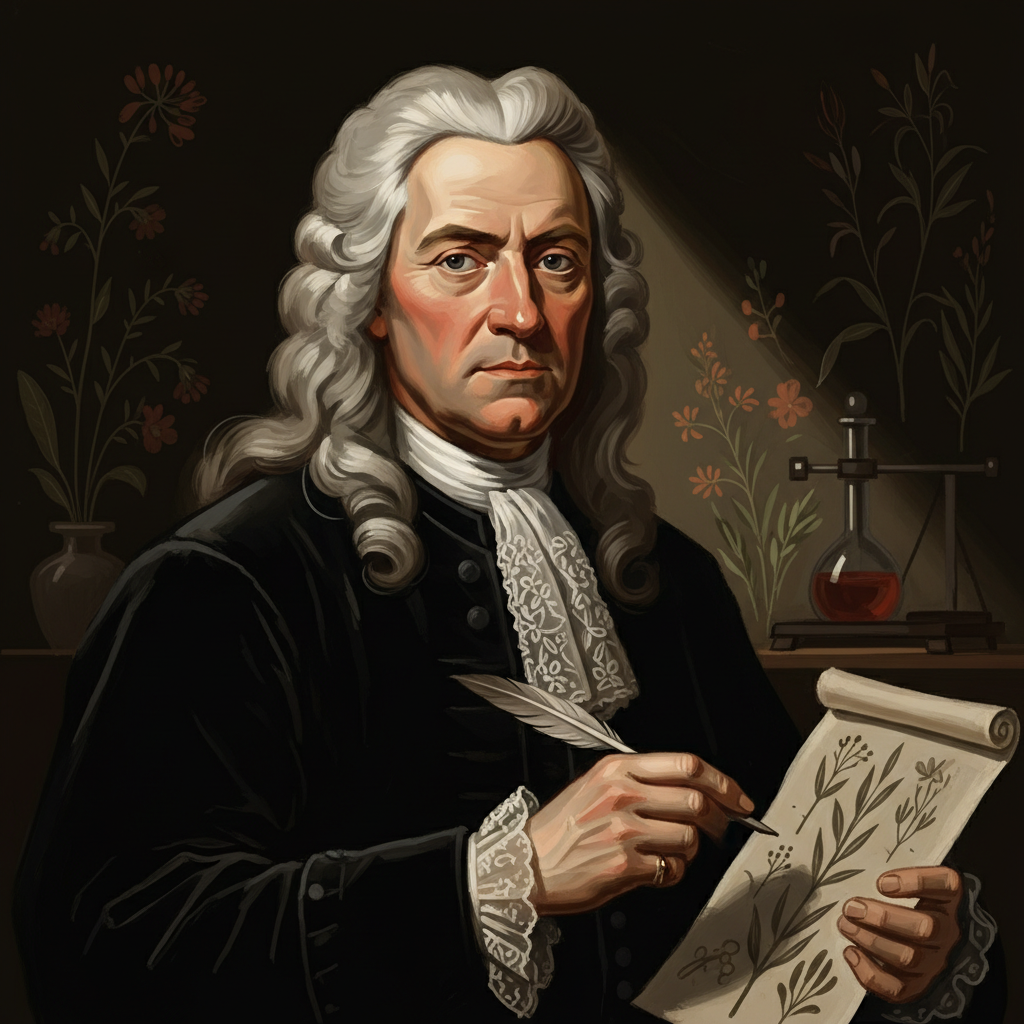
Carl Linnaeus — "Without names, knowledge is lost."
Without names, knowledge is lost.
Without names, knowledge is lost.
Click any product to generate a realistic preview. Up to 3 at a time.
* Initial load can take up to 90 seconds — revising the preview in another color is nearly instant.
"The earth is the theatre of God's glory."
"The more I study plants, the more I believe in God."
"God's wisdom is as infinite as His power."
"The Negro is a different species from the European."
"I saw the infinite, all-knowing and all-powerful God from behind as he went away, and I grew dizzy. I followed his footsteps over nature's fields and saw everywhere an eternal wisdom and power, an ins…"
Swedish botanist and the father of modern taxonomy whose Systema Naturae (1735) introduced binomial nomenclature for naming all species. Closely associated with Joseph Banks (British naturalist who carried Linnaean classification on Cook's voyages). For an intellectual contrast, see Comte de Buffon, French naturalist and Histoire Naturelle author (1749-1788) — Buffon explicitly attacked Linnaean fixed-categories taxonomy as artificial and rejected the binomial system; his gradualist, environment-shaped natural history was the explicit alternative. Anticipates the fixed-species-vs-evolution debate Darwin would later resolve.
Found in 1 providers: gemini
1 source checked
The quote asserts that naming is the prerequisite for organized knowledge. Without stable, shared names, discoveries cannot be communicated across languages or generations, ideas cannot be built upon, and understanding dissolves into chaos. It argues that classification — the act of naming — is not merely labeling but the very infrastructure of thought itself. Knowledge requires a common language to survive transmission between minds and across time.
Linnaeus built his entire career on this conviction. His binomial nomenclature system — giving every organism a two-part Latin name (genus and species) — solved centuries of chaos where the same plant carried dozens of regional names, making scientific exchange nearly impossible. His Systema Naturae (1735) and Species Plantarum (1753) unified natural history under a universal standard. He believed naming was the first act of science — without it, observation remained ephemeral and untransmittable.
The 18th-century Enlightenment was an age of frantic natural history exploration. European expeditions returned from the Americas, Africa, and Asia with thousands of undescribed species, while scholars across nations used incompatible local names for the same organisms. Scientific correspondence flourished, but a flower named one thing in Sweden carried a different name in France and another in England. Linnaeus's era desperately needed a universal naming system — his taxonomy provided exactly that solution.
AI-generated insights based on extensive research and information for context. Factual errors? Email [email protected].
Your cart is empty