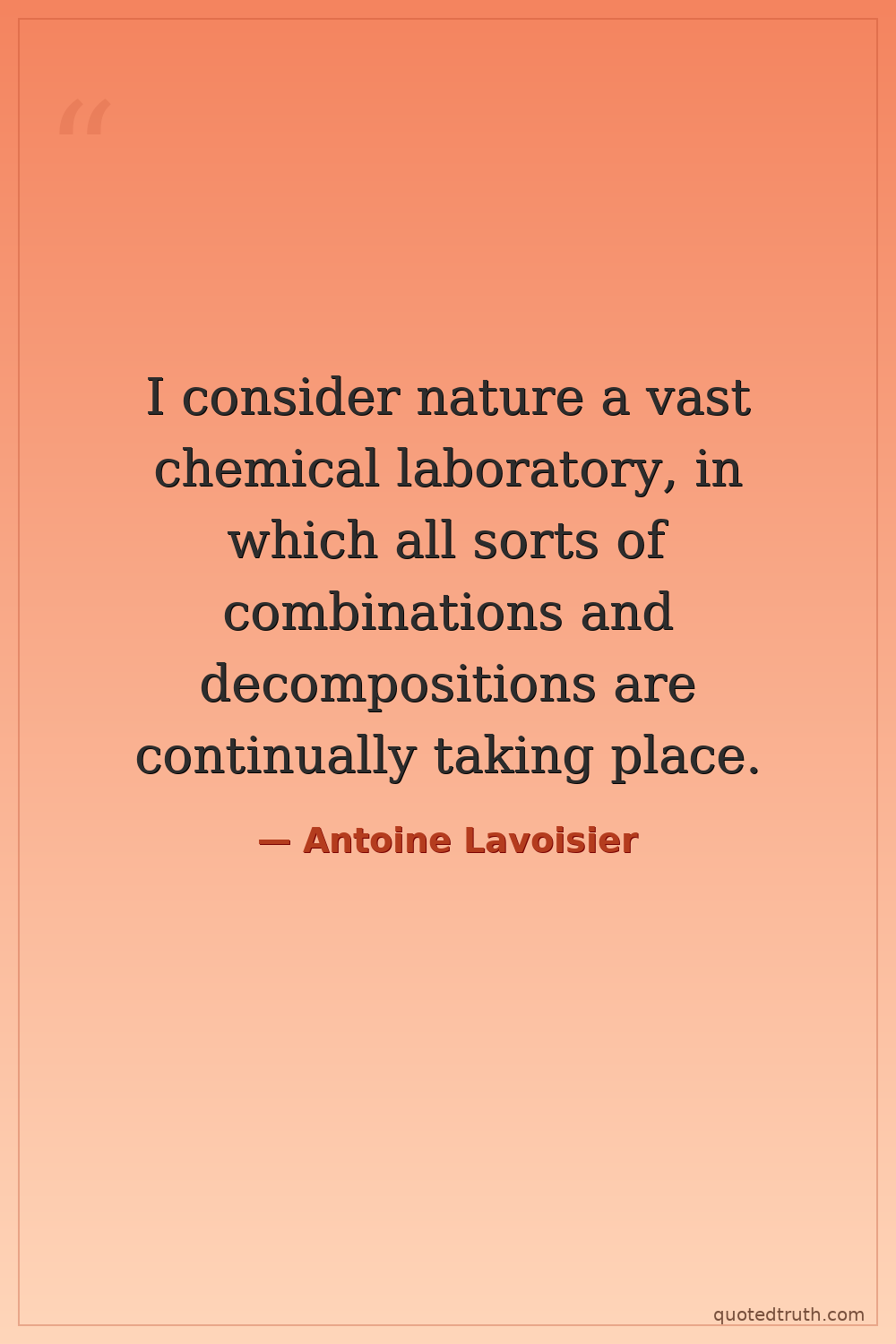
Antoine Lavoisier — "I consider nature a vast chemical laboratory, in which all sorts of combinations…"
I consider nature a vast chemical laboratory, in which all sorts of combinations and decompositions are continually taking place.
I consider nature a vast chemical laboratory, in which all sorts of combinations and decompositions are continually taking place.
Click any product to generate a realistic preview. Up to 3 at a time.
* Initial load can take up to 90 seconds — revising the preview in another color is nearly instant.
"The scientist should be a judge, not an advocate."
"The more I study, the more I am convinced of the existence of a superior intelligence."
"Nothing is created, either in the operations of art, or in those of nature; and it may be considered as a general principle that in every operation there exists an equal quantity of matter before and …"
"It is almost possible to predict one or two days in advance, within a rather broad range of probability, what the weather is going to be; it is even thought that it will not be impossible to publish d…"
"The universe is a machine, and we are its engineers."
Found in 1 providers: grok
1 source checked
Nature itself is one enormous chemistry experiment. Everywhere around us, substances are constantly combining into new compounds and breaking back apart into simpler pieces. Rivers, air, soil, living bodies, rocks weathering in rain, fires, digestion, rusting metal, all of it is chemistry happening without any human involvement. The natural world is not static scenery but an endless ongoing process of chemical change, and the same reactions we study in a lab are simply small versions of what nature is already doing on a vast scale.
Lavoisier built modern chemistry by insisting reactions obey measurable laws, most famously conservation of mass: matter is neither created nor destroyed, only rearranged. Seeing nature as a giant laboratory fits perfectly with that worldview. As a tax collector and agricultural reformer, he also studied respiration, fermentation, and soil chemistry, treating living processes as combustion and decomposition. The quote captures his central conviction that every natural phenomenon, from breathing to rusting, is chemistry, and that careful quantitative study can reveal its rules.
Late 18th century France was overturning old science. Alchemy and phlogiston theory still lingered, but Enlightenment thinkers demanded measurement, reason, and systematic classification. Lavoisier renamed the elements, disproved phlogiston, and published his Traité in 1789, the year the French Revolution began. Industry, mining, and agriculture were hungry for chemical knowledge about gunpowder, metals, and fertilizers. Treating nature as one continuous laboratory reflected the era's confidence that rational investigation, not ancient authority or mysticism, would finally unlock how the physical world actually worked.
AI-generated insights based on extensive research and information for context. Factual errors? Email [email protected].
Your cart is empty