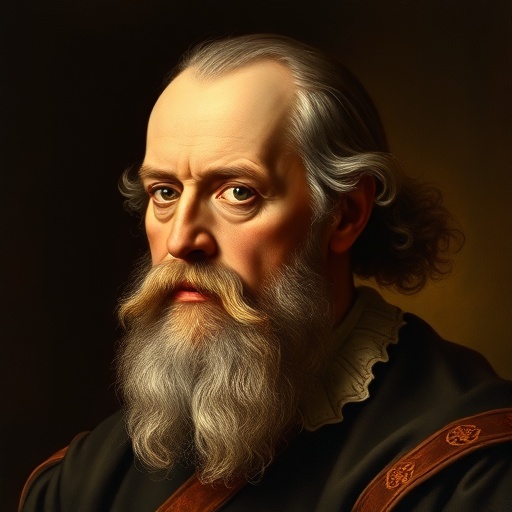
Galileo Galilei — "I consider the best judge to be the one who knows how to listen to both sides."
I consider the best judge to be the one who knows how to listen to both sides.
I consider the best judge to be the one who knows how to listen to both sides.
Click any product to generate a realistic preview. Up to 3 at a time.
* Initial load can take up to 90 seconds — revising the preview in another color is nearly instant.
"The sun, with all those planets revolving around it and dependent on it, can still ripen a bunch of grapes as if it had nothing else in the universe to do."
"I think that in the discussion of natural problems we ought not to begin at the authority of places of Scripture, but at sensible experiments and necessary demonstrations."
"The greater the number of people who believe a proposition, the more likely it is to be false."
"And finally, if the earth were to stop spinning, then the water in the oceans would fly off, and the mountains would crumble. So it must be moving."
"In questions of science, the authority of a thousand is not worth the humble reasoning of a single individual."
Found in 1 providers: grok
1 source checked
A fair judge withholds verdict until hearing all perspectives fully. True judgment requires active listening to opposing sides before reaching conclusions. This argues against prejudging based on reputation, authority, or first impressions alone — the quality of reasoning depends on the breadth of evidence considered, not the certainty with which one begins.
Galileo spent decades fighting institutional resistance from the Catholic Church and Aristotelian academics who refused to examine his telescopic evidence. He appeared before the Inquisition in 1633, denied a fair hearing. His heliocentrism was condemned by authorities who judged without genuinely engaging his observational data — making this principle deeply personal and professionally defining.
The early modern period saw entrenched scholastic authority suppress empirical inquiry. The Inquisition wielded judgment as ecclesiastical power, not impartial deliberation. Galileo's trial epitomized an era when dogma overrode evidence, and being heard by truly open arbiters was rare. The Scientific Revolution itself was a struggle to establish observation — not tradition — as the legitimate basis for judgment.
AI-generated insights based on extensive research and information for context. Factual errors? Email [email protected].
Your cart is empty