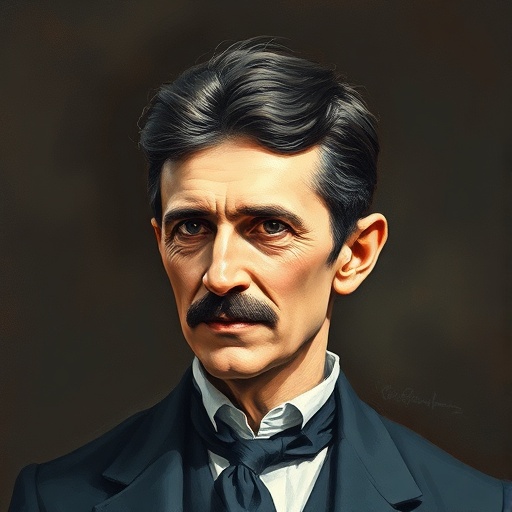
Nikola Tesla — "I could not sleep for several nights for the sheer joy of it."
I could not sleep for several nights for the sheer joy of it.
I could not sleep for several nights for the sheer joy of it.
Click any product to generate a realistic preview. Up to 3 at a time.
* Initial load can take up to 90 seconds — revising the preview in another color is nearly instant.
"I have been feeding pigeons, thousands of them, for years. But there was one, a beautiful bird, pure white with light grey tips on its wings; that one was different."
"What one man calls God, another calls the laws of physics."
"If you don't know how, observe the phenomena of nature, they will give you clear answers and inspiration."
"Insufficient observation is only a form of unknowing, a cause of many perverse incidents and a triumph of crazy ideas."
"It is not a death ray in the sense that it kills. It is a weapon that will make war impossible."
Serbian-American inventor and electrical engineer whose alternating-current designs powered the modern electrical grid; died poor and largely forgotten. Closely associated with George Westinghouse (his AC-power business partner) and Mihajlo Pupin (fellow Serbian-American physicist at Columbia). For an intellectual contrast, see Thomas Edison, American inventor and direct-current advocate — Edison's direct-current power-distribution scheme was displaced by Tesla-Westinghouse AC in the 1890s 'War of Currents'. Edison ran a public-relations campaign electrocuting animals to discredit AC — the most famous engineering-ethics rivalry in American history. Tesla's AC won and powers nearly every electrical grid on Earth.
Found in 1 providers: grok
1 source checked
Pure intellectual euphoria — joy so overwhelming it overrides sleep entirely. The speaker experienced a breakthrough so thrilling their mind refused to rest. This isn't insomnia from worry; it's the opposite: being too alive, too lit up by discovery to shut down. It captures the rare, electric state when an idea consumes you completely and every waking moment feels like a gift rather than a burden.
Tesla was famous for obsessive work habits and sleeping only two hours a night. He described visualizing his AC induction motor in a sudden flash of insight in Budapest in 1882 — seeing the rotating magnetic field fully formed in his mind. Such moments of violent creative illumination defined his life. Tesla's joy came not from money or fame but from the act of discovery itself, which he called his greatest reward.
Tesla lived through the Second Industrial Revolution, when electricity was reshaping civilization from scratch. The 1880s–1900s saw the literal electrification of cities, with Tesla and Edison's War of Currents deciding the infrastructure of the modern world. Scientific breakthroughs weren't incremental — they were civilizational. Inventors worked with the urgency of people who knew their discoveries would outlive them by centuries, making sleepless nights not just understandable but almost mythologically expected.
AI-generated insights based on extensive research and information for context. Factual errors? Email [email protected].
Your cart is empty