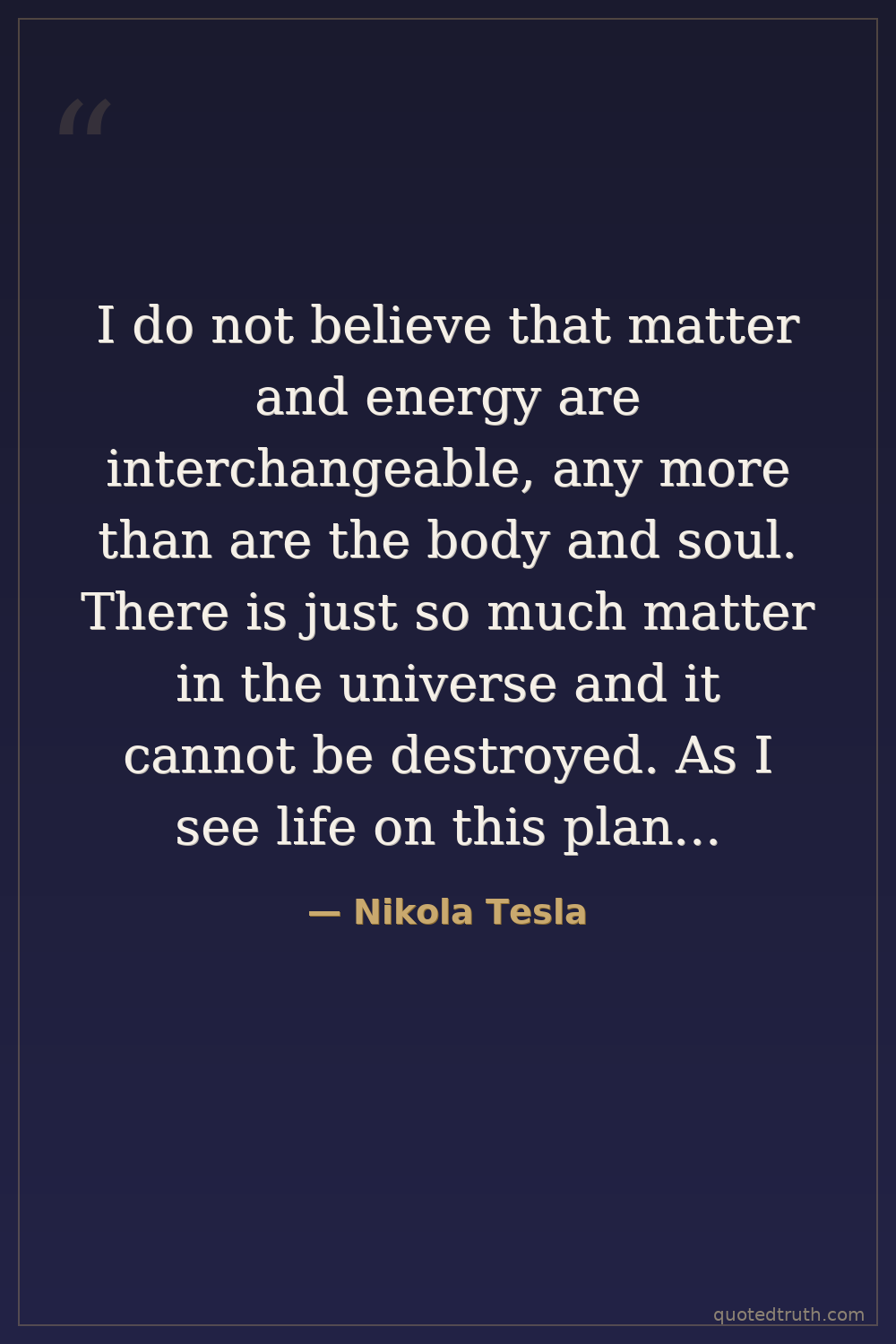
Nikola Tesla — "I do not believe that matter and energy are interchangeable, any more than are t…"

I do not believe that matter and energy are interchangeable, any more than are the body and soul. There is just so much matter in the universe and it cannot be destroyed. As I see life on this planet, there is no individuality. It may sound ridiculous to say so, but I believe each person is but a wave passing through space, ever-changing from minute to minute as it travels along, finally, some day, just becoming dissolved.
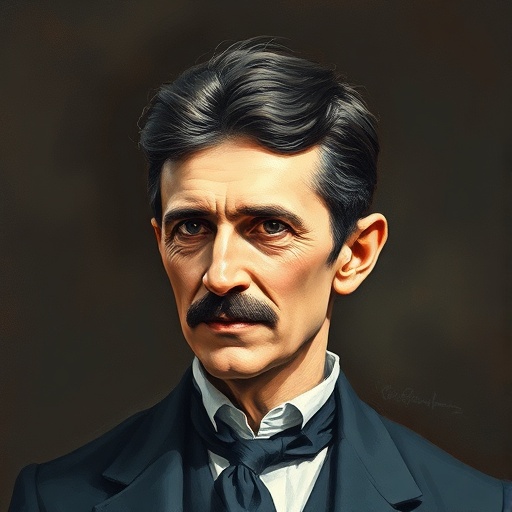
Nikola Tesla — Nikola Tesla Modern · AC electrical system, inventor

Get This Quote & Author's Image Illustrated On:

Click any product to generate a realistic preview. Up to 3 at a time.
* Initial load can take up to 90 seconds — revising the preview in another color is nearly instant.

Kitchen

Apparel

Other

About Nikola Tesla (1856-1943)

Serbian-American inventor and electrical engineer whose alternating-current designs powered the modern electrical grid; died poor and largely forgotten. Closely associated with George Westinghouse (his AC-power business partner) and Mihajlo Pupin (fellow Serbian-American physicist at Columbia). For an intellectual contrast, see Thomas Edison, American inventor and direct-current advocate — Edison's direct-current power-distribution scheme was displaced by Tesla-Westinghouse AC in the 1890s 'War of Currents'. Edison ran a public-relations campaign electrocuting animals to discredit AC — the most famous engineering-ethics rivalry in American history. Tesla's AC won and powers nearly every electrical grid on Earth.

Details

Deep, mind-bending, and controversial view on matter, energy, individuality, and the nature of existence.

Date: Approximate

Philosophical

Verification

Unverifiable

Found in 1 providers: gemini

1 source checked

Understanding this quote

What it means

Tesla argues that matter and energy are fundamentally separate — not interchangeable — and that matter itself is indestructible, conserved throughout the universe. More strikingly, he dismisses individual identity as illusion: each person is not a fixed, permanent self but a transient pattern, like a wave, continuously reshaping as it moves through time, eventually dissolving back into the larger whole. What we call a person is a temporary form, not a lasting entity.

Relevance to Nikola Tesla

Tesla spent his career mastering electromagnetic waves and oscillating currents, making the wave metaphor his natural lens for existence. He corresponded with Swami Vivekananda, absorbing Vedic ideas about prana and the impermanence of selfhood. Famously celibate and solitary, Tesla lived without conventional personal attachment, embodying his own philosophy of dissolved individuality. His open rejection of Einstein's mass-energy equivalence also reflects his lifelong resistance to theoretical physics he believed was mathematically elegant but physically unverifiable.

The era

Tesla made these remarks as Einstein's 1905 special relativity — including E=mc² — was actively reshaping physics, a framework Tesla publicly rejected. Simultaneously, Eastern philosophy was spreading through Western intellectual circles via the Theosophical Society and Vedanta movements. This collision between revolutionary Western science and ancient metaphysics created fertile ground for Tesla's unusual worldview: a pioneering electrical engineer who drew on Hindu cosmology to argue that consciousness, like current, dissolves but never truly disappears.

AI-generated insights based on extensive research and information for context. Factual errors? Email [email protected].
Your Cart

Your cart is empty