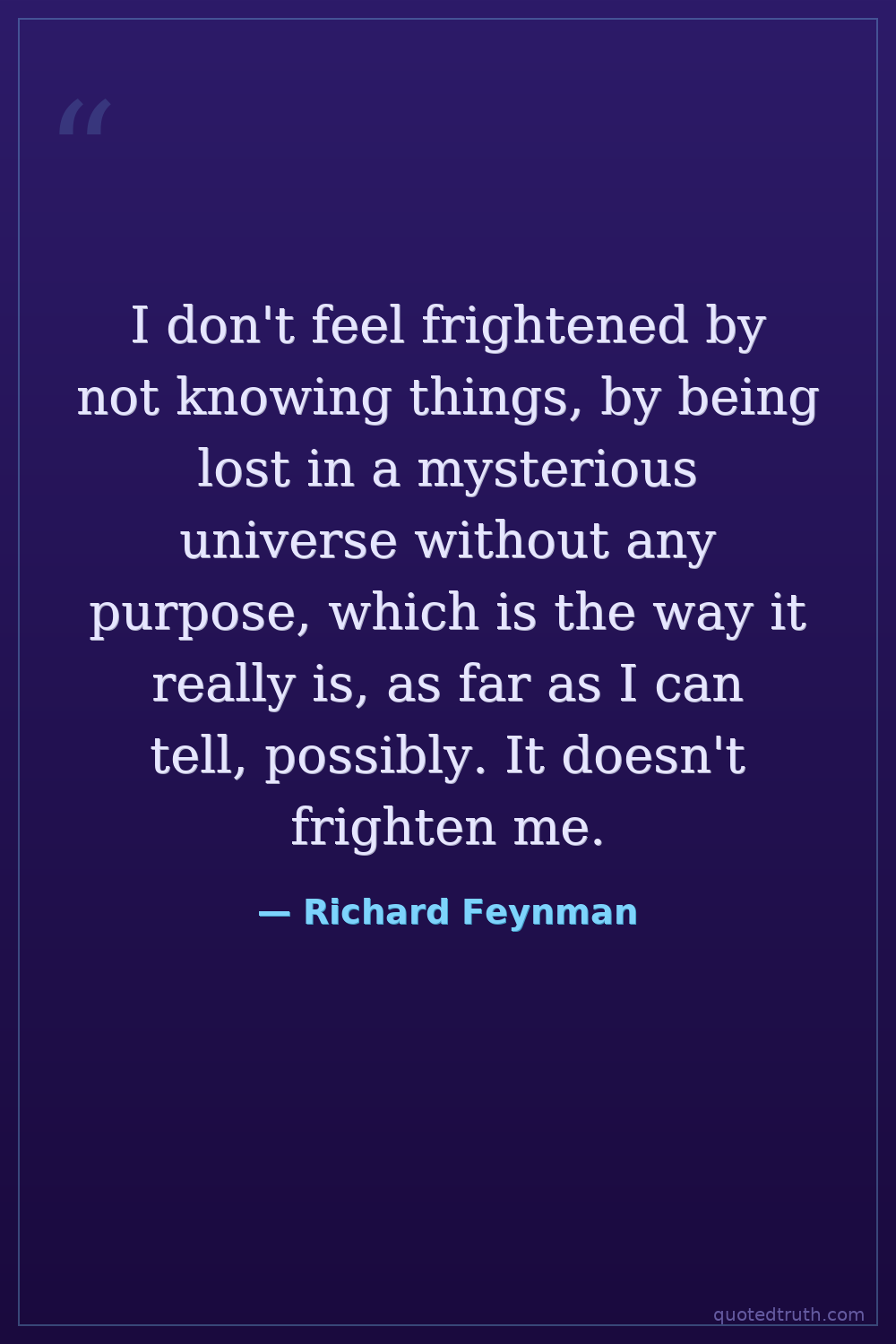
Richard Feynman — "I don't feel frightened by not knowing things, by being lost in a mysterious uni…"

I don't feel frightened by not knowing things, by being lost in a mysterious universe without any purpose, which is the way it really is, as far as I can tell, possibly. It doesn't frighten me.
Richard Feynman — Richard Feynman Modern · Quantum electrodynamics

Get This Quote & Author's Image Illustrated On:

Click any product to generate a realistic preview. Up to 3 at a time.
* Initial load can take up to 90 seconds — revising the preview in another color is nearly instant.

Kitchen

Apparel

Other

About Richard Feynman (1918-1988)

American theoretical physicist who shared the 1965 Nobel for QED, developed Feynman diagrams, and wrote the Feynman Lectures on Physics. Closely associated with Julian Schwinger (co-Nobelist for QED) and Murray Gell-Mann (Caltech rival and Eightfold-Way physicist). For an intellectual contrast, see Deepak Chopra, physician and quantum-mysticism author — Feynman's Caltech 'cargo cult science' commencement address is the precise template for what he saw as misuse of physics terminology — Chopra-style appropriation of quantum vocabulary for metaphysical claims is the canonical example of what Feynman called 'fooling yourself'.

Details

From 'The Pleasure of Finding Things Out'

Date: 1981

Inspirational

Verification

Unverifiable

Found in 1 providers: grok

1 source checked

Understanding this quote

What it means

Uncertainty and mystery about existence are not threats to be feared, but simply the honest reality of being human. Not knowing why the universe exists or what our purpose is doesn't need to be resolved before you can live fully. Accepting that some questions have no answers — and being comfortable with that — is intellectual maturity, not weakness or defeat.

Relevance to Richard Feynman

Feynman built his entire career on probing the deepest unknowns of physics — quantum electrodynamics, particle behavior, subatomic reality. He famously distrusted false certainty and pretentious explanation. His Caltech lectures, his 'Surely You're Joking' stories, and his Challenger investigation all show a man who thrived on open questions. Comfortable with 'I don't know' was his default scientific posture.

The era

Feynman worked through the Cold War, the atomic age, and the Space Race — an era when science was expected to provide definitive answers and national confidence. Existentialism was reshaping philosophy; Sputnik and nuclear anxiety made purposelessness terrifying to many. Against that backdrop, Feynman's calm acceptance of cosmic uncertainty was genuinely countercultural and grounding.

AI-generated insights based on extensive research and information for context. Factual errors? Email [email protected].
Your Cart

Your cart is empty