Richard Feynman — "I learned very early the difference between knowing the name of something and kn…"
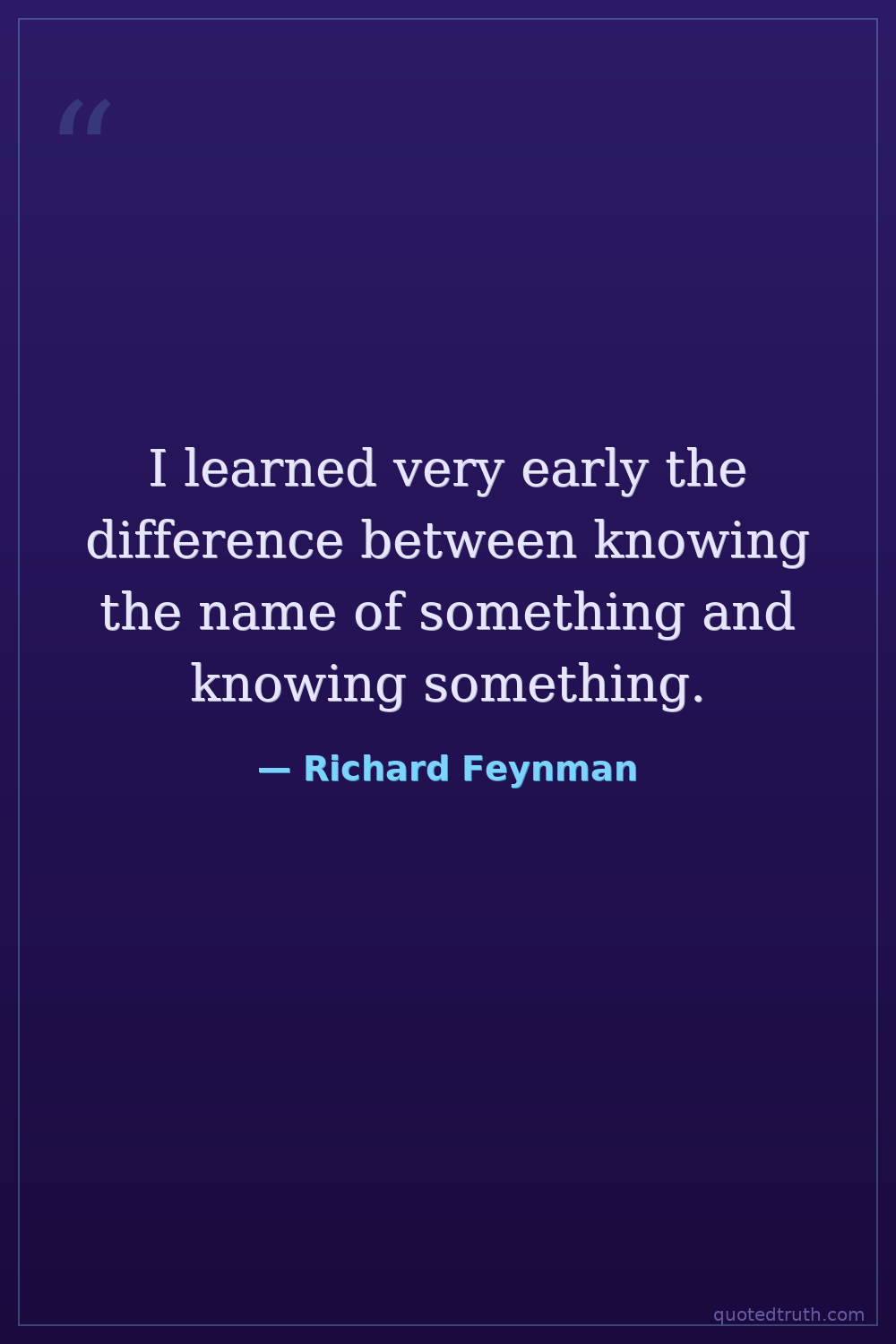
I learned very early the difference between knowing the name of something and knowing something.
I learned very early the difference between knowing the name of something and knowing something.
Click any product to generate a realistic preview. Up to 3 at a time.
* Initial load can take up to 90 seconds — revising the preview in another color is nearly instant.
"It doesn't seem to me that this fantastically marvelous universe, this tremendous range of time and space and different kinds of animals, and all the different planets, and all these atoms with all th…"
"The imagination of nature is far, far greater than the imagination of man."
"I don't know anything about anything."
"I was born with an ability to do mathematics, which is what they want in physics. I can think of problems and solve them. So what? I'm not very good at anything else. I can't dance, I can't sing, I ca…"
"I'm not a deep thinker. I'm a practical thinker."
American theoretical physicist who shared the 1965 Nobel for QED, developed Feynman diagrams, and wrote the Feynman Lectures on Physics. Closely associated with Julian Schwinger (co-Nobelist for QED) and Murray Gell-Mann (Caltech rival and Eightfold-Way physicist). For an intellectual contrast, see Deepak Chopra, physician and quantum-mysticism author — Feynman's Caltech 'cargo cult science' commencement address is the precise template for what he saw as misuse of physics terminology — Chopra-style appropriation of quantum vocabulary for metaphysical claims is the canonical example of what Feynman called 'fooling yourself'.
Found in 1 providers: grok
1 source checked
Labeling something doesn't mean you understand it. Knowing a word — a bird's name, a disease, a concept — gives you nothing about how it actually works, what causes it, or how it behaves. Real knowledge means grasping the underlying mechanism, the why and how, not just possessing a vocabulary term you can recite when asked.
Feynman's father taught him this lesson as a child, pointing to birds and explaining their behavior rather than just their names. It became central to his teaching philosophy and scientific method. As a Nobel-winning physicist who rebuilt quantum electrodynamics from first principles, Feynman was famous for refusing to accept jargon as understanding — he'd rederive everything himself rather than trust a label.
Post-WWII physics and academia were increasingly specialized and jargon-heavy. The Cold War arms race created pressure to produce technical credentials fast. Feynman stood against credentialism in an era of growing institutional science bureaucracy, where classification systems and terminology could substitute for genuine comprehension. His Caltech lectures in the 1960s deliberately stripped away received wisdom to rebuild understanding from scratch.
AI-generated insights based on extensive research and information for context. Factual errors? Email [email protected].
Your cart is empty