What it means
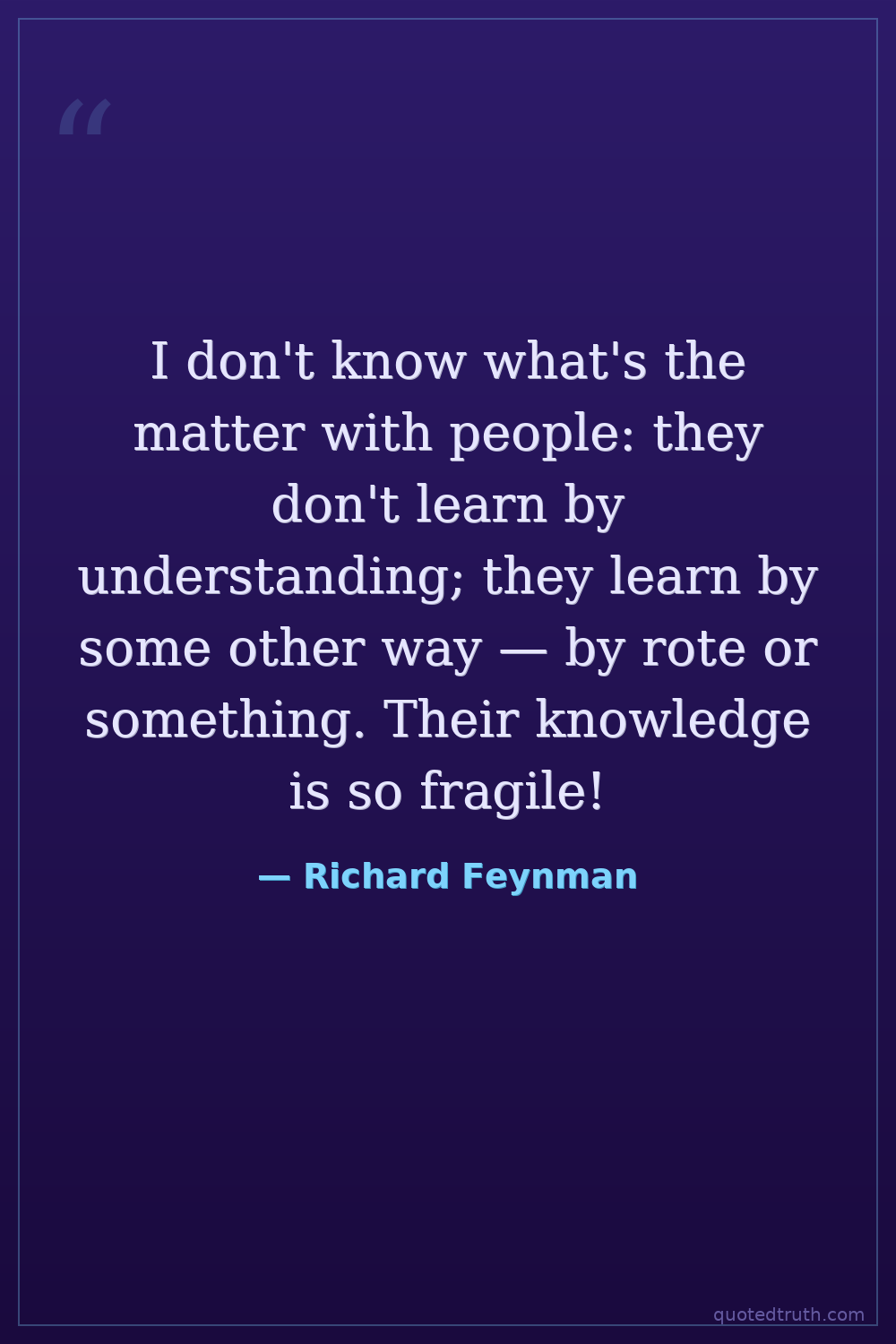
Most people memorize facts without grasping the underlying principles, leaving their knowledge brittle and easily forgotten. True understanding means being able to reconstruct what you know from first principles — if you can't explain why something works, you don't really know it. Rote learning creates an illusion of competence that collapses the moment conditions change or questions probe deeper than the memorized surface.
Relevance to Richard Feynman
Feynman was legendary for his 'first principles' thinking — he famously re-derived physics from scratch rather than memorizing textbooks. His Nobel Prize in quantum electrodynamics came from genuinely understanding nature, not reciting formulas. He created the Feynman Technique specifically to expose gaps in understanding. His Caltech lectures were designed to provoke real comprehension, and he was visibly frustrated by students who aced exams yet couldn't apply basic physics to novel problems.
The era
Post-WWII American education expanded rapidly through the GI Bill and Sputnik-driven STEM funding, flooding universities with students trained for standardized testing rather than deep reasoning. Cold War competition pressured schools toward measurable outputs — grades, degrees, credentials — over genuine comprehension. Feynman witnessed this at Caltech and in Brazil, where he found students could recite textbook passages perfectly but failed completely when asked to apply concepts to real physical situations.
AI-generated insights based on extensive research and information for context. Factual errors? Email [email protected].