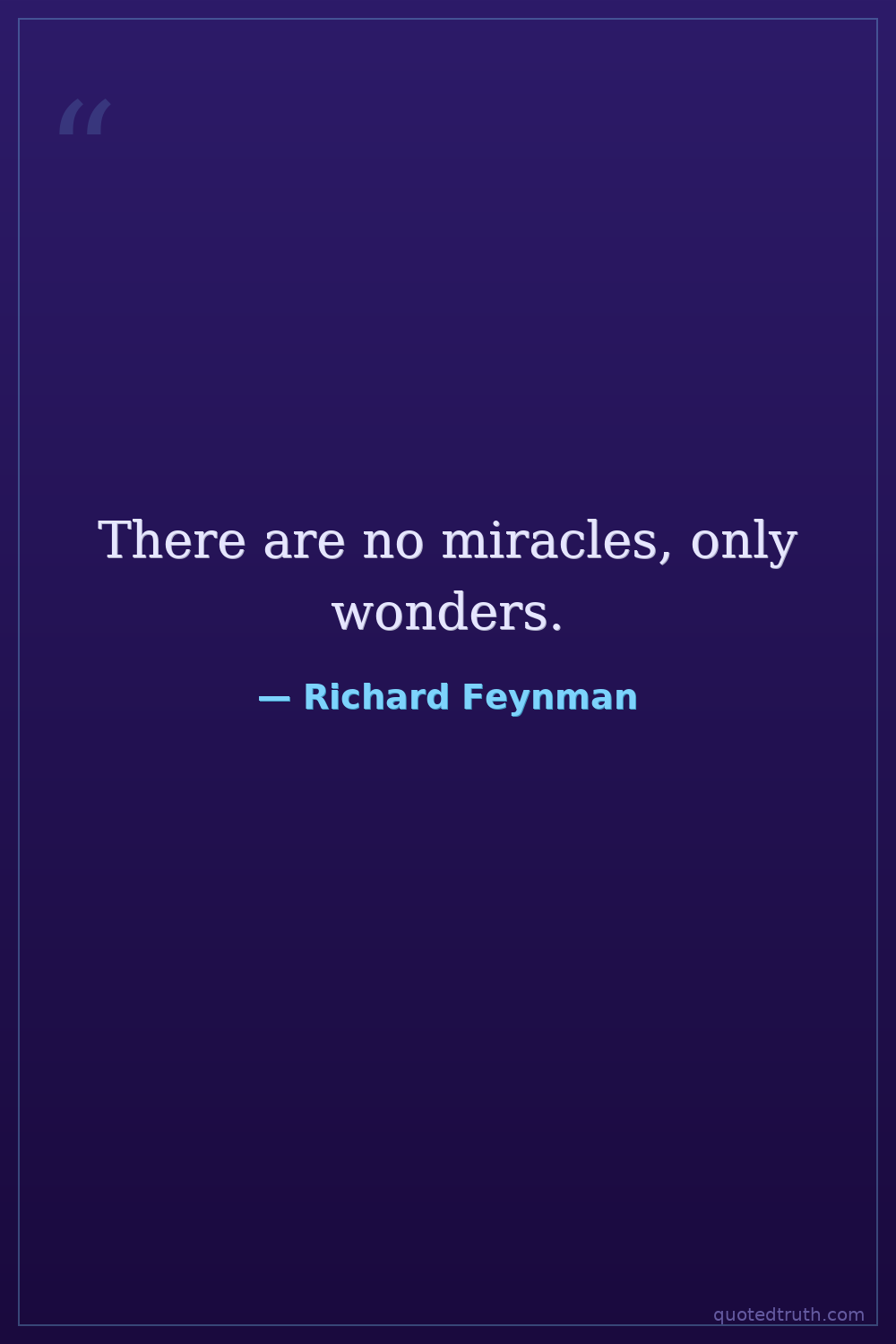
Richard Feynman — "There are no miracles, only wonders."
There are no miracles, only wonders.
There are no miracles, only wonders.
Click any product to generate a realistic preview. Up to 3 at a time.
* Initial load can take up to 90 seconds — revising the preview in another color is nearly instant.
"I have often thought that if there is any hell, it must be the place where there are no questions, only answers."
"I'm not a serious fellow."
"I don't want to be a part of the establishment. I want to be an outsider."
"I don't have to follow rules. I just have to find out what's true."
"What one fool can do, another can."
American theoretical physicist who shared the 1965 Nobel for QED, developed Feynman diagrams, and wrote the Feynman Lectures on Physics. Closely associated with Julian Schwinger (co-Nobelist for QED) and Murray Gell-Mann (Caltech rival and Eightfold-Way physicist). For an intellectual contrast, see Deepak Chopra, physician and quantum-mysticism author — Feynman's Caltech 'cargo cult science' commencement address is the precise template for what he saw as misuse of physics terminology — Chopra-style appropriation of quantum vocabulary for metaphysical claims is the canonical example of what Feynman called 'fooling yourself'.
Found in 1 providers: grok
1 source checked
The quote draws a firm line between supernatural intervention — miracles that break physical law — and genuine wonder, which is astonishment rooted in reality. Nothing violates nature's rules, yet that constraint doesn't flatten existence into the boring. The universe, examined honestly, is so strange and intricate that it surpasses anything invented mythology could offer. Awe doesn't require magic; it requires paying close attention to what is actually there.
Feynman built quantum electrodynamics, a theory predicting how light and matter interact with absurd precision — real phenomena stranger than any myth. He famously argued that understanding nature deepens rather than kills wonder. His Feynman Lectures made curiosity a moral stance. Deeply skeptical of authority and superstition, he demonstrated through bongo drums, safe-cracking, and Nobel-winning physics that reality, honestly examined, needs no supernatural supplement to be worthy of a lifetime of awe.
Feynman worked through the mid-20th century — Manhattan Project, Cold War, space race. Science simultaneously became humanity's greatest power and its deepest anxiety. Nuclear weapons, Sputnik, and quantum theory destabilized old certainties about God, nature, and human control. Religious and scientific worldviews clashed openly in public culture. In that charged climate, insisting wonder survives the elimination of miracles was a pointed philosophical stance: trust evidence, not doctrine, for your sense of astonishment.
AI-generated insights based on extensive research and information for context. Factual errors? Email [email protected].
Your cart is empty