What it means
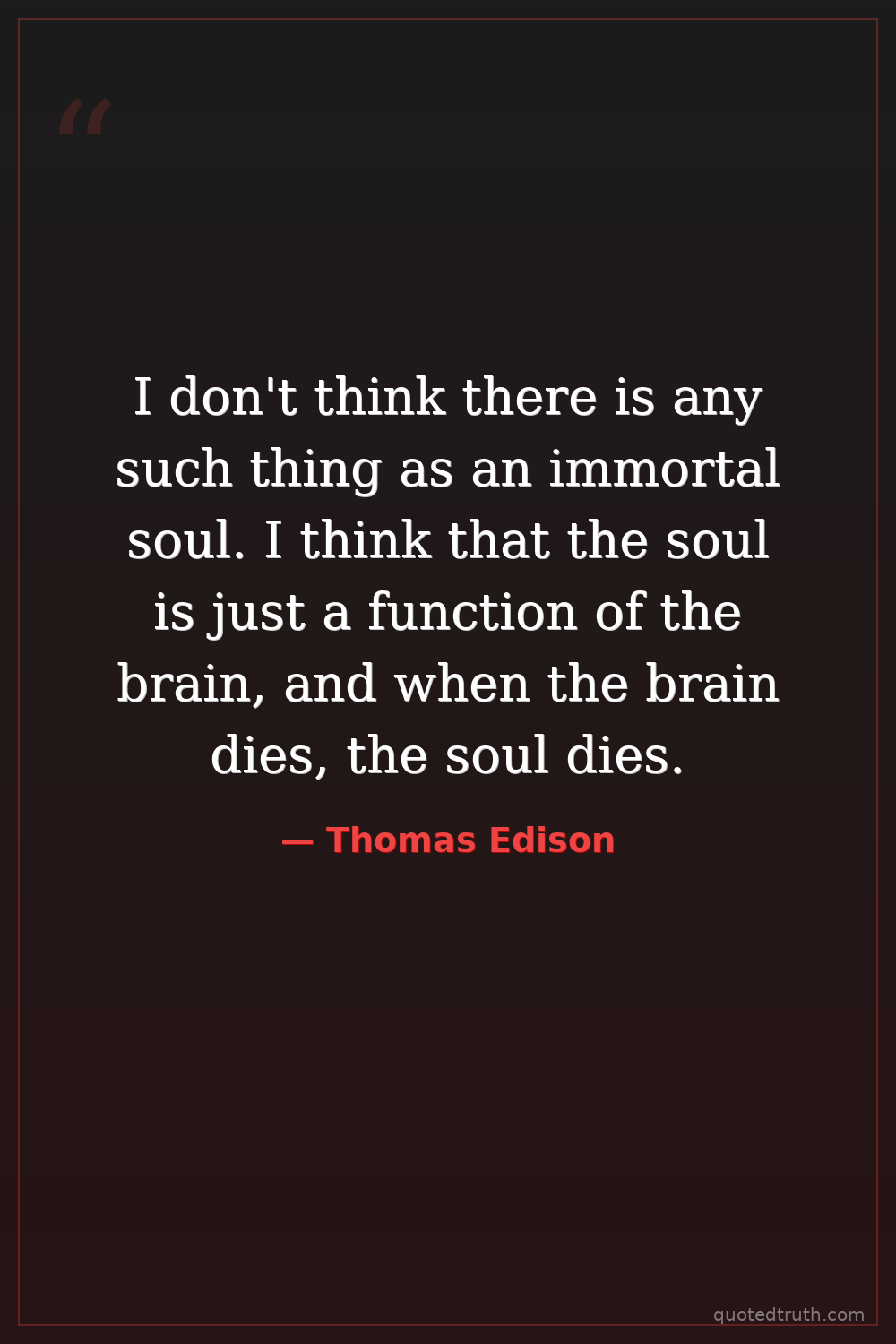
There is no permanent, eternal essence that survives death. The soul is not a supernatural entity but rather an emergent product of brain activity — consciousness, memory, personality. When the physical organ stops functioning permanently, everything we call the self ceases to exist. This is a materialist view: mind is matter, nothing more, and death is final rather than a transition to another existence.
Relevance to Thomas Edison
Edison was a relentless empiricist who trusted measurable evidence over tradition or dogma. He famously experimented obsessively — over 10,000 attempts on the lightbulb alone — believing reality was something you test, not accept on faith. This rejection of an immortal soul aligns with his scientific worldview: if it cannot be demonstrated or measured, Edison was deeply skeptical. His atheistic materialism was consistent with his lifelong method.
The era
Edison lived during late 19th and early 20th century America, when Darwinian evolution had recently upended religious certainty and scientific materialism was gaining serious intellectual credibility. Debates between faith and empiricism were fierce and public. Figures like Huxley, Spencer, and Ingersoll challenged supernatural beliefs openly. Edison's statement was culturally provocative in a deeply religious society, yet reflected a growing current of secular scientific thought reshaping Western civilization.
AI-generated insights based on extensive research and information for context. Factual errors? Email [email protected].