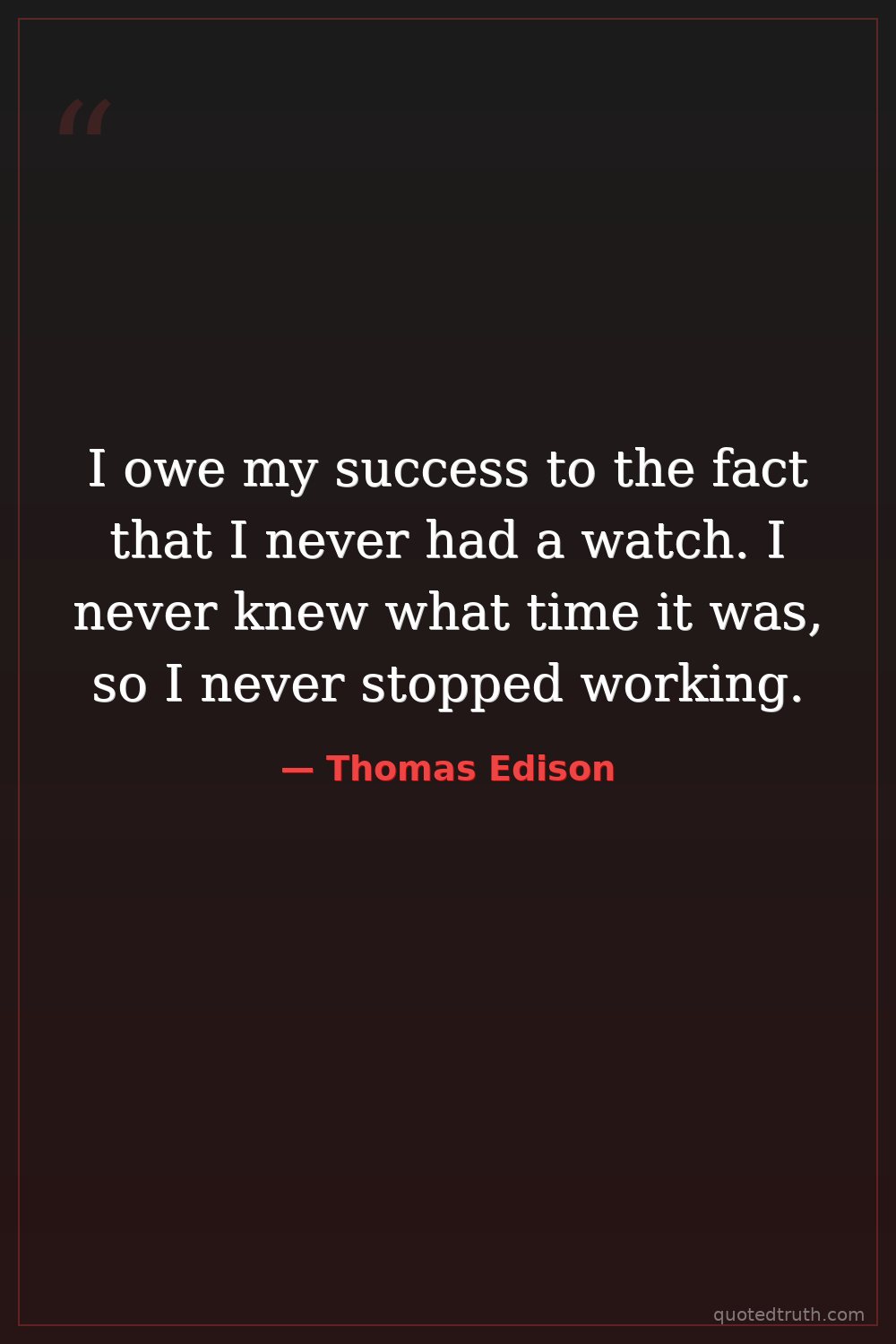
Thomas Edison — "I owe my success to the fact that I never had a watch. I never knew what time it…"
I owe my success to the fact that I never had a watch. I never knew what time it was, so I never stopped working.
I owe my success to the fact that I never had a watch. I never knew what time it was, so I never stopped working.
Click any product to generate a realistic preview. Up to 3 at a time.
* Initial load can take up to 90 seconds — revising the preview in another color is nearly instant.
"Non-violence leads to the highest ethics, which is the goal of all evolution. Until we stop harming all other living beings, we are still savages."
"I have always been a great admirer of women. I think they are the most wonderful creatures on earth. I think they are more intelligent than men. I think they are more capable than men. I think they ar…"
"There's a way to do it better - find it."
"I am long on ideas, but short on time. I expect to live only to 100."
"I have a theory that the human voice is immortal. It is a form of energy that never dies. It just changes form. I believe that we can record the voices of the dead and play them back."
Found in 1 providers: grok
1 source checked
Success came from ignoring the clock. Without a watch to tell him when to stop, break, or sleep, he kept working past normal quitting times. The idea is that fixed schedules cap output, while time-blindness lets effort compound. Strip away the artificial markers that tell you the day is over, and you get more done than people watching minutes tick by.
Edison ran his Menlo Park lab on famously brutal hours, often working 18–20 hour days and napping on workbenches rather than going home. He filed 1,093 patents, including the phonograph and practical incandescent bulb, by outlasting competitors. He openly dismissed regular sleep as wasteful and pushed assistants through all-night sessions, making this quote a literal description of how his 'invention factory' actually operated.
Edison worked from the 1870s through the 1920s, when the electric light he commercialized was itself dissolving the boundary between day and night labor. Factories were shifting from sunrise-to-sunset rhythms to clock-timed shifts, and Frederick Taylor's scientific management was turning minutes into units of productivity. Edison's anti-watch boast pushed back against that timed discipline while simultaneously embodying the Gilded Age ideal of the self-made industrialist whose output justified any personal cost.
AI-generated insights based on extensive research and information for context. Factual errors? Email [email protected].
Your cart is empty