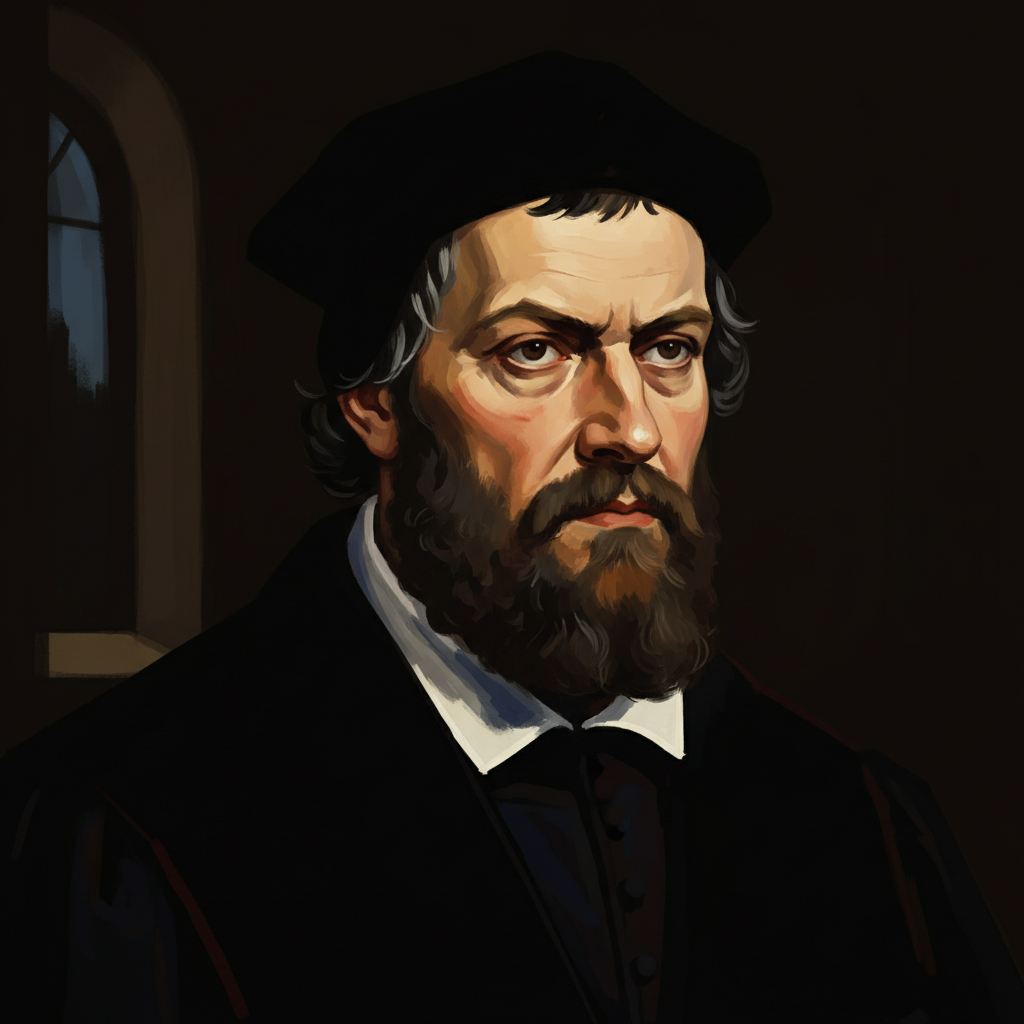
Martin Luther — "I feel much freer now that I am certain the pope is the Antichrist."
I feel much freer now that I am certain the pope is the Antichrist.
I feel much freer now that I am certain the pope is the Antichrist.
Click any product to generate a realistic preview. Up to 3 at a time.
* Initial load can take up to 90 seconds — revising the preview in another color is nearly instant.
"Where God builds a church, the Devil builds a chapel."
"I am a man of contention, and I thank God for it."
"Sometimes it is necessary to commit some sin out of hatred and contempt for the Devil."
"If you want to have a good laugh, read the Papal Bulls. They are so full of nonsense that they will make you split your sides."
"What is worse, the Jews, in their synagogues, curse our Lord Jesus Christ and Mary His mother, and call her a whore, and Christ a mamzer [bastard], that is, a son of a whore."
German theologian whose 95 Theses (1517) launched the Protestant Reformation and broke the Catholic Church's monopoly on Western Christianity. Closely associated with Philipp Melanchthon (Lutheran systematizer) and John Calvin (later Reformer who built on Luther's break). For an intellectual contrast, see Pope Leo X, Renaissance pope (1513-1521) — Leo X's indulgence sales triggered Luther's break and Leo excommunicated him in 1521 — Luther's entire Reformation is structured as a direct answer to the indulgence-funded Vatican Leo represented.
Found in 1 providers: gemini
1 source checked
Luther is expressing relief and liberation that comes from identifying what he considers the ultimate source of spiritual corruption. Once he named the papacy as the Antichrist, his doubts and hesitation dissolved. Naming the enemy clarified his mission and removed any lingering obligation to submit to Rome's authority. The certainty gave him courage to break fully from the Catholic Church without guilt or second-guessing his conscience.
Luther spent years as a devoted Augustinian monk wrestling with papal authority before his 1517 Ninety-Five Theses sparked the Reformation. After his 1521 excommunication and the Diet of Worms, he grew increasingly radical, publishing tracts explicitly labeling the pope as Antichrist. This framing became central to his theology and justified his rejection of indulgences, papal supremacy, and Church tradition in favor of sola scriptura and salvation by faith alone.
The early 16th century saw a corrupt Renaissance papacy selling indulgences to fund St. Peter's Basilica, while the printing press let dissenting ideas spread rapidly across Europe. Apocalyptic expectation was widespread, and calling someone the Antichrist carried enormous theological weight. The Holy Roman Empire was fracturing along religious lines, German princes resented Roman taxation, and Luther's branding of the pope as Antichrist crystallized grievances that ignited decades of religious warfare.
AI-generated insights based on extensive research and information for context. Factual errors? Email [email protected].
Your cart is empty