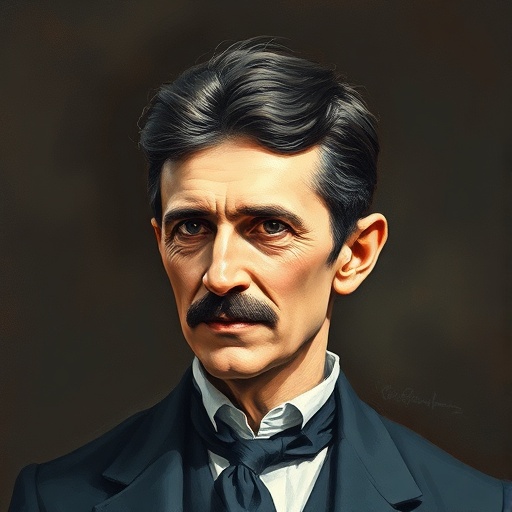
Nikola Tesla — "I felt that I could not touch the hair of other people, except with gloves."
I felt that I could not touch the hair of other people, except with gloves.
I felt that I could not touch the hair of other people, except with gloves.
Click any product to generate a realistic preview. Up to 3 at a time.
* Initial load can take up to 90 seconds — revising the preview in another color is nearly instant.
"I have no doubt that some of my ideas will be misinterpreted, misrepresented, and even ridiculed."
"The theory of relativity is a mass of errors and deceptive ideas violently opposed to the teachings of the great men of science of the past and even to common sense."
"The opinion of the world does not affect me. I have placed as the real values in my life what follows when I am dead."
"I see no reason why a man should not be able to transmit his thoughts to another across the ocean."
"Not by a jugfull, I am enjoying myself."
Serbian-American inventor and electrical engineer whose alternating-current designs powered the modern electrical grid; died poor and largely forgotten. Closely associated with George Westinghouse (his AC-power business partner) and Mihajlo Pupin (fellow Serbian-American physicist at Columbia). For an intellectual contrast, see Thomas Edison, American inventor and direct-current advocate — Edison's direct-current power-distribution scheme was displaced by Tesla-Westinghouse AC in the 1890s 'War of Currents'. Edison ran a public-relations campaign electrocuting animals to discredit AC — the most famous engineering-ethics rivalry in American history. Tesla's AC won and powers nearly every electrical grid on Earth.
Reported idiosyncrasy, mentioned in biographies like 'Prodigal Genius' by O'Neill.
Date: Throughout his adult life
GeneralFound in 1 providers: grok
1 source checked
A visceral aversion to touching other people's hair without a protective barrier — expressing a compulsive need to separate oneself from physical contact with others' bodies. In modern terms this describes mysophobia (contamination fear) or sensory processing sensitivity: the feeling that direct tactile contact with another person is intolerable without a buffer. It captures extreme bodily boundary-consciousness and the discomfort of perceiving other humans as physically threatening or repulsive.
Tesla was famously mysophobic and showed clear obsessive-compulsive traits throughout his life. He detested touching hair, pearls, and round objects, avoided handshakes, counted his steps, and performed entry rituals before buildings. His compulsions coexisted with his genius — rigid self-imposed rules may have focused his mind on electromagnetic research. These tendencies intensified with age; he spent his final decades in deliberate isolation in a New York hotel room, refusing most physical contact entirely.
Tesla lived through the germ theory revolution — Pasteur and Koch had newly proven microbes cause disease, triggering widespread hygiene anxiety across Western culture. Public health campaigns promoted cleanliness as moral virtue. The 1918 influenza pandemic killed 50 million globally, validating contact-transmission fears. Yet obsessive-compulsive behavior had no clinical framework then; what we now recognize as OCD or sensory processing disorder was simply labeled eccentricity or nervous temperament, offering no treatment or understanding for Tesla's suffering.
AI-generated insights based on extensive research and information for context. Factual errors? Email [email protected].
Your cart is empty