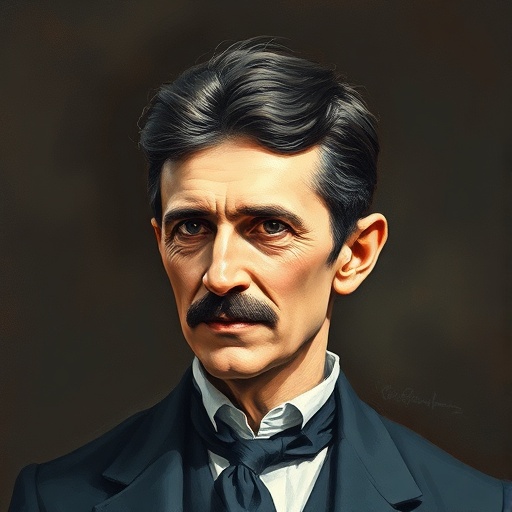
Nikola Tesla — "I have no doubt that some of my ideas will be misinterpreted, misrepresented, an…"
I have no doubt that some of my ideas will be misinterpreted, misrepresented, and even ridiculed.
I have no doubt that some of my ideas will be misinterpreted, misrepresented, and even ridiculed.
Click any product to generate a realistic preview. Up to 3 at a time.
* Initial load can take up to 90 seconds — revising the preview in another color is nearly instant.
"The idea of atomic energy is illusionary but it has taken so powerful a hold on the minds, that although I have preached against it for twenty-five years, there are still some who believe it to be rea…"
"I felt that I could not touch the hair of other people, except with gloves."
"I am a man of science, not a politician."
"If the genius of invention were to reveal to-morrow the secret of immortality, of eternal beauty and youth, for which all humanity is aching, the same inexorable agents which prevent a mass from chang…"
"We must all have some ideal which will govern our behaviour and satisfy us, but it is not material. It can be religion, art, science, whatever, it is only important that it acts as a non-material forc…"
Serbian-American inventor and electrical engineer whose alternating-current designs powered the modern electrical grid; died poor and largely forgotten. Closely associated with George Westinghouse (his AC-power business partner) and Mihajlo Pupin (fellow Serbian-American physicist at Columbia). For an intellectual contrast, see Thomas Edison, American inventor and direct-current advocate — Edison's direct-current power-distribution scheme was displaced by Tesla-Westinghouse AC in the 1890s 'War of Currents'. Edison ran a public-relations campaign electrocuting animals to discredit AC — the most famous engineering-ethics rivalry in American history. Tesla's AC won and powers nearly every electrical grid on Earth.
Found in 1 providers: grok
1 source checked
Bold, original ideas face a predictable gauntlet: misreading by those who lack context, distortion by those with competing interests, and mockery from those threatened by change. Genuine innovation runs ahead of consensus, making it temporarily incomprehensible to most audiences. Accepting that ridicule is part of the process — not evidence of being wrong — is the mindset that allows a thinker to keep working despite hostile reception.
Tesla experienced this directly. Thomas Edison waged a coordinated smear campaign against AC power during the War of Currents, staging public animal electrocutions to frame Tesla's system as deadly. His wireless power vision — the Wardenclyffe Tower project — was defunded by JP Morgan once it became clear the technology couldn't be metered for profit. He died in 1943 in a New York hotel room, alone and nearly penniless, his grandest ideas still unrealized.
Tesla's peak years spanned the 1880s through 1910s — the Gilded Age, when industrial monopolies and wealthy financiers dictated which technologies reached market. Edison's direct-current infrastructure represented enormous capital investment that AC threatened to obsolete. Scientific establishment gatekeeping was fierce; ideas without immediate commercial applications were dismissed as impractical. Public understanding of electricity was minimal, making complex innovations easy targets for deliberate misrepresentation by well-funded competitors.
AI-generated insights based on extensive research and information for context. Factual errors? Email [email protected].
Your cart is empty