What it means
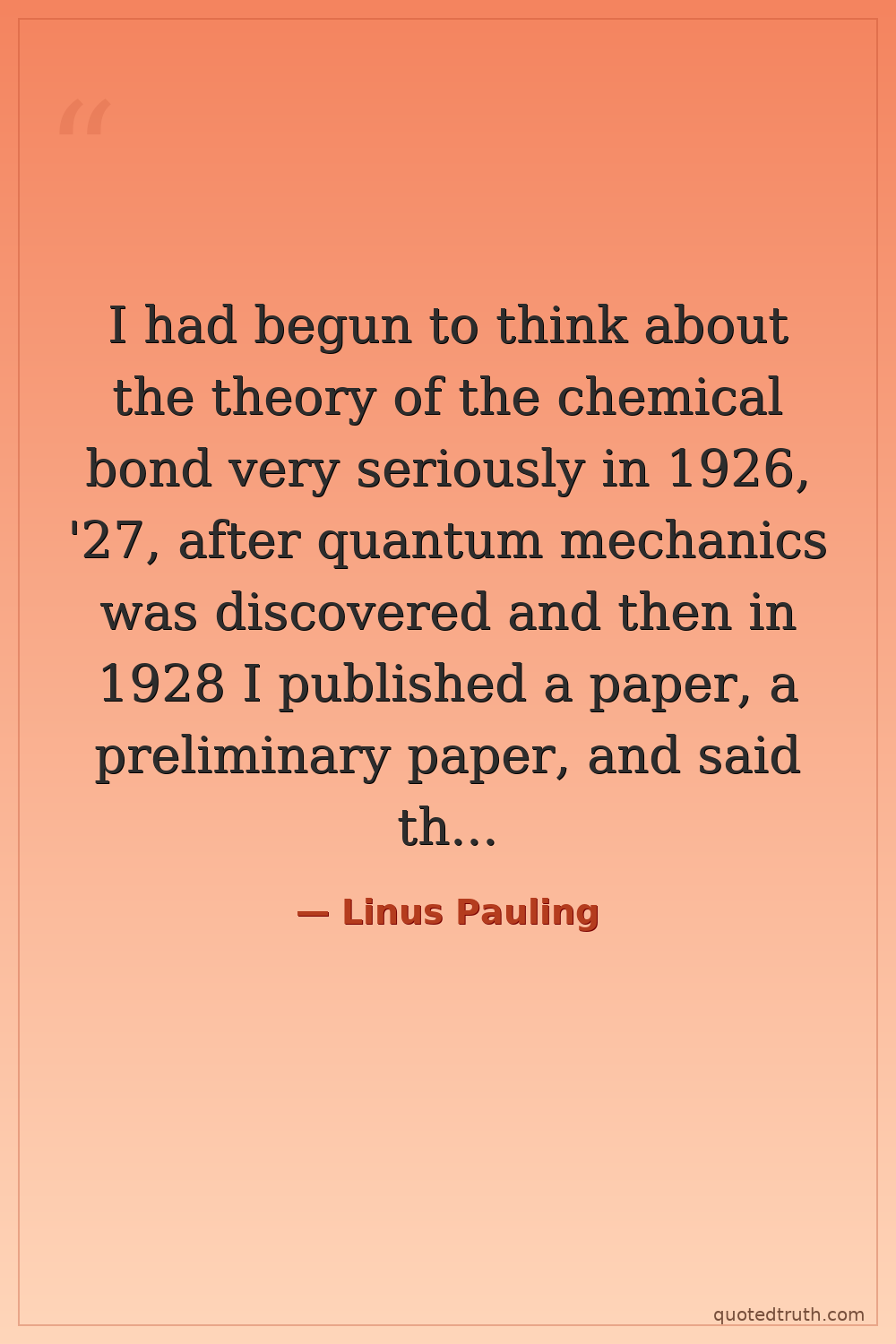
Pauling describes how he eagerly set out to apply the newly discovered quantum mechanics to explain chemical bonding, announced ambitious plans, then spent three years in silence because the underlying mathematics proved far harder than anticipated. Genuine scientific progress requires confronting problems that resist easy solutions, and premature publication promises can be humbled by reality's complexity.
Relevance to Linus Pauling
Pauling's entire career centered on understanding the chemical bond — his 1939 book became foundational. This admission reveals his intellectual honesty and rigor: he publicly committed to follow-up work, hit a mathematical wall, and refused to publish half-solutions. His eventual breakthroughs, including the nature of the chemical bond and protein structures, emerged from exactly this patient, uncompromising approach.
The era
Quantum mechanics was revolutionizing physics in 1926-28, with Schrödinger and Heisenberg publishing landmark papers. Scientists worldwide scrambled to apply these new tools to chemistry and atomic structure. The mathematical formalism — wave equations, matrix mechanics — was genuinely novel and difficult even for trained physicists, making Pauling's three-year struggle representative of an entire generation wrestling with an unprecedented intellectual frontier.
AI-generated insights based on extensive research and information for context. Factual errors? Email [email protected].