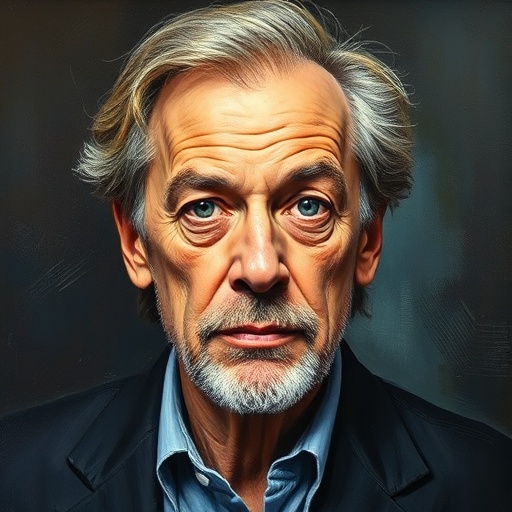
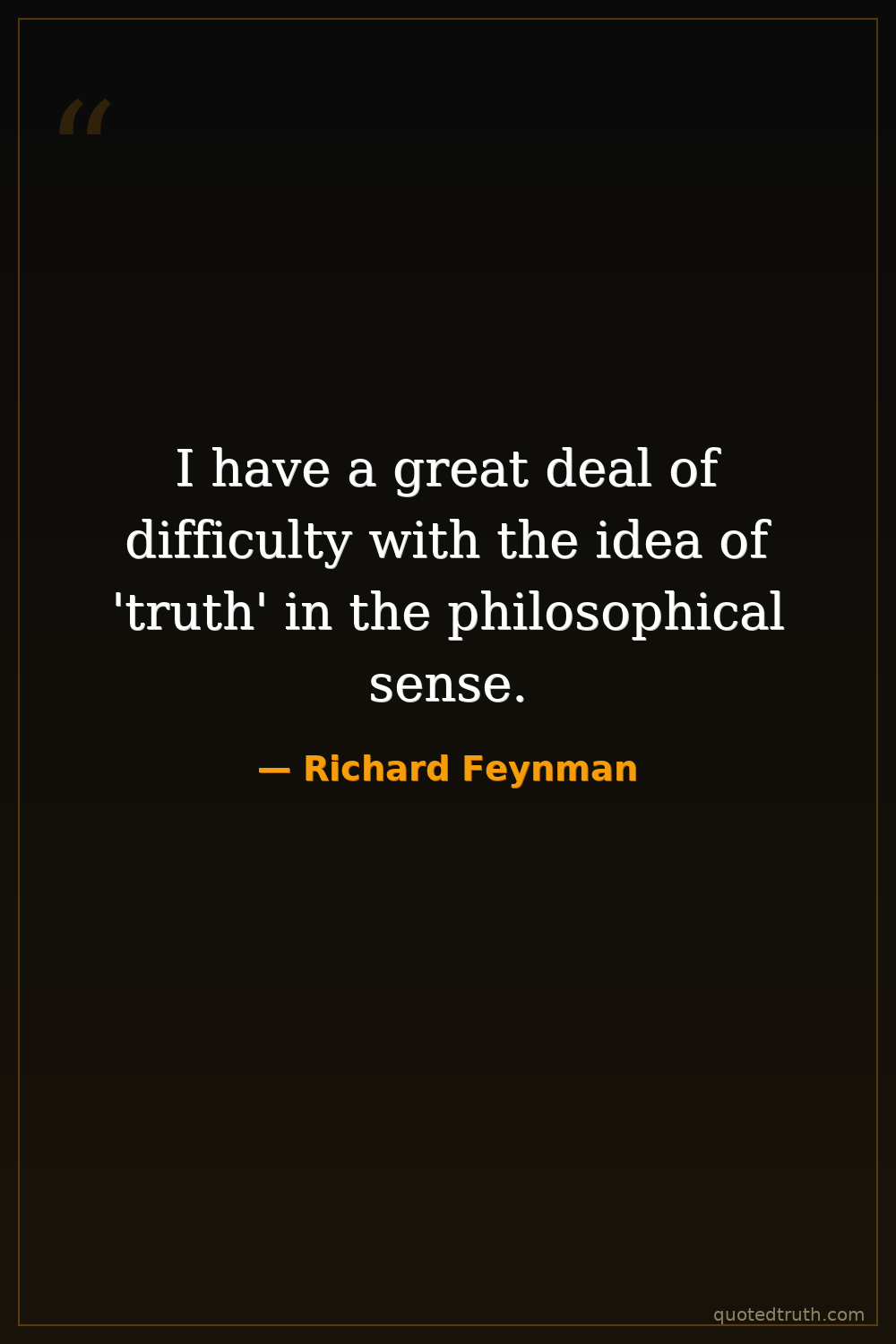
Richard Feynman — "I have a great deal of difficulty with the idea of 'truth' in the philosophical …"
I have a great deal of difficulty with the idea of 'truth' in the philosophical sense.
I have a great deal of difficulty with the idea of 'truth' in the philosophical sense.
Click any product to generate a realistic preview. Up to 3 at a time.
* Initial load can take up to 90 seconds — revising the preview in another color is nearly instant.
"I don't understand the world in the way that I think other people claim to understand it."
"The more you learn, the more you learn how little you know."
"Study hard what interests you the most in the most undisciplined, irreverent and original manner possible."
"The game is to find out how nature works."
"You know, the dumbest goddamn student you ever saw can understand things if you explain them right. So if you can’t explain it, it’s because you don’t understand it."
American theoretical physicist who shared the 1965 Nobel for QED, developed Feynman diagrams, and wrote the Feynman Lectures on Physics. Closely associated with Julian Schwinger (co-Nobelist for QED) and Murray Gell-Mann (Caltech rival and Eightfold-Way physicist). For an intellectual contrast, see Deepak Chopra, physician and quantum-mysticism author — Feynman's Caltech 'cargo cult science' commencement address is the precise template for what he saw as misuse of physics terminology — Chopra-style appropriation of quantum vocabulary for metaphysical claims is the canonical example of what Feynman called 'fooling yourself'.
Found in 1 providers: grok
1 source checked
Feynman rejects the idea that truth is some fixed, abstract thing philosophers debate endlessly. Instead, he sees truth as provisional — something earned through experiment, measurement, and honest doubt. Certainty claimed without evidence is suspect. Real understanding means staying comfortable with not knowing, and updating beliefs when evidence demands it. Truth isn't a destination; it's a practice of rigorous, humble inquiry.
Feynman built his career on quantum electrodynamics — predicting particle behavior with extraordinary precision through calculation and experiment. He famously refused intellectual posturing, dismantling the Space Shuttle Challenger investigation with a cup of ice water. His Caltech lectures celebrated uncertainty as a scientific virtue. Philosophical 'truth' felt too static and uncheckable for a man who trusted only what nature itself confirmed through measurement.
Feynman worked through mid-20th century physics — the Cold War era when science carried enormous cultural authority yet also existential weight after Hiroshima. Logical positivism and linguistic philosophy dominated academia, often trading in unfalsifiable abstractions. The scientific community was simultaneously celebrated and feared. Feynman's skepticism toward philosophical truth was partly a reaction against grandiose theoretical claims untethered from experimental verification.
AI-generated insights based on extensive research and information for context. Factual errors? Email [email protected].
Your cart is empty