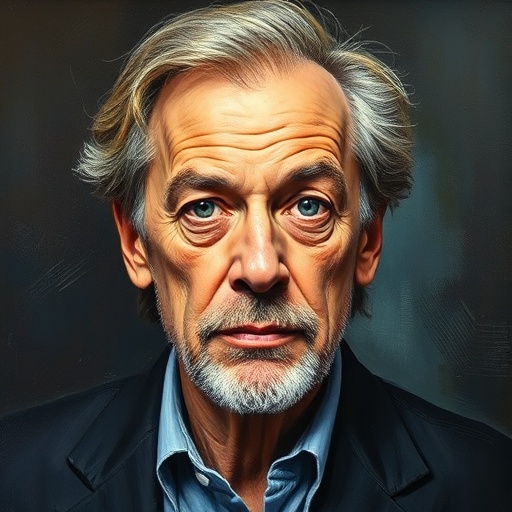
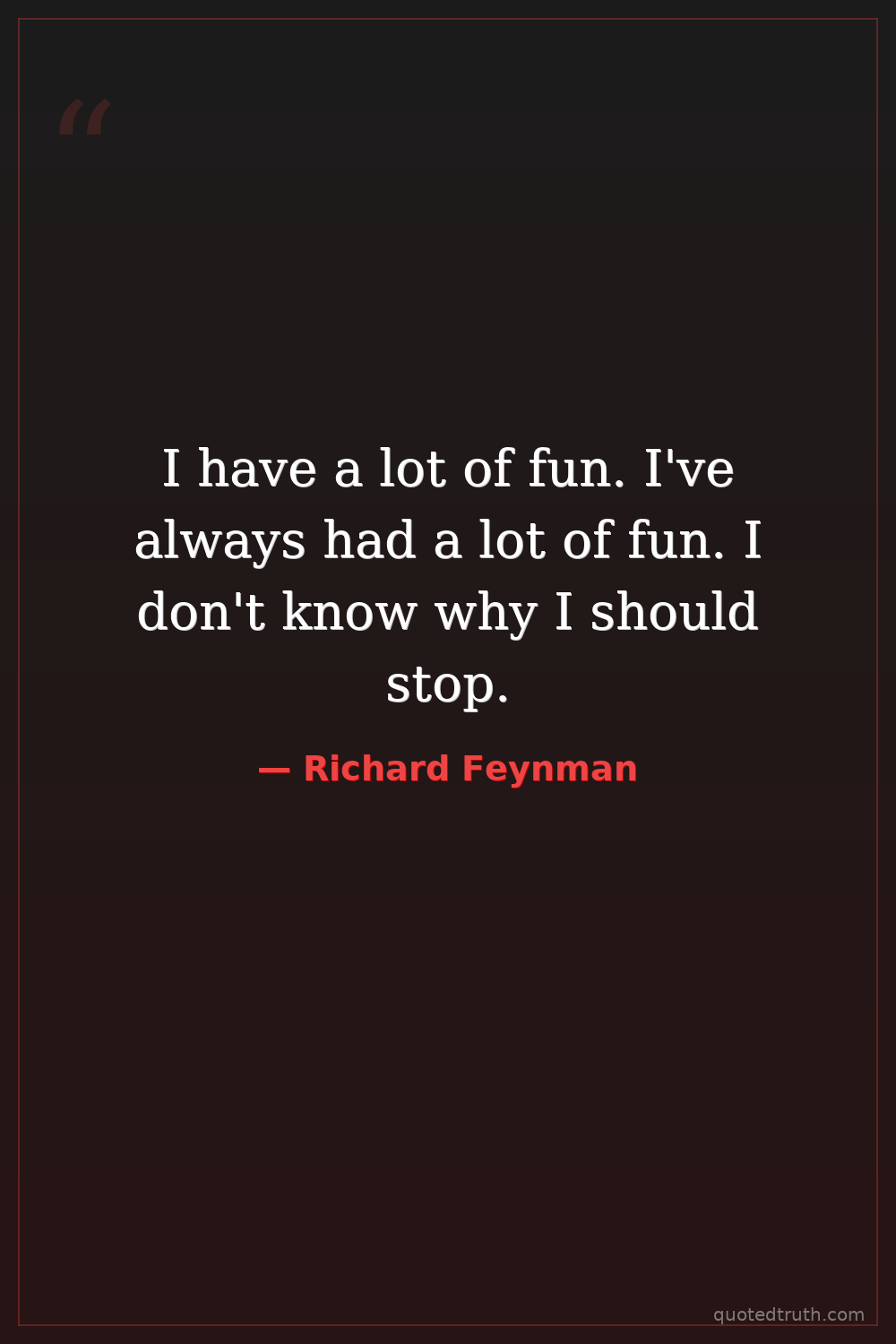
Richard Feynman — "I have a lot of fun. I've always had a lot of fun. I don't know why I should sto…"
I have a lot of fun. I've always had a lot of fun. I don't know why I should stop.
I have a lot of fun. I've always had a lot of fun. I don't know why I should stop.
Click any product to generate a realistic preview. Up to 3 at a time.
* Initial load can take up to 90 seconds — revising the preview in another color is nearly instant.
"When you are a scientist, you are a child. You are always asking 'Why?'"
"The age of ignorance is past. The age of reason is here. And it will be a glorious age, if we but choose to make it so."
"I have no responsibility to be like what other people expect me to be. It's their mistake, not my failing."
"The thing that bothered me about it was that I was doing work for the military, and I didn't like that."
"I'm a great believer in the idea that if you don't understand something, you should try to explain it to someone else."
American theoretical physicist who shared the 1965 Nobel for QED, developed Feynman diagrams, and wrote the Feynman Lectures on Physics. Closely associated with Julian Schwinger (co-Nobelist for QED) and Murray Gell-Mann (Caltech rival and Eightfold-Way physicist). For an intellectual contrast, see Deepak Chopra, physician and quantum-mysticism author — Feynman's Caltech 'cargo cult science' commencement address is the precise template for what he saw as misuse of physics terminology — Chopra-style appropriation of quantum vocabulary for metaphysical claims is the canonical example of what Feynman called 'fooling yourself'.
Found in 1 providers: grok
1 source checked
Life should be enjoyed fully and continuously, without arbitrary reasons to become serious or stop pursuing what brings genuine joy. The speaker insists that having fun is not frivolous but a legitimate, sustainable way to live — and sees no logical reason to abandon an approach to life that has always worked. Fun is treated as a default state, not a reward.
Feynman was legendarily playful — he played bongo drums in strip clubs, cracked safes at Los Alamos for amusement, and drew nude sketches between Nobel-level physics work. He believed curiosity and delight were inseparable from scientific discovery. His Caltech lectures radiated infectious enthusiasm. Even battling kidney cancer in his final years, he continued joking and exploring, embodying this philosophy completely until his 1988 death.
Post-war American science culture often valorized stern, serious professionalism. The Cold War arms race and Sputnik shock pressured physicists into solemn national-duty framing. Feynman deliberately resisted this gravity — his 1965 Nobel acceptance, his Challenger investigation humor, and his popular books reframed science as joyful human adventure during an era when the scientific establishment projected humorless authority.
AI-generated insights based on extensive research and information for context. Factual errors? Email [email protected].
Your cart is empty