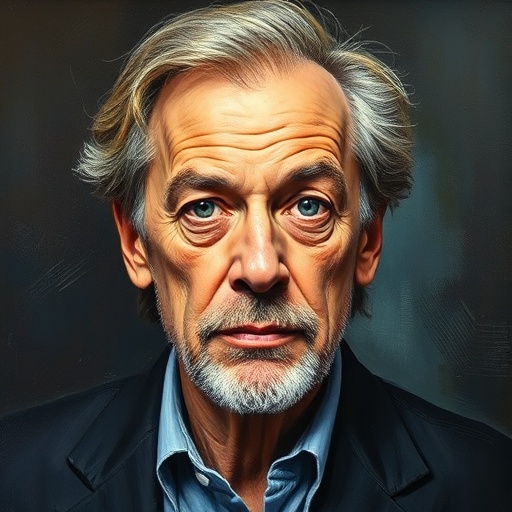
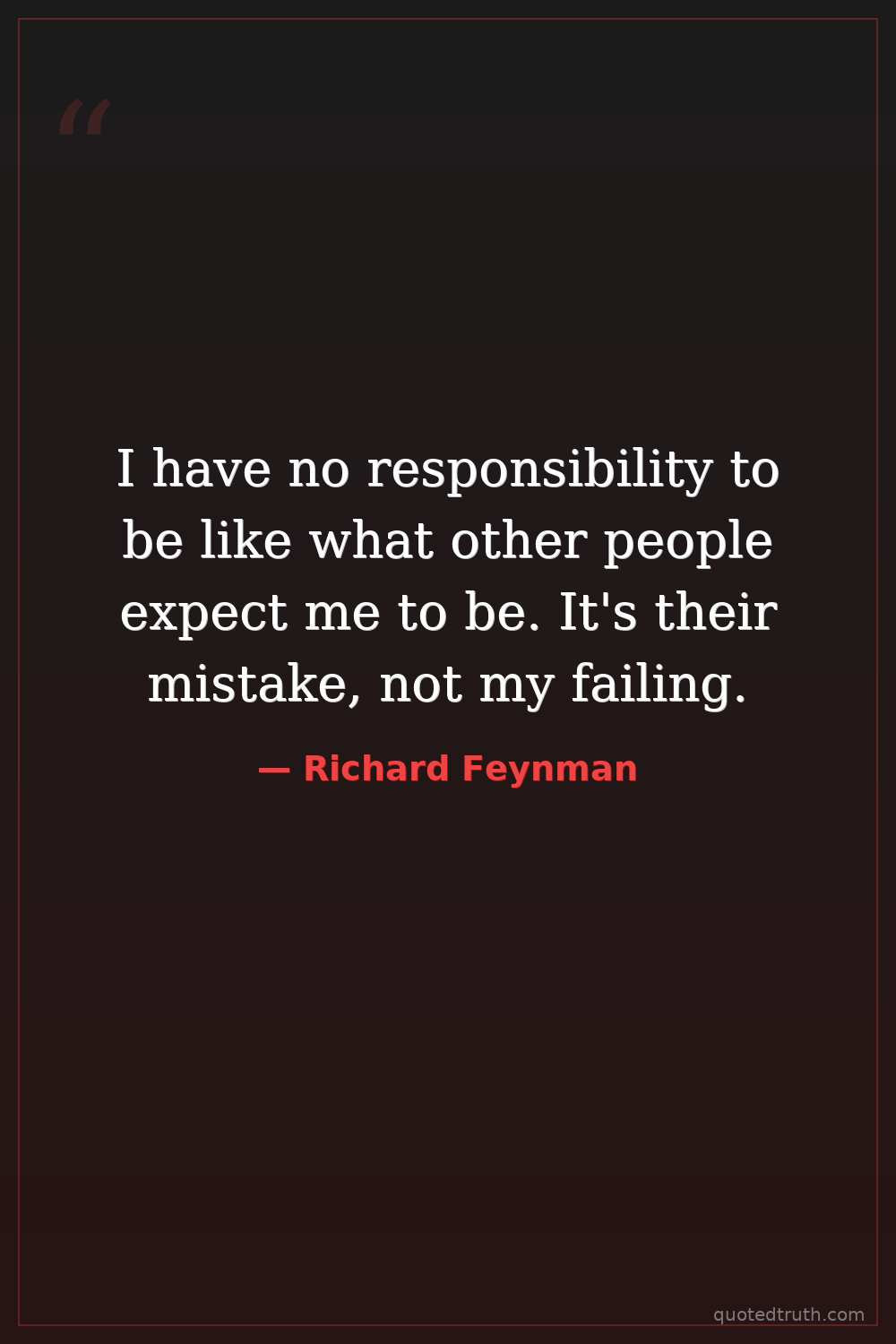
Richard Feynman — "I have no responsibility to be like what other people expect me to be. It's thei…"
I have no responsibility to be like what other people expect me to be. It's their mistake, not my failing.
I have no responsibility to be like what other people expect me to be. It's their mistake, not my failing.
Click any product to generate a realistic preview. Up to 3 at a time.
* Initial load can take up to 90 seconds — revising the preview in another color is nearly instant.
"I was an average student, but I had a good teacher."
"You know, the dumbest goddamn student you ever saw can understand things if you explain them right. So if you can’t explain it, it’s because you don’t understand it."
"When you are a scientist, you are a member of a community of people who are trying to find out the truth."
"I don't know what's the matter with people: they don't learn by understanding; they learn by some other way — by rote or something. Their knowledge is so fragile!"
"Nature uses only the longest threads to weave her patterns, so each small piece of her fabric reveals the organization of the entire tapestry."
American theoretical physicist who shared the 1965 Nobel for QED, developed Feynman diagrams, and wrote the Feynman Lectures on Physics. Closely associated with Julian Schwinger (co-Nobelist for QED) and Murray Gell-Mann (Caltech rival and Eightfold-Way physicist). For an intellectual contrast, see Deepak Chopra, physician and quantum-mysticism author — Feynman's Caltech 'cargo cult science' commencement address is the precise template for what he saw as misuse of physics terminology — Chopra-style appropriation of quantum vocabulary for metaphysical claims is the canonical example of what Feynman called 'fooling yourself'.
Found in 1 providers: grok
1 source checked
You owe nobody conformity to their mental image of you. When someone's expectations go unmet, the error lies in having formed those expectations in the first place — not in your failure to perform to spec. Authenticity isn't rudeness; it's accuracy. Other people's projections are their own construction, and dismantling them is their problem to solve, not yours to prevent.
Feynman embodied this daily. A Nobel laureate who played bongos in strip clubs, cracked safes at Los Alamos for fun, and gave Caltech lectures in Hawaiian shirts. Colleagues expected a solemn physicist; he gave them a prankster who also revolutionized quantum electrodynamics. He famously resigned from the National Academy of Sciences because he found the institution's self-congratulatory culture absurd — textbook refusal to perform expected roles.
Feynman's career peaked during the Cold War, when American scientists were national assets expected to project gravitas and institutional loyalty. The Manhattan Project had mythologized physicists as serious, secretive, and grave. Against this backdrop, Feynman's public clowning, his Challenger Commission theater-trick with the O-ring, and his 'Surely You're Joking' memoir were deliberate rejections of the solemn-scientist archetype the era demanded.
AI-generated insights based on extensive research and information for context. Factual errors? Email [email protected].
Your cart is empty