Charles Darwin — "But I am very poorly today & very stupid & I hate everybody & everything. One li…"
But I am very poorly today & very stupid & I hate everybody & everything. One lives only to make blunders.
But I am very poorly today & very stupid & I hate everybody & everything. One lives only to make blunders.
Click any product to generate a realistic preview. Up to 3 at a time.
* Initial load can take up to 90 seconds — revising the preview in another color is nearly instant.
"I am almost convinced that species are not (it is like confessing a murder) immutable."
"I am almost convinced (quite contrary to opinion I started with) that species are not (it is like confessing a murder) immutable."
"I own that I cannot see as plainly as others do, and as I should wish to do, evidence of design and beneficence on all sides of us. There seems to me too much misery in the world. I cannot persuade my…"
"I have gradually come to disbelieve in Christianity as a divine revelation."
"I have just finished my 'Origin,' and am now going to be a hermit for the rest of my life."
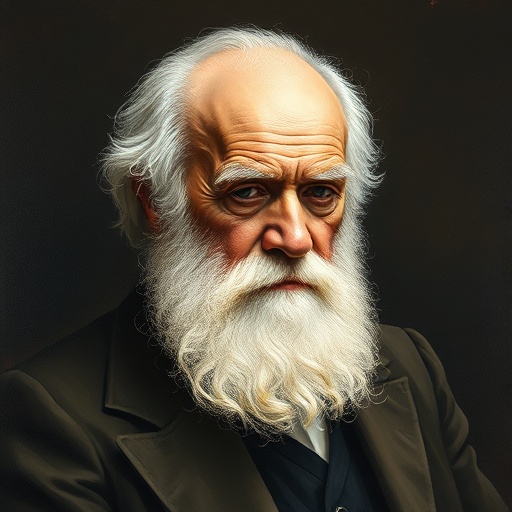
British naturalist whose On the Origin of Species (1859) established evolution by natural selection — the unifying theory of modern biology. Closely associated with Thomas Henry Huxley (his 'bulldog' public defender) and Alfred Russel Wallace (independent co-discoverer of natural selection). For an intellectual contrast, see William Paley, Anglican theologian and Natural Theology author (1743-1805) — Origin of Species is structurally a 400-page reply to Paley — Darwin admired Paley's watchmaker-argument as an undergraduate at Cambridge and then spent 20 years building the empirical machinery to displace him. The cleanest 'design argument vs natural selection' founding rebuttal in science.
The standard scholarly entry points to Charles Darwin's work: Janet Browne (Harvard, history of science) — Charles Darwin: Voyaging (1995) and The Power of Place (2002); Adrian Desmond (UCL, biographer) — Darwin: The Life of a Tormented Evolutionist (1991, with James Moore). These are the works graduate seminars cite when teaching Charles Darwin.
From a letter to biologist Charles Lyell, expressing personal frustration and self-deprecating humor.
Date: 1861
WisdomFound in 1 providers: gemini
1 source checked
A raw, unfiltered expression of a bad day — feeling mentally dull, socially misanthropic, and convinced that one's existence amounts to nothing but mistakes. It captures the universal human experience of self-doubt and exhaustion overwhelming rational thought, where even accomplished people feel completely worthless and alienated from the world around them.
Darwin suffered chronic illness throughout his adult life — nausea, fatigue, heart palpitations — likely stemming from Chagas disease contracted during the Beagle voyage. This complaint, written in a private letter, reveals the man behind the monument: anxious, self-critical, plagued by self-doubt even as he revolutionized biology. He delayed publishing On the Origin of Species for decades partly from fear of being wrong.
Victorian culture demanded stoic public composure, especially from gentlemen-scientists. Private correspondence was one of the few outlets for authentic emotional expression. Darwin wrote prolifically to close friends like Joseph Hooker, creating an intimate record of his inner life. The era also had no effective treatments for chronic illness, making his sustained scientific output amid constant physical suffering all the more remarkable.
AI-generated insights based on extensive research and information for context. Factual errors? Email [email protected].
Your cart is empty