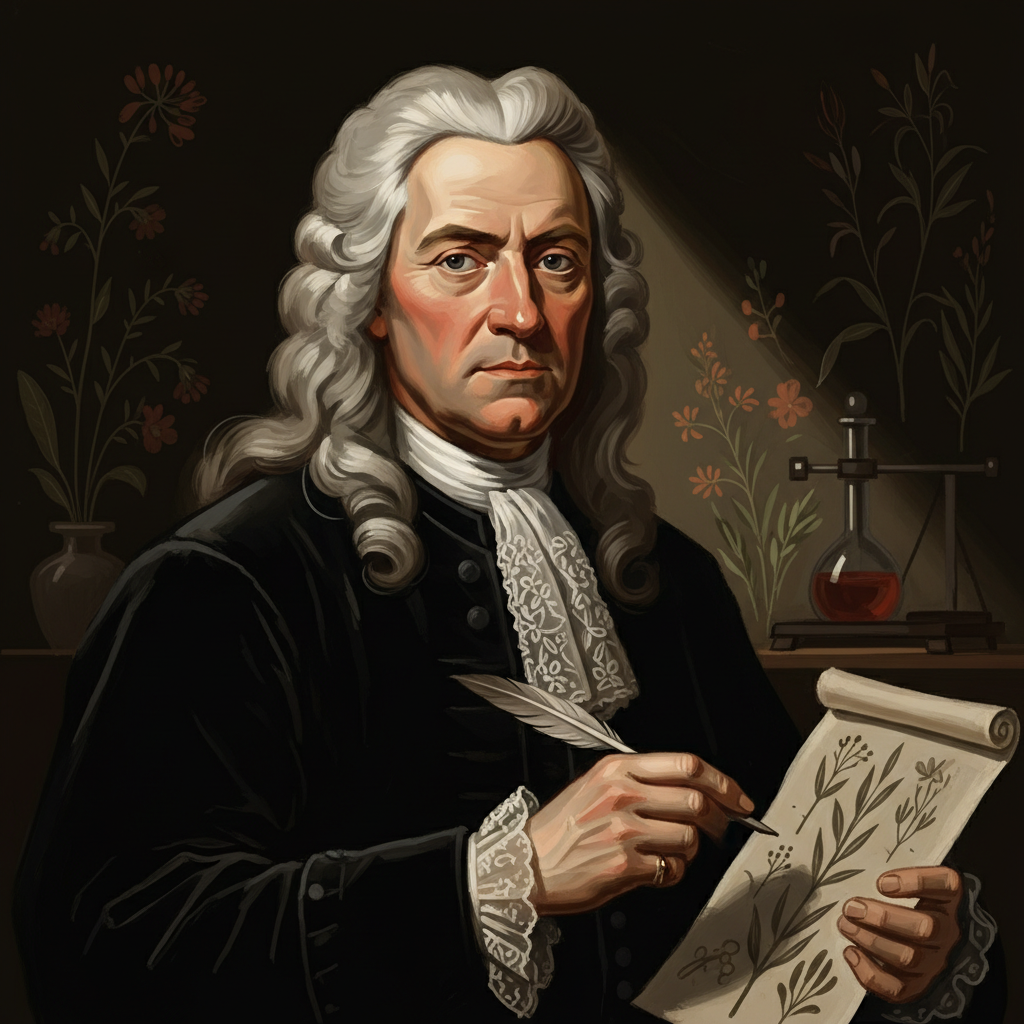
Carl Linnaeus — "I have been called the Prince of Botanists."
I have been called the Prince of Botanists.
I have been called the Prince of Botanists.
Click any product to generate a realistic preview. Up to 3 at a time.
* Initial load can take up to 90 seconds — revising the preview in another color is nearly instant.
"I have established a new era in natural history."
"I have seen no one who has been able to distinguish the species of plants better than I have."
"A natural arrangement is one which is based on all parts of the plant."
"The greatest pleasure of a naturalist is to make new discoveries."
"Man is the masterpiece of creation."
Swedish botanist and the father of modern taxonomy whose Systema Naturae (1735) introduced binomial nomenclature for naming all species. Closely associated with Joseph Banks (British naturalist who carried Linnaean classification on Cook's voyages). For an intellectual contrast, see Comte de Buffon, French naturalist and Histoire Naturelle author (1749-1788) — Buffon explicitly attacked Linnaean fixed-categories taxonomy as artificial and rejected the binomial system; his gradualist, environment-shaped natural history was the explicit alternative. Anticipates the fixed-species-vs-evolution debate Darwin would later resolve.
Found in 1 providers: grok
1 source checked
The speaker acknowledges a prestigious title bestowed upon them by others, recognizing their supreme authority and achievement in a particular field. It is a statement of earned distinction, reflecting mastery so complete that peers and contemporaries elevated this person above all others in their domain.
Linnaeus earned this epithet through his revolutionary work systematizing all known life using binomial nomenclature, published in Species Plantarum and Systema Naturae. He personally trained disciples called 'apostles' who traveled the globe collecting specimens. His classification system became the universal language of biology, making him genuinely the foremost botanist of the 18th century.
The 18th century Enlightenment drove Europeans to catalog and rationalize the natural world amid global exploration. Expeditions returning from the Americas, Asia, and Africa brought thousands of unknown species requiring systematic organization. Linnaeus emerged during this explosion of natural history, when botany was a prestigious scientific discipline intersecting medicine, agriculture, and imperial ambition, making mastery of plant classification enormously consequential.
AI-generated insights based on extensive research and information for context. Factual errors? Email [email protected].
Your cart is empty