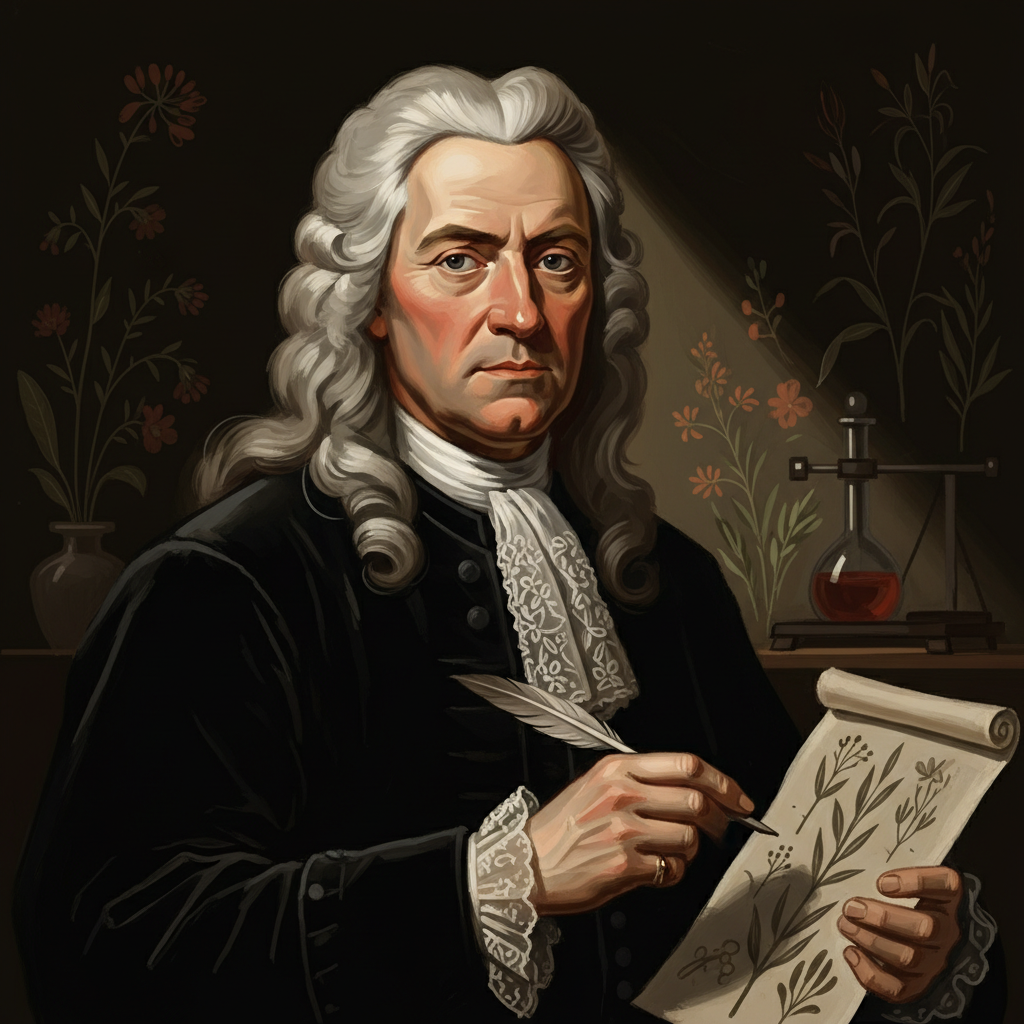
Carl Linnaeus — "I have seen no one who has been able to distinguish the species of plants better…"
I have seen no one who has been able to distinguish the species of plants better than I have.
I have seen no one who has been able to distinguish the species of plants better than I have.
Click any product to generate a realistic preview. Up to 3 at a time.
* Initial load can take up to 90 seconds — revising the preview in another color is nearly instant.
"The whole creation is a song of praise to the Creator."
"I was born on a farm, and I have always loved the countryside."
"Man is the measure of all things, but the Creator is the measure of man."
"Homo sapiens, nosce te ipsum. (Man, know thyself.)"
"The flower's leaves...serve as bridal beds which the Creator has so gloriously prepared, adorned with such noble bed curtains, and perfumed with so many sweet scents to induce the young bridegroom to …"
Swedish botanist and the father of modern taxonomy whose Systema Naturae (1735) introduced binomial nomenclature for naming all species. Closely associated with Joseph Banks (British naturalist who carried Linnaean classification on Cook's voyages). For an intellectual contrast, see Comte de Buffon, French naturalist and Histoire Naturelle author (1749-1788) — Buffon explicitly attacked Linnaean fixed-categories taxonomy as artificial and rejected the binomial system; his gradualist, environment-shaped natural history was the explicit alternative. Anticipates the fixed-species-vs-evolution debate Darwin would later resolve.
Found in 1 providers: grok
1 source checked
A blunt declaration of unmatched expertise: no one alive can identify and distinguish plant species as precisely as the speaker. It rejects false modesty in favor of confident, evidence-backed self-assessment. After comparing himself against every contemporary botanist, the speaker finds no equal. The claim centers on diagnostic precision — knowing exactly where one species ends and another begins — a skill most naturalists of his era routinely got wrong.
Linnaeus spent decades examining thousands of plant specimens across Europe and Lapland, developing an extraordinary eye for morphological differences between species. His binomial naming system — still the global standard — required exactly this skill: you cannot name what you cannot distinguish. His confidence was earned; rivals like Buffon and Haller challenged his methods, but his Species Plantarum (1753) codified plant taxonomy so comprehensively that competitors never produced anything comparable.
The early 18th century flooded European botanical gardens with thousands of undescribed plant species arriving from every continent via colonial expeditions. Natural history had no standardized naming system — botanists used incompatible polynomial Latin descriptions, making knowledge-sharing nearly impossible. Into this chaos, Linnaeus introduced binomial nomenclature and a universal taxonomic hierarchy. The ability to reliably distinguish species wasn't mere pride; it was the exact skill on which all of science's new order depended.
AI-generated insights based on extensive research and information for context. Factual errors? Email [email protected].
Your cart is empty